
Proxy Season Board Composition: Skills Take Priority

This proxy season, board refreshment is changing. New director appointments show a declining emphasis on demographic diversity and a growing focus on skills tied to risk, strategy, and resilience amid ongoing economic uncertainty.
As companies seek shareholder approval to elect new board members this proxy season, a clear trend is emerging. Less emphasis is being placed on demographic factors while more attention is paid to skills that address economic uncertainty reflecting a recalibration of priorities.
Proxy season board composition is shifting
Companies have largely scaled back on corporate diversity policies and initiatives in the past year, and this trend has impacted the boardroom dynamics as well. Boards are seating fewer diverse new directors in terms of gender, ethnic diversity, or age, according to data for Russell 3000 constituents through April 28, 2026. Meanwhile, directors with disclosed expertise in areas that respond to uncertainty, such as risk management, strategic planning, and mergers, are increasingly making their way onto corporate boards.
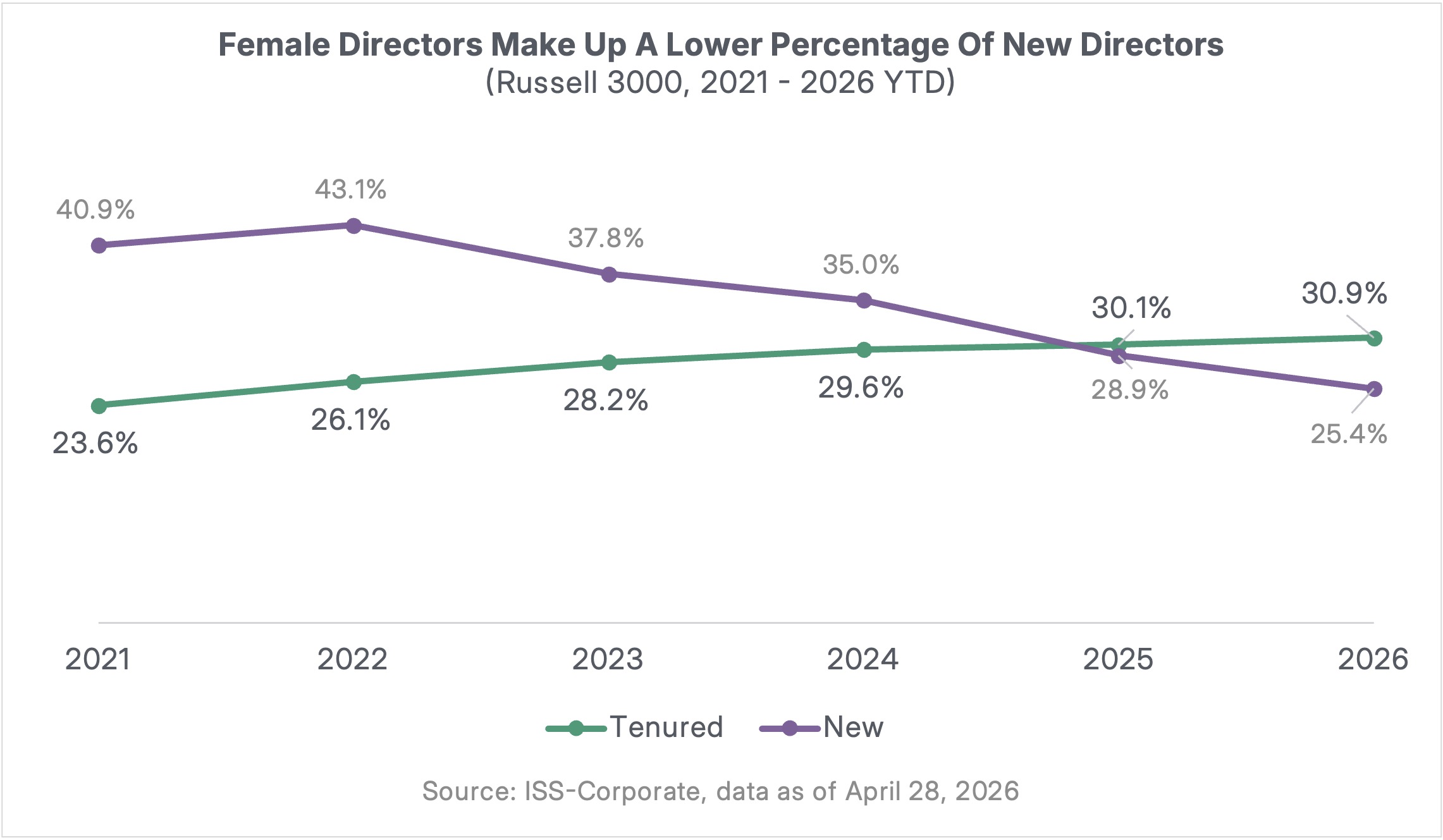
New female director appointments decline after 2022
The appointment of new female directors had outpaced the percentage of tenured female directorships until recently, peaking at 17% more in both 2021 and 2022, suggesting boards were gaining female representation at a swift pace. Since then, the rate of new female directors joining boards has slowed, and in 2026 YTD only 25% of new directors who have joined the board in the past 12 months were women, a decline of nearly 4% from the prior year and nearly 18% from a high in 2022. The proportion of tenured directors who are women has continued to increase despite the drop in new female board members, but if the current trend continues, the proportion of women on boards is likely to start to decline in the coming years.
Navigate shifting board expectations with expert governance advisory support »
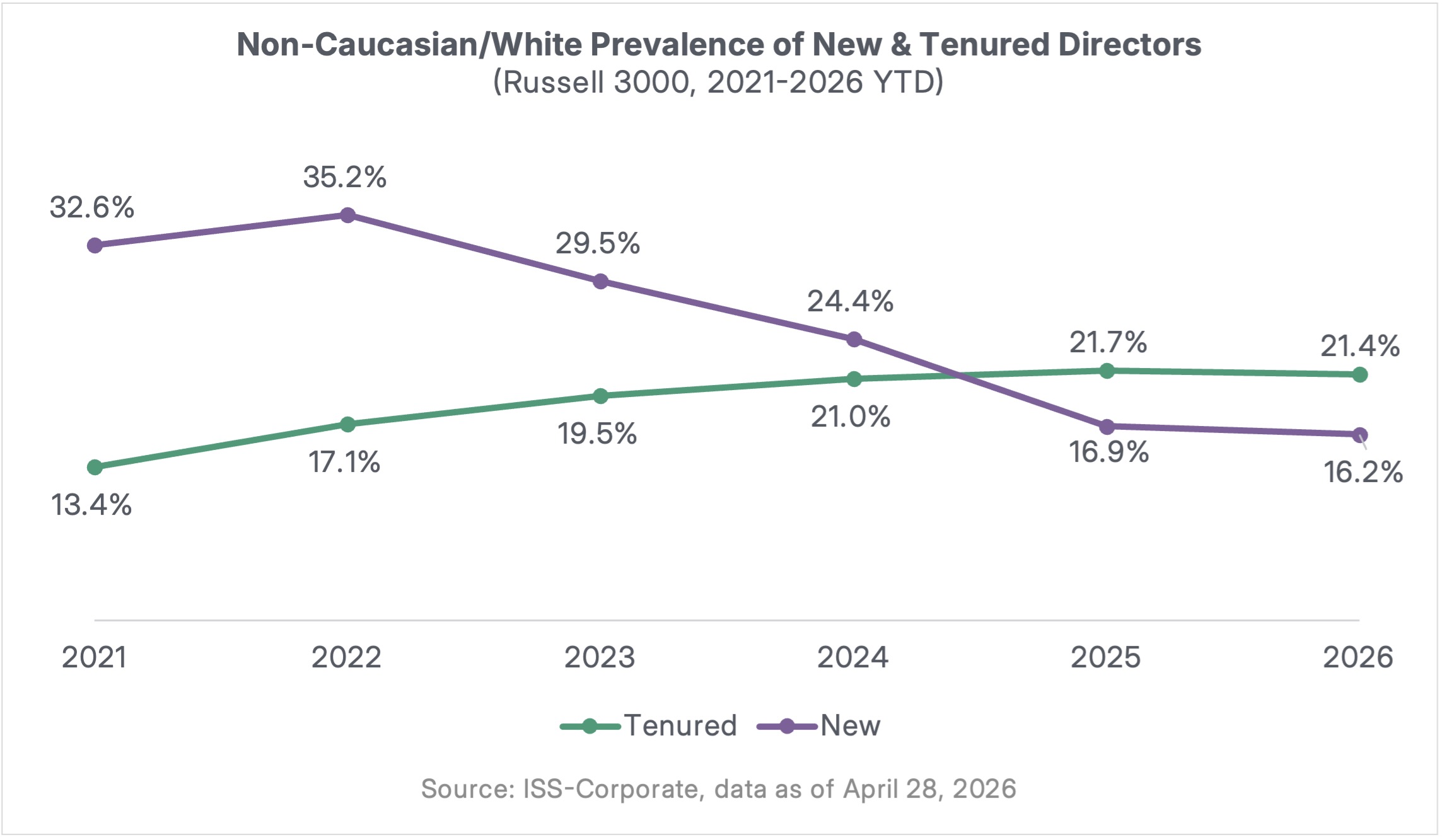
Ethnically diverse new director appointments plateau
Meanwhile, the rate of new ethnically diverse directors joining corporate boards has also decelerated. Like gender, ethnic diversity among new directors far outpaced tenured directors in 2022 by nearly 18% and then began to decline. Only about 16% of directors who have newly joined the board in the past 12 months exhibited ethnic diversity, down nearly 19% from the peak in 2022. The proportion of ethnically diverse tenured directors plateaued at around 22% over the prior three years and started to decline in 2026.
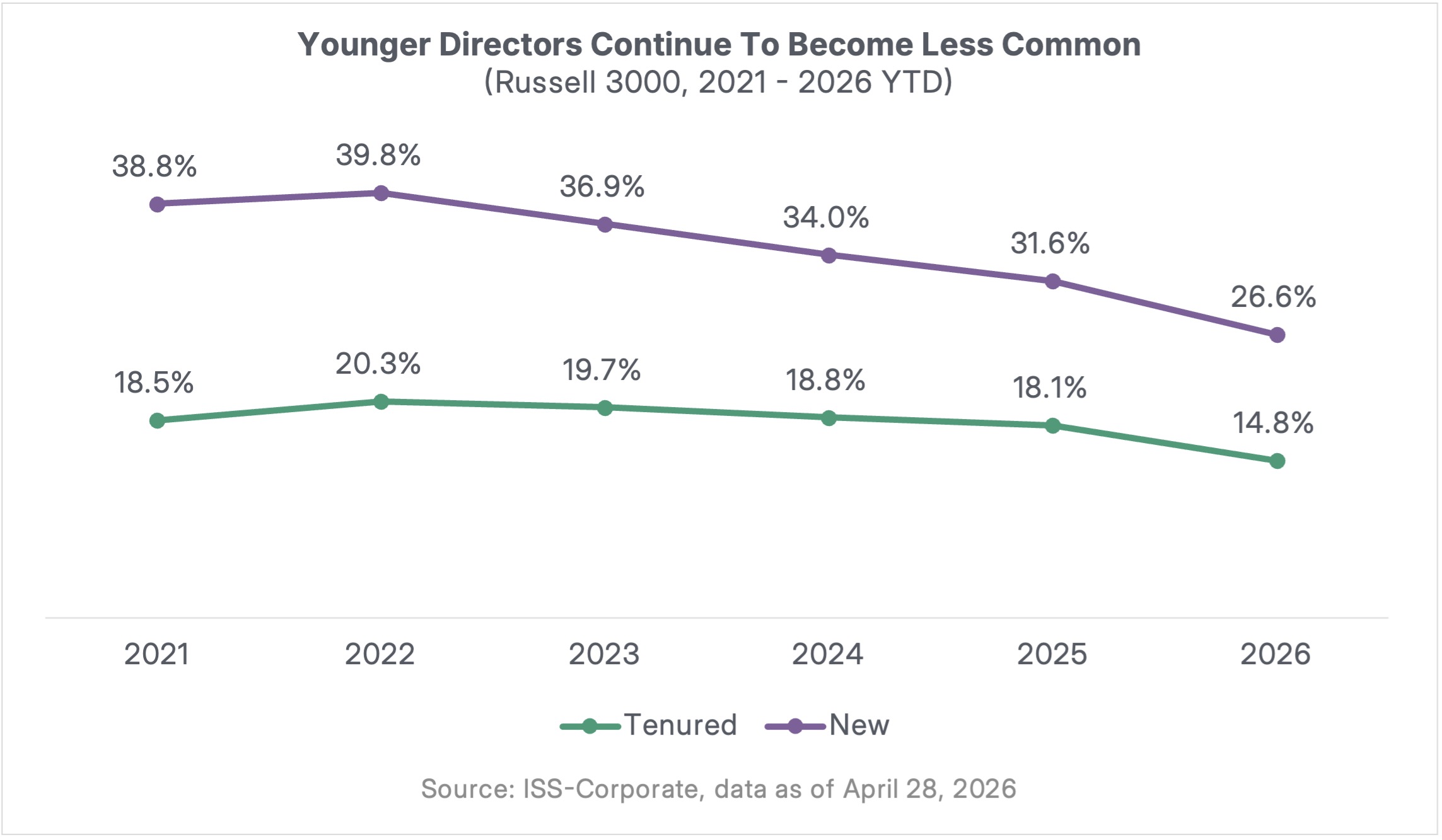
Fewer younger directors appointed in 2026
Nominating committees also appear to be putting less emphasis on age, as directors are, objectively, not getting any younger. New directors below age 55 represented nearly 40% of all new seats in 2022, but they have since diminished at a steady rate. The trend of fewer younger directors accelerated in 2026, with only 27% of new board members being below age 55 and tenured directors below age 55 down over 3% from the prior year. These trends suggest that boards are prioritizing experience and continuity over generational change.
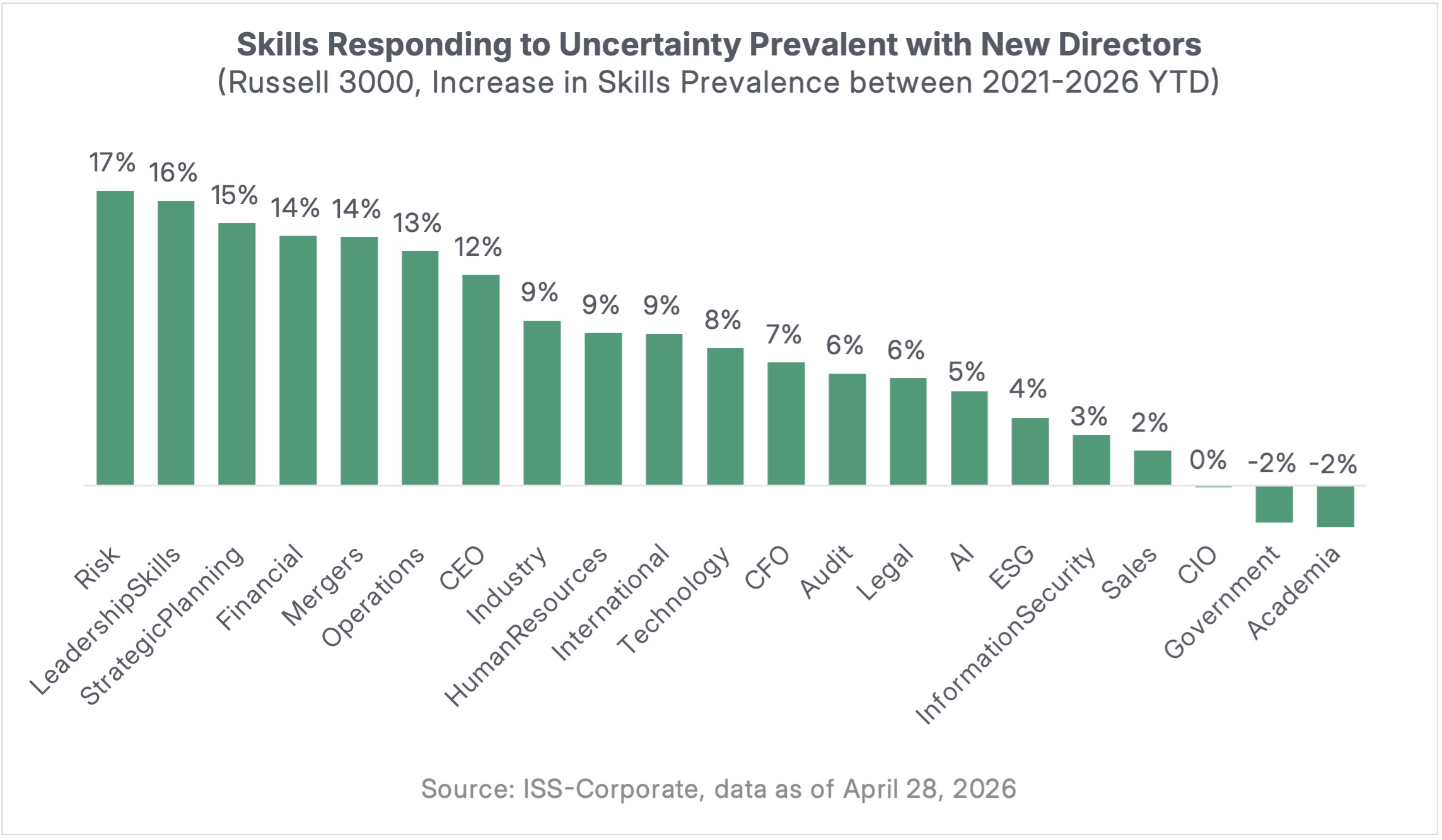
Rising demand for risk, strategy, and M&A expertise
While demographic indicators appear to take less priority among recent director appointments, boards’ skills composition provide additional insight into their refreshment strategies. Companies are increasingly seeking new directors with expertise in areas that stress resilience and responsiveness to economic uncertainty.
For example, comparing the change in prevalence among 20 of the most-frequently-disclosed director skills tracked by ISS-Corporate, risk management ranks top among new directors, increasing by 17% from five years ago. Strategic planning saw a 15% increase, and mergers expertise also rose by 14%. These competencies may be seen as better positioning boards to respond to economic uncertainties stemming from policy and market-related shocks or industry consolidation.
What the proxy season data shows
Overall, proxy season data indicates a shift in how boards are approaching refreshment. While diverse voices made significant inroads onto corporate boards in recent years, this trend appears to have peaked in 2022 and has since moderated. This proxy season suggests a continued de-prioritization of demographic considerations, like gender, ethnic/racial diversity, and age, in director selection decisions.
Meanwhile, recent new joiners to corporate boards demonstrate that, in addition to more traditional skills like leadership or financial, companies are increasingly seeking board members that can contribute to greater resiliency at companies with expertise in areas such as risk, strategic planning, or mergers. Taken together, these trends reflect how board composition is evolving in response to current market and operating conditions, as reflected in the composition of newly appointed directors.
Navigate shifting board expectations with expert governance advisory support »
ISS-Corporate’s approach to proxy season insight
ISS-Corporate analyzes early proxy disclosures and board refreshment activity to identify governance trends and shifts in director composition priorities. As companies navigate economic and policy uncertainty, issuers increasingly benefit from a view into how boards are evolving in terms of skills, experience, and demographic composition. ISS-Corporate’s Compensation & Governance Advisory team supports issuers by contextualizing these trends, evaluate composition against peer and investor expectations, and proactively address governance considerations.