
Sustainability’s Role in Capital Allocation Decisions

Sustainability considerations are increasingly shaping capital allocation outcomes in certain strategies, affecting which companies are included, how capital is distributed, and how investors differentiate across peers.
In the past decade, sustainability has gradually shifted from a complementary lens to a factor that can shape how capital is allocated across markets. What was often treated as a complementary lens alongside traditional financial analysis is now, for many investors, more frequently incorporated into how certain investors assess risk, compare issuers, and construct portfolios.
Across many asset managers, sustainability performance can influence which companies are eligible for inclusion, how capital is distributed, and where investors concentrate exposure around themes such as transition, resource efficiency, or resilience. Regulation, index design, and product mandates can further reinforce these effects in certain market segments.
Strengthen your sustainability performance with ISS-Corporate advisory »
As sustainability becomes more embedded in investment processes through data, benchmarks, and disclosure frameworks, it increasingly acts as a differentiating factor in capital allocation. For companies, demonstrated progress on governance, strategy, and risk management may carry more weight than narrative positioning alone. Stronger alignment with investor frameworks may support inclusion in certain funds, while weaker disclosure, persistent controversies, or limited evidence of implementation may contribute to underweighting or exclusion in some mandates.
The result is not a single, uniform outcome, but a set of mechanisms through which performance, credibility, and positioning can influence access to capital.
How Sustainability Influences Allocation Decisions
These mechanisms are often most visible in portfolio construction, where sustainability considerations can affect capital allocation at multiple stages of the investment process.
Eligibility and Inclusion Criteria
Sustainability-linked criteria can influence investment eligibility criteria by helping define which companies may be included in a portfolio. Many investors, particularly in sustainability-focused products, apply baseline criteria using rating thresholds, revenue exposure limits, or controversy- and norms-based screens. These criteria are often embedded in fund rules, mandates, or index methodologies.
In these cases, sustainability considerations may act as a gatekeeping factor. Companies that do not meet minimum expectations may be excluded from certain funds or indices regardless of financial profile. The effect is not universal, but it may shape access to capital where sustainability criteria are prioritized.
Positioning Within Portfolios
Sustainability-linked criteria can also influence how capital is allocated within the investable universe. Rather than excluding companies outright, many investors differentiate among peers based on relative sustainability performance, disclosure quality, transition preparedness, or controversy exposure. Stronger performers may at times receive larger allocations, while weaker performers may be underweighted.
In practice, this differentiation can occur through portfolio tilts, position sizing, and risk-budgeting decisions. Some investors may increase weights where sustainability performance appears stronger or moderate exposure where performance lags sector peers. These adjustments are often incremental, but when applied systematically across portfolios, they may still contribute to differences in capital allocation.
Thematic Allocation Strategies and Targeted Exposure
Beyond relative positioning, sustainability considerations can also influence allocation through thematic strategies. Some investors allocate capital to strategies that are explicitly oriented around sustainability themes, such as climate transition, resource efficiency, or adaptation. In these cases, investment exposure may be more concentrated in specific technologies, business models, or transition-related activities, including renewable power, energy efficiency, and circular business models.
These mechanisms matter in part because they can operate at scale. When sustainability criteria are embedded in indices, mandates, or investment products, they may be applied consistently across broad pools of capital.
The Role of Regulation in Sustainability Investment Strategies
While these mechanisms help explain how sustainability can influence capital allocation in practice, their effects often depend on how sustainability is embedded within a given investment strategy. Regulatory frameworks and investment product definitions have played an important role in clarifying these distinctions, particularly by differentiating between strategies that integrate sustainability as one factor among several and those where sustainability objectives are more explicitly binding. This helps explain why capital allocation outcomes can vary meaningfully across mandates.
In Europe, the Sustainable Finance Disclosure Regulation (SFDR) has been one of the more influential frameworks shaping how sustainability characteristics are incorporated into investment products and communicated to the market. While implementation continues to evolve, the framework has helped reinforce a practical distinction between two broad strategy types.
Integration-focused strategies (often aligned with Article 8 of the SFDR) incorporate sustainability factors into investment decisions without making them the defining investment objective. In these approaches, the universe often remains relatively broad, and sustainability is more commonly used to inform risk assessment, relative positioning, and engagement priorities rather than to determine eligibility outright.
By contrast, sustainability-focused or outcome-oriented strategies (typically aligned with Article 9 of the SFDR) embed sustainability more directly into the investment objective. Inclusion may be more selective and linked to explicit criteria, measurable outcomes, or minimum thresholds. These strategies can involve narrower universes and tighter definitions, which may make capital allocation more directly responsive to sustained performance in some cases.
Why Sustainability Performance Impacts Capital Allocation
Across the S&P 500, SEC Form N-PX filings can offer a useful view of which companies are more commonly represented in sustainability-focused funds and in funds that incorporate sustainability criteria into investment decision-making. These filings disclose annual proxy voting records for U.S.-registered funds and, while they are not a direct measure of investment intent, can still provide a useful indication of the types of companies and sectors that appear more frequently across sustainability-focused strategies.
In this snapshot, representation is not evenly distributed across sectors. Some sectors, including Information Technology, Consumer Staples, and Financials, appear more prominently represented, while others, particularly those more commonly associated with higher environmental or transition-related exposure, appear less represented.
The relative prominence of these sectors may reflect how sustainability criteria are applied in practice. For many sustainability-focused strategies, sectors that are less directly affected by certain exclusionary screens may remain more visible, particularly where they also account for a meaningful share of benchmark-aware portfolios.
However, sector positioning is not static. Information Technology may be a sector subject to change overtime as data center expansion and AI-related growth increase energy demand and bring greater resource and infrastructure considerations into focus. More broadly, sector-level sustainability positioning can shift as business models evolve and external expectations change.
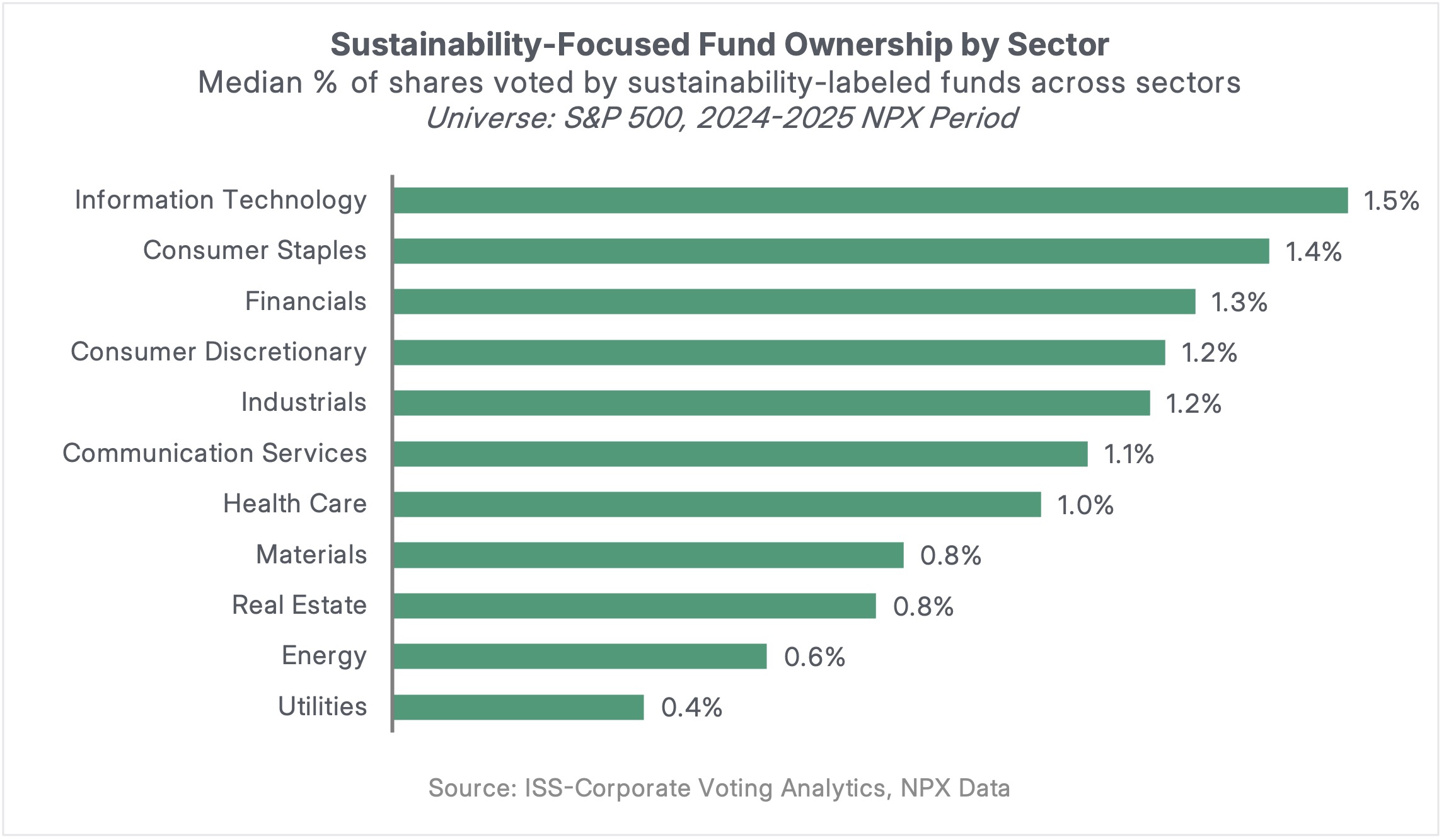
Sector exposure alone does not determine allocation outcomes. Differentiation also occurs within sectors, where investors compare companies on relative sustainability performance, disclosure quality, transition preparedness, and controversy exposure.
In many cases, stronger sustainability performance, as reflected in ISS STOXX Corporate Rating scores used here as a proxy, may translate into greater representation in sustainability-focused portfolios.
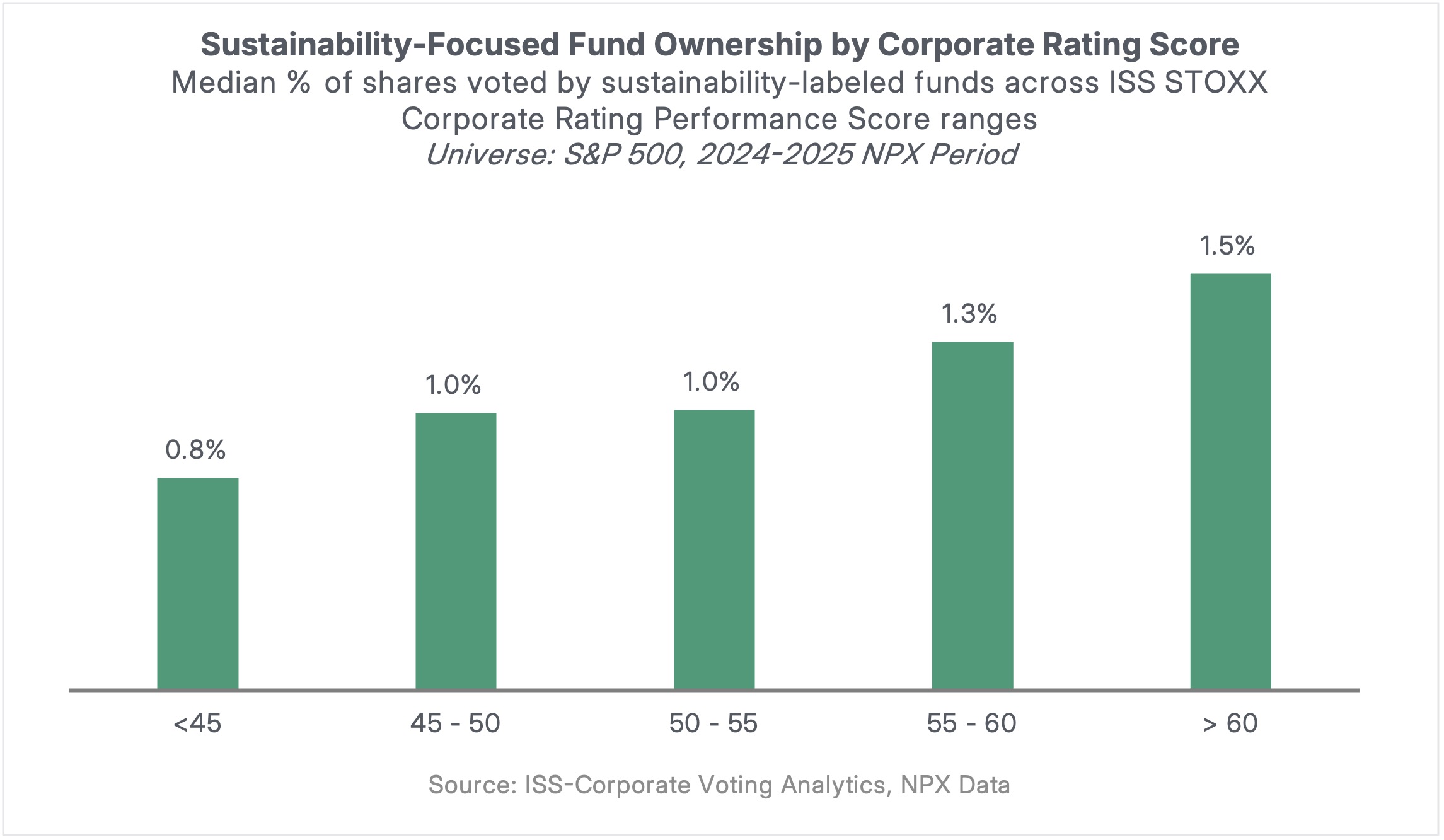
Taken together, these patterns suggest that sustainability is not only influencing whether companies attract capital, but increasingly how much they receive relative to peers.
These observations are broadly consistent with the mechanisms discussed earlier. Sustainability can shape capital allocation both by influencing the investable universe for some strategies and by affecting relative positioning within that universe. Sector characteristics may help define part of the opportunity set, but company-level performance can also play an important role in how capital is allocated within sectors and across peers.
What Capital Allocation Trends Mean for Companies
Where sustainability criteria are embedded in fund rules, index methodologies, or portfolio construction frameworks, they can influence both eligibility for inclusion and relative positioning against peers. This makes it increasingly important for companies to demonstrate not only transparency, but also credible performance, clear governance, and evidence of implementation in material areas to investors. In that context, disclosure alone may be insufficient if it is not supported by evidence that sustainability considerations are being embedded in strategy, oversight, and decision-making.
Key Takeaways on Sustainability and Capital Allocation
- Sustainability can influence allocation, not just risk assessment
It affects eligibility, position sizing, and thematic exposure across strategies.
- Exclusion is only part of the story
Relative performance increasingly drives overweight vs. underweight decisions within sectors.
- Regulation is accelerating differentiation across strategies
Article 8 vs. Article 9-type approaches can lead to materially different allocation outcomes.
- Sector effects matter, but company sustainability performance still drives outcomes
Allocation differences emerge both across and within sectors.
- Execution now outweighs narrative
Investors are increasingly prioritizing governance, implementation, and measurable progress over disclosures alone.
Strengthen your sustainability performance with ISS-Corporate advisory »