
Climate Action 100+: Trends and Expectations for 2026

Climate Action 100+ companies show strong disclosure and targets, as climate oversight increasingly influences investor scrutiny and proxy-season expectations.
Climate Action 100+ is one of the largest investor led engagement initiatives focused on the world’s highest emitting companies. Launched in 2017, it brings together several hundred asset owners, asset managers, and engagement service providers to encourage 170 focus companies to reduce emissions, strengthen governance, and improve climate related disclosures. The initiative does not provide voting recommendations, but its company list and the expectations embedded in its Net Zero Company Benchmark have become reference points for stewardship teams during proxy season.
In the past couple of years, several large U.S. managers – including J.P. Morgan Asset Management, State Street Global Advisors, and PIMCO – have withdrawn, and BlackRock shifted its participation to a non U.S. affiliate. While notable, these departures coexist with continued global participation: hundreds of signatories remain involved, and new investors have joined under the initiative’s second phase. Overall, Climate Action 100+ continues to influence how many investors approach climate risk and company engagement ahead of the 2026 proxy season.
Global Overview of Climate Action 100+ Companies
Climate Action 100+ currently identifies 165 companies considered among the highest greenhouse gas emitters globally. Collectively, they represent approximately $16 trillion in market capitalization and span 32 countries across EMEA (53 companies), Asia Pacific (50), and the Americas (62). Although the initiative covers a broad set of industries, high-emitting sectors dominate: Energy, Materials, Utilities, and Industrials account for 82% of companies under review.
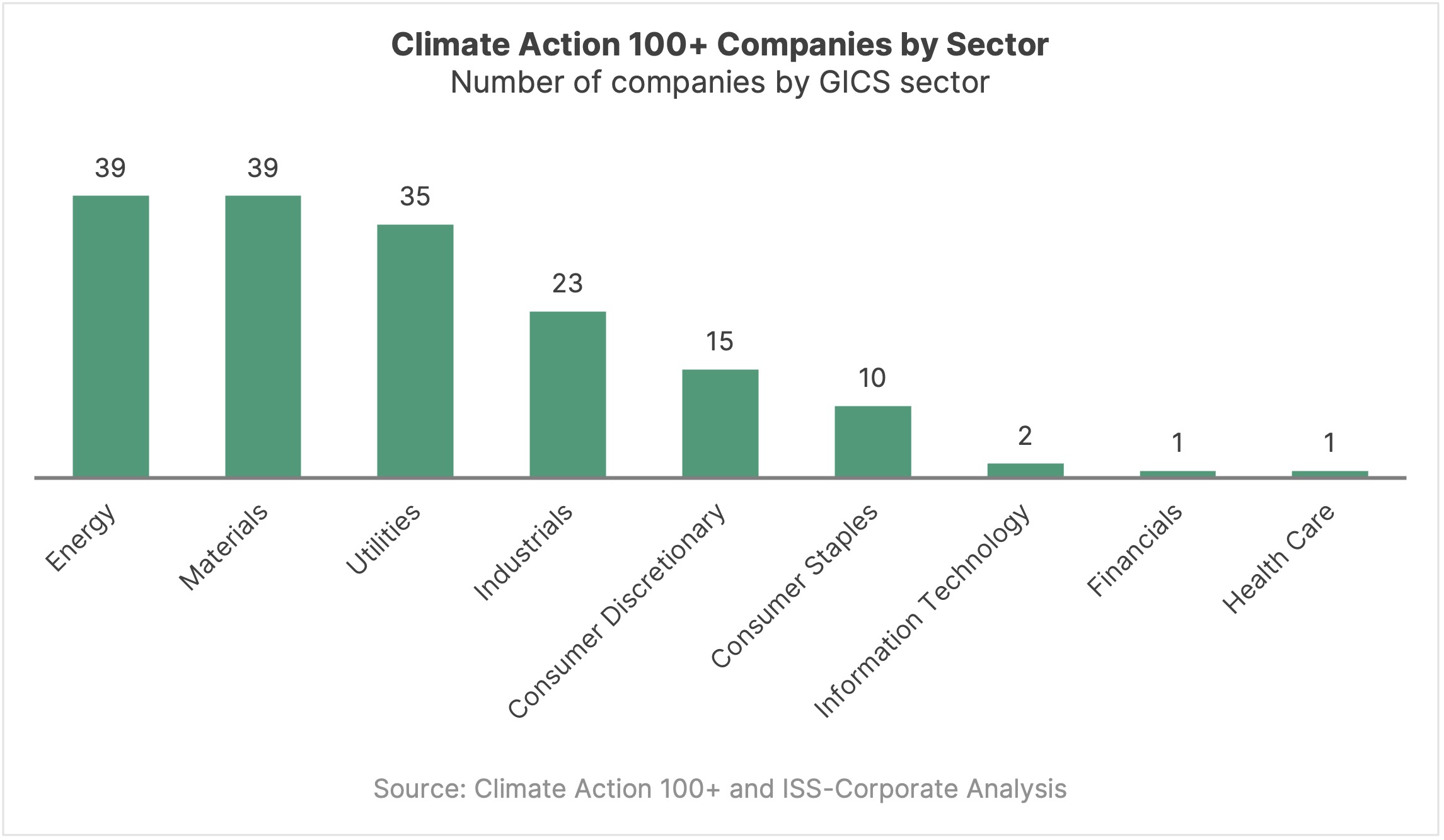
Most entities are large-capitalization firms, with a median market cap near $50 billion, and roughly 88% exceed $10 billion.
Climate-Related Disclosure and Emissions Targets Among Climate Action 100+ Companies
Across the Climate Action 100+ universe, climate-related disclosure is broadly strong, reflecting both the profile of these companies and the expectations placed on them as among the world’s largest emitters. ISS-Corporate’s review of corporate disclosure data indicates that 94% of companies meet or exemplify alignment with prevailing disclosure standards, such as TCFD or its successor IFRS S2, with only a small minority showing partial alignment.
Emissions reporting is similarly widespread, with 97% of Climate Action 100+ companies disclosing Scope 1 and Scope 2 emissions, and nearly nine in ten report Scope 3, a level well above what is typically observed across large-cap companies globally. Target-setting is common as well, with 94% of companies having established GHG reduction targets, many supported by more detailed transition planning. A meaningful share also demonstrates the adoption of formal management systems – 37% disclose implementation of ISO 50001, compared to roughly 27% among large-cap peers – suggesting more advanced energy-management practices among this group.
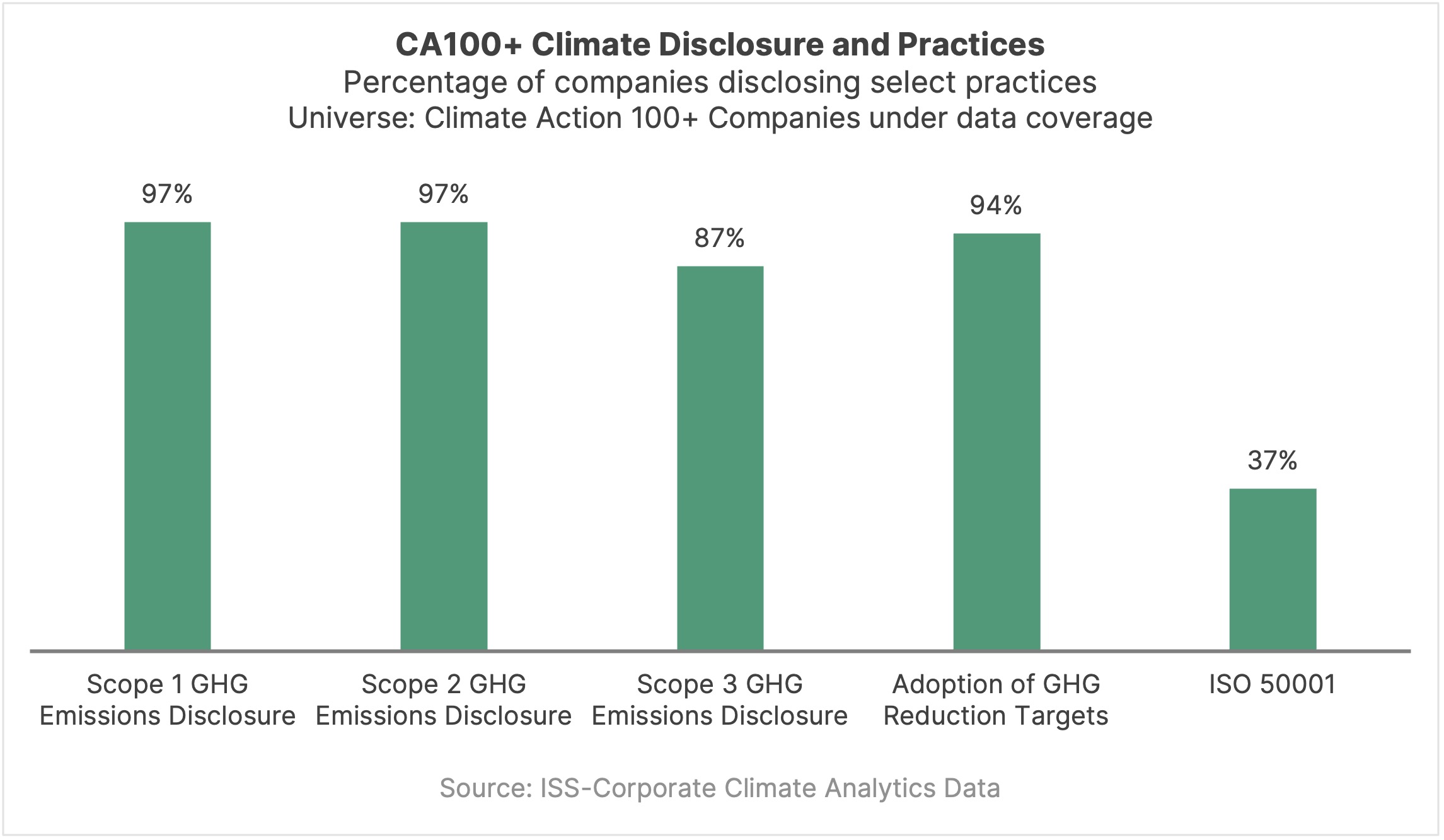
Taken together, the disclosure patterns indicate that most companies acknowledge the financial and operational relevance of climate-related risks and are broadly responsive to investor and stakeholder expectations around transparency, governance, and performance.
Potential Implications for Proxy Season
Many investors incorporate climate considerations into stewardship efforts, with heightened attention on companies in high-emitting sectors. Key areas of focus typically include:
-
- alignment of disclosures with recognized standards;
- clarity of strategy, risk management, and transition planning;
- presence of mid-term and long-term GHG reduction targets; and
- evidence of progress over time.
Climate-related board oversight is also evaluated by proxy advisory firms, though through different lenses. ISS’s Climate Board Accountability policy applies specifically to high emitting companies and assesses whether boards provide adequate oversight of climate risks and demonstrate responsiveness where gaps are identified. Glass Lewis, by contrast, incorporates climate within a broader review of environmental and social oversight that applies to all companies, not just high emitters, and may raise concerns where boardlevel structures or practices appear insufficient. Together, these frameworks contribute to the heightened scrutiny many large emitters face during proxy season, particularly when disclosures, transition strategies, or risk management practices fall short of investor expectations.
A review of ISS Benchmark Policy recommendations over the past two years shows that while governance concerns remain the primary driver of negative recommendations among Climate Action 100+ companies, climate-related issues also contribute to voting risk for a smaller subset of the universe. Director elections appeared on ballots at 155 companies, and climate concerns under ISS’s Climate Board Accountability policy were raised at nine of them. Although this is a relatively limited portion of the list, flagged items consistently attracted lower support, with median backing of about 91% of votes cast FOR and AGAINST compared with roughly 98% where no concerns were raised. Governance-related issues – including board independence, director over-boarding, and other structural issues – were more widespread, affecting 42 companies and generating even lower median support of around 87% when negative recommendations were issued.
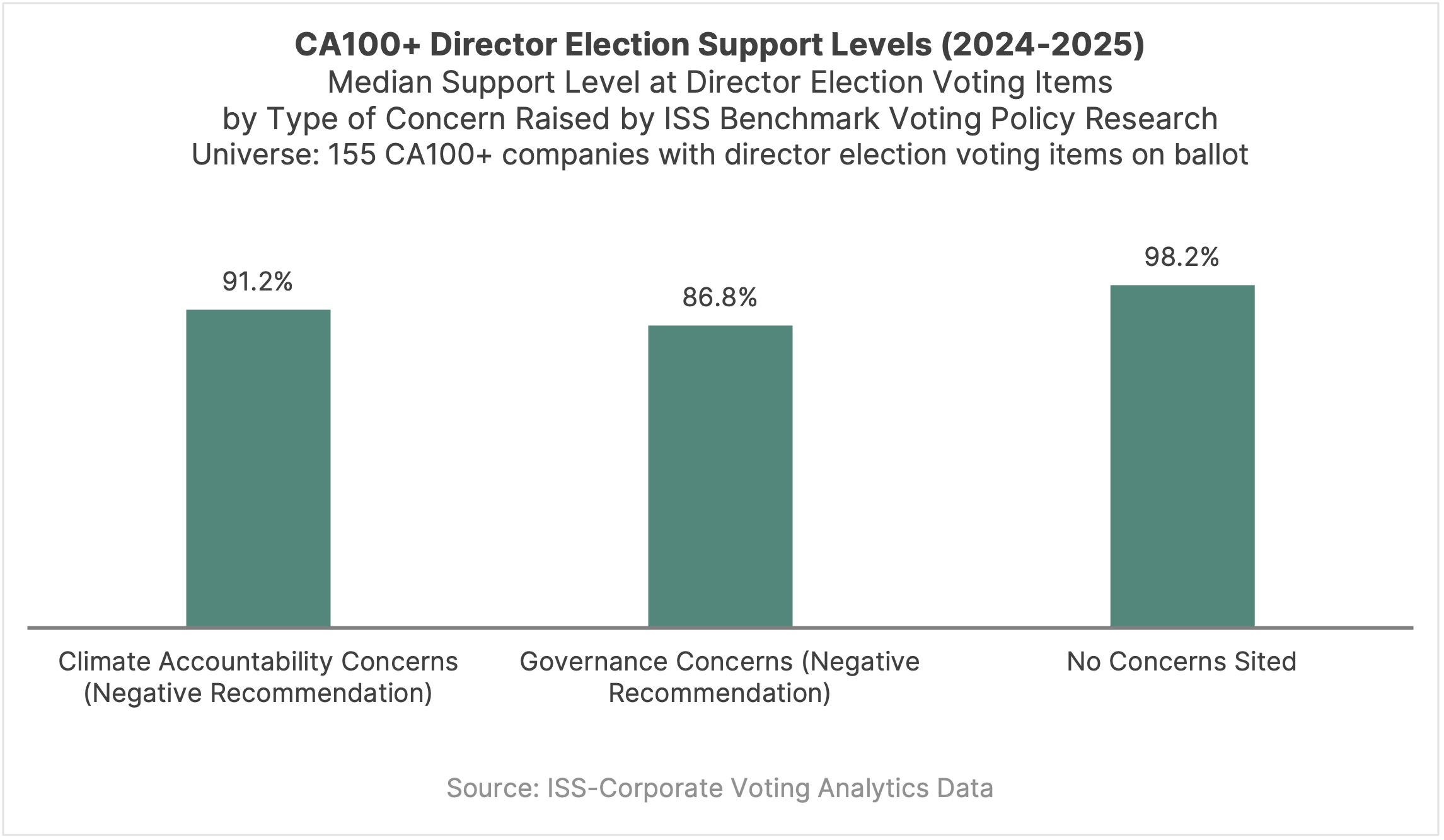
The pattern suggests that while climate oversight concerns are less common, they are directionally meaningful: when they arise, they tend to depress support and contribute to the broader scrutiny high-emitting companies face during proxy season. For companies in this group, maintaining strong governance and demonstrating credible board-level oversight of climate risks both remain important to sustaining investor confidence.
How High-Emitting Companies Can Strengthen Climate Governance in 2026
As proxy season approaches, companies – particularly those in high-emitting sectors – can expect continued focus from investors and proxy advisors on the credibility of their climate oversight and disclosures. While the intensity of scrutiny varies across markets, the themes emerging from Climate Action 100+ data and recent voting patterns point to several practical areas where companies can position themselves more effectively.
Strengthen disclosure in line with major standards
Clear, decision-useful reporting remains foundational. Companies should aim for disclosures aligned with recognized frameworks, including TCFD or IFRS S2, articulating governance structures, strategic priorities, and how climate risks and opportunities are integrated into enterprise risk management. Consistent reporting of key metrics – such as GHG emissions, energy consumption, and progress toward targets – helps investors evaluate performance over time and reduces the likelihood of perceived gaps.
Set clear mid-term and long-term targets
Investors increasingly look for credible pathways rather than high-level commitments. Establishing short-, mid-, and long-term GHG reduction targets that reflect the company’s operational realities and transition strategy can help demonstrate a structured approach. Targets should be supported by concrete plans, interim milestones, and transparent assumptions to show how the company intends to navigate transition risks and capture opportunities.
Engage proactively with major shareholders and relevant stakeholders
Regular and substantive engagement with top shareholders provides an opportunity to explain strategy, gather feedback, and address potential areas of concern before they escalate. For companies included in widely referenced lists – such as Climate Action 100+ – it can also be useful to engage with proxy advisors and data providers, where appropriate, to ensure company information is accurately represented and any discrepancies are resolved early in the cycle.
How ISS-Corporate Can Help
Strengthening climate oversight, disclosure, and transition planning is essential—especially for companies in high-emitting sectors. Our Climate Solutions help companies assess climate-related risks, benchmark disclosure against global standards, set credible targets, and prepare for investor and proxy advisor scrutiny.
Connect with our team to learn how we can support your climate strategy and governance approach »