
2026 U.S. Proxy Season: Evolving Incentive Design and CEO Pay Trends

CEO pay continues to climb in 2025, but investor scrutiny is evolving fast. From incentive design to vesting horizons, proxy season is surfacing new pressure points for boards and compensation committees.
As 2026 U.S. proxy filings reach critical mass, clear trends in CEO compensation have emerged. Consistent with recent years, CEO pay has progressed at a steady upward clip, and incentive design practices continue to evolve. As shareholders cast their say-on-pay votes this proxy season, pay-for-performance alignment, incentive structure rigor, and incentive time horizon are emerging as areas of elevated investor scrutiny.
CEO Pay Climbs to Record Highs
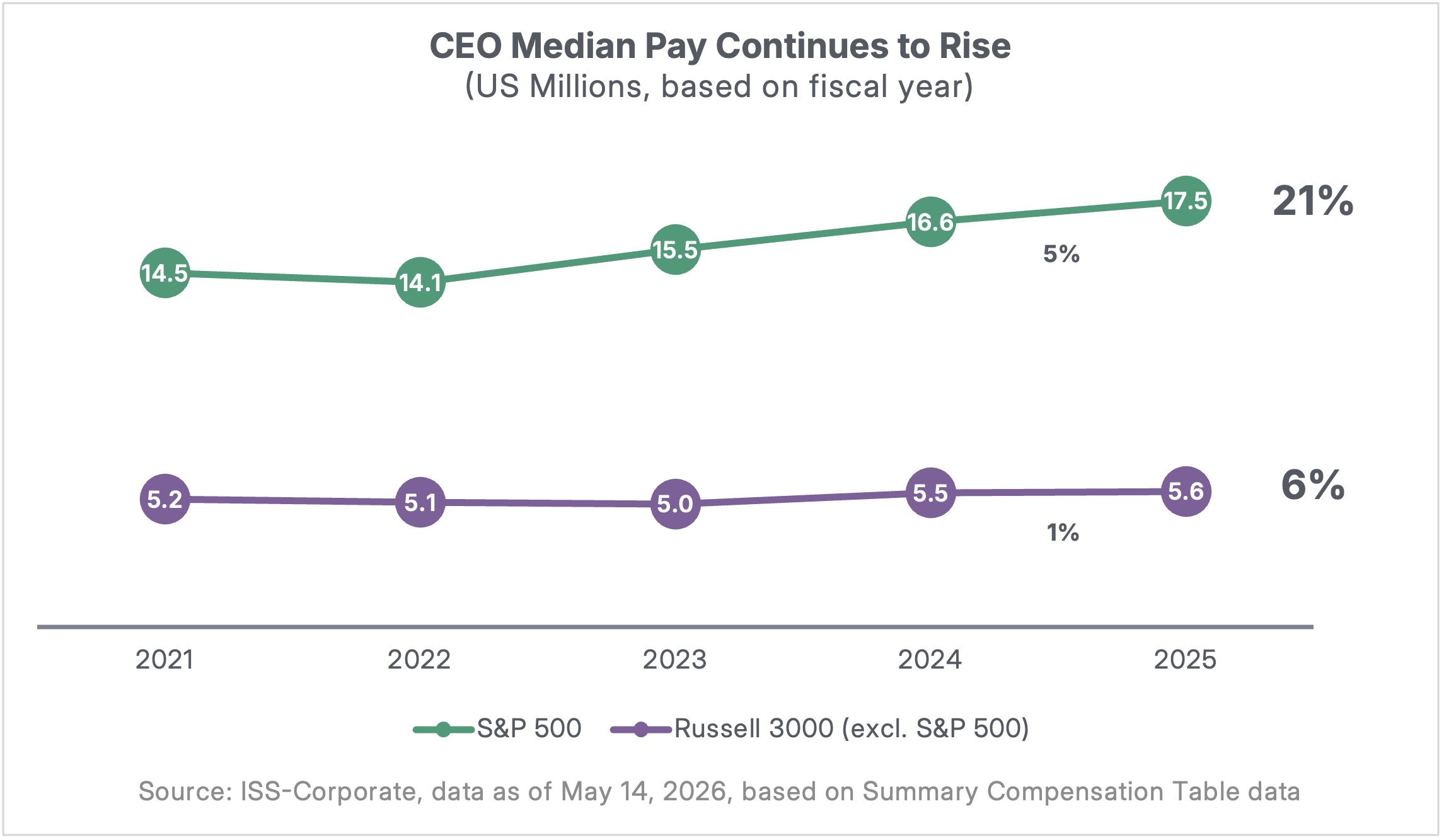
CEO pay has increased steadily in fiscal year 2025, reaching a new record for both the S&P 500 and the Russell 3000. Historically, the Russell 3000 has been categorized by starts and stops, while the S&P 500 has increased steadily over the last 10 years. This year, both indices have seen modest increases that look more like a continuing long-term trend than a divergence from years past.
The chart below illustrates a steady upward trend in median CEO total pay over the past five years, with growth more pronounced among S&P 500 companies than among smaller public companies. Median CEO pay for S&P 500 firms increased from approximately $14.5 million in 2021 to $17.5 million in 2025, representing roughly 21% cumulative growth over the period. By contrast, median CEO pay at Russell 3000 companies outside the S&P 500 rose more modestly from about $5.2 million to $5.6 million. After a slight dip, CEO pay resumed its upward trajectory in both cohorts, with larger-cap companies showing stronger and more consistent increases.
Five-year growth in S&P 500 vs. Russell 3000 CEO pay
Not All Sectors Rising: CEO Pay Diverges Across Industries
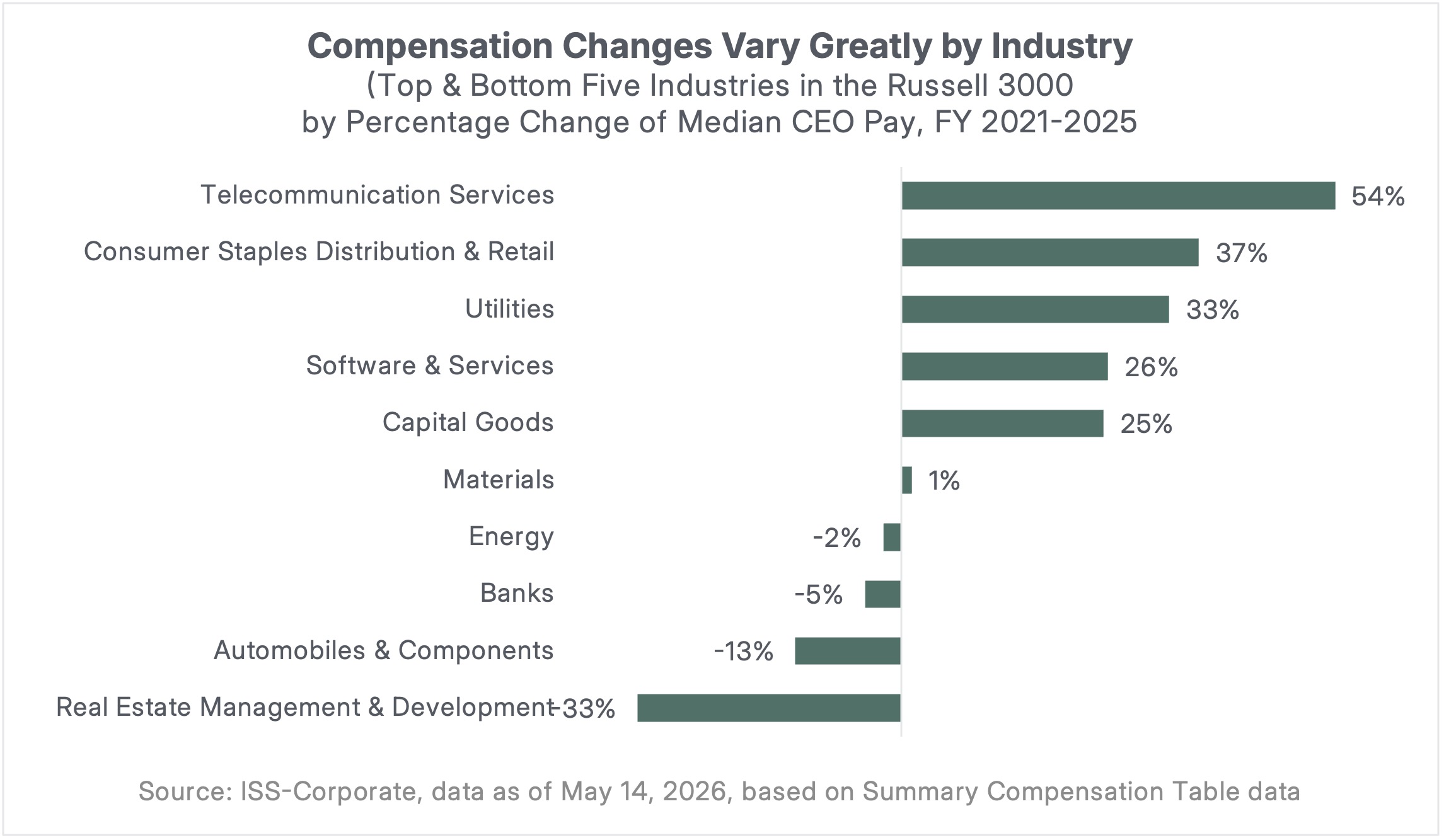
While fiscal year 2025 reflects a continuation of the broader upward trend at the median company level, the underlying experience has been more varied across industries. At this point last year, all industries had seen elevated pay compared to the prior five years. This year, however, Banks, Automobiles & Components, and Real Estate Management & Development show declines in CEO pay relative to fiscal year 2021. Real Estate experienced the largest decline, likely reflecting a slowdown in the real estate sector in recent years, while Telecommunication Services recorded the strongest growth, with median CEO pay reaching $9.1 million, up from 5.9 million in fiscal year 2021.
Which industries are driving pay growth
Extended Vesting Horizons Draw Investors’ Attention
A key theme this season is the greater emphasis from the investor community on longer time horizons in aligning pay and performance. Some investors have been advocating for extended vesting periods for time-based awards, questioning the rigor of performance conditions on long-term equity[1]. Notably, both ISS and Glass Lewis have updated their pay‑for‑performance frameworks to extend the lookback period for quantitative tests, and ISS has also updated its policy this year to consider time-based awards with extended vesting structures as a positive factor, provided that the combined vesting and post-vesting holding periods of the awards span at least five years.
A small minority of companies maintain 5+ year holding horizons
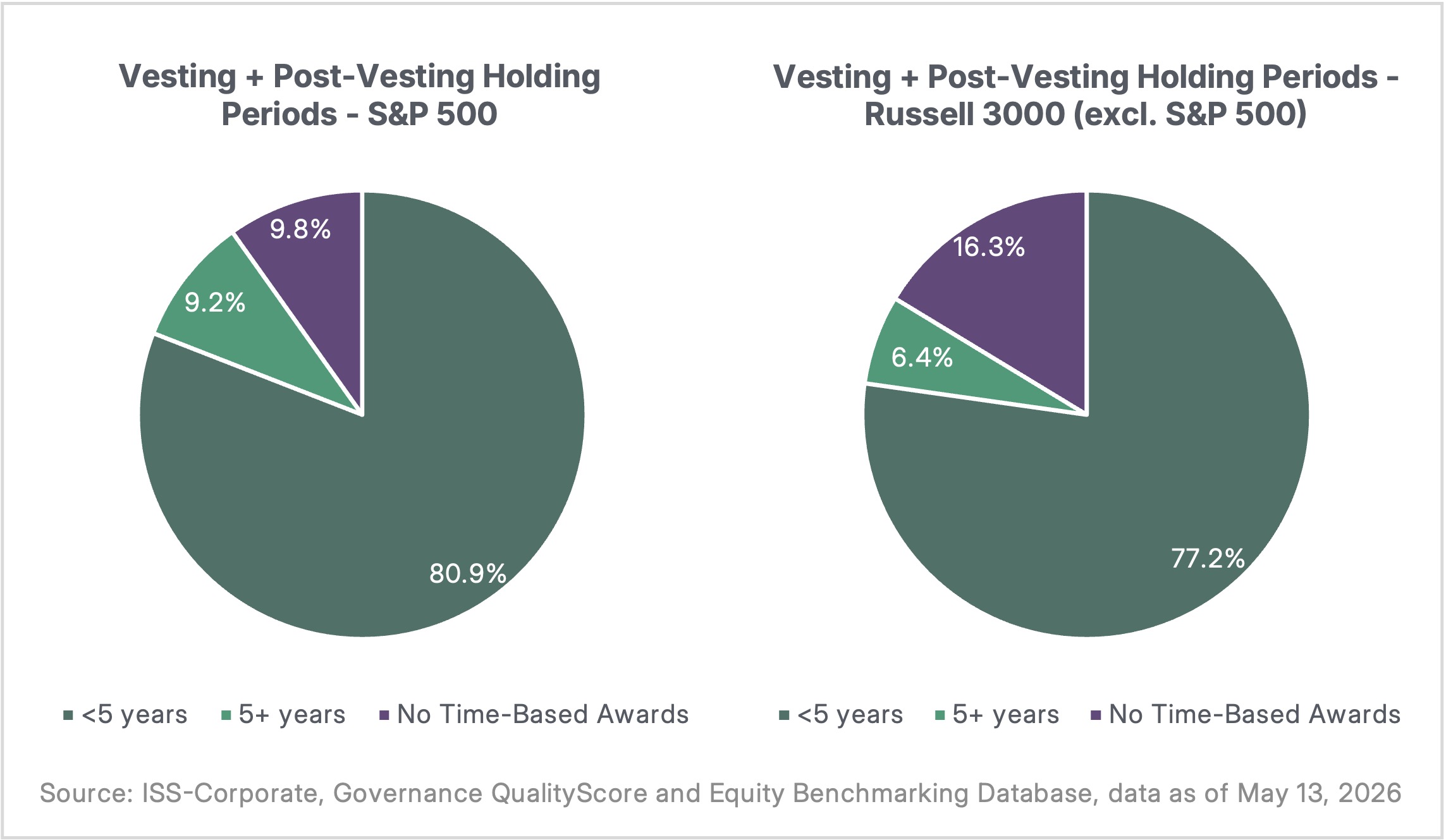
Although investors may be increasingly receptive to longer vesting periods and post‑vesting holding requirements in lieu of performance conditions, these design features remain relatively uncommon and have become less prevalent in recent years. Less than 10% of S&P 500 companies currently have time-based equity awards with extended time horizon, and over the past five fiscal years, a three-year vesting period has become increasingly common, driven by reductions in both shorter and longer vesting schedules
Three-year vesting increasingly becomes market standard
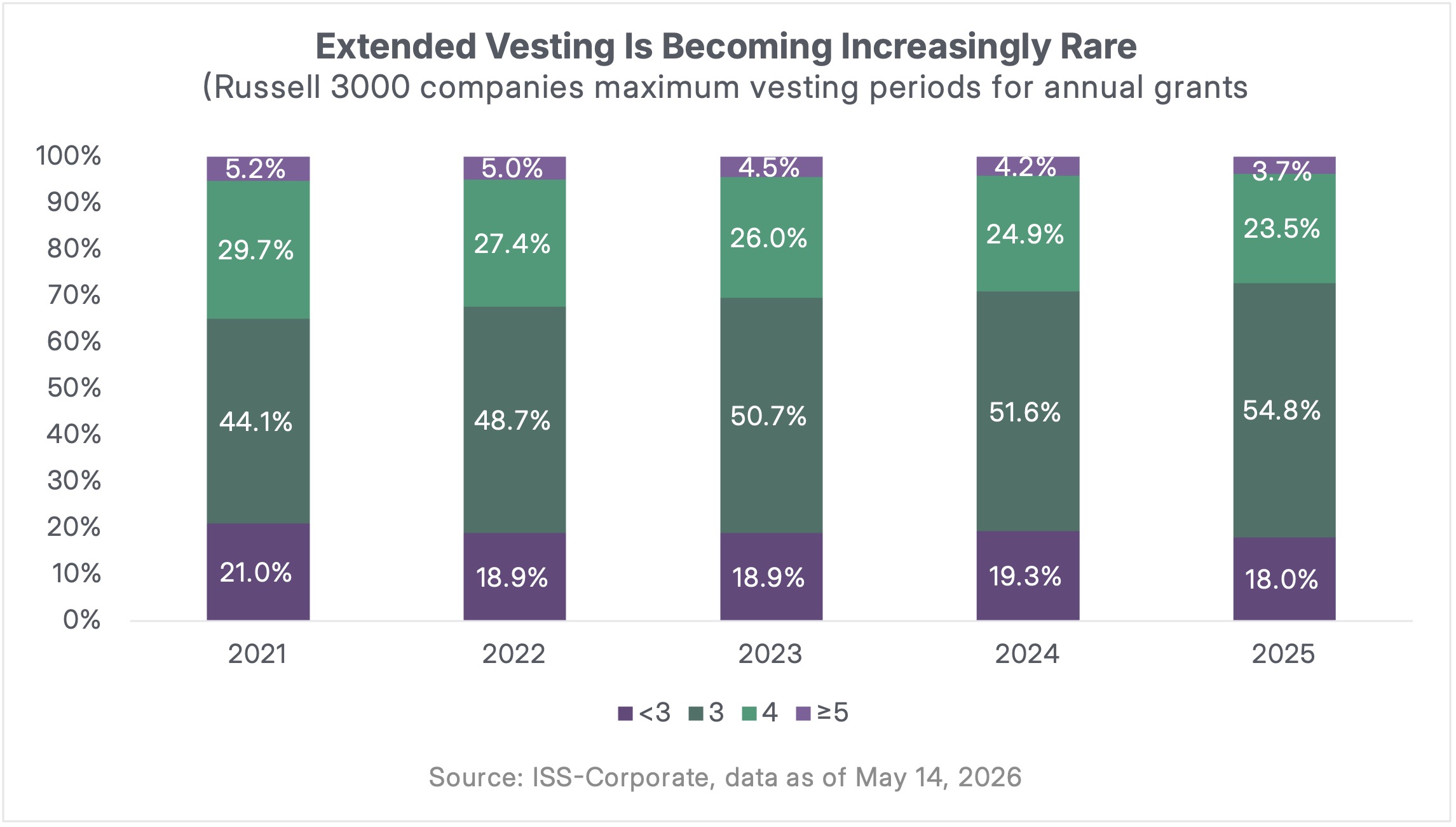
Shifts in institutional investor sentiment could upend the market consensus of three-year vesting schedule in coming years and provide companies with alternative shareholder-approved paths for long‑term incentive design. In particular, companies that face challenges in identifying clear performance metrics that align executive incentives with shareholder interests may consider extending vesting periods, implementing post‑vesting holding requirements, or adopting a combination of both. This is an area that warrants close attention heading into the next proxy season.
ISS-Corporate’s Approach to Proxy Season Insight
As CEO pay continues its steady upward trajectory and incentive design practices evolve, the fiscal year 2025[1] data underscores that scrutiny of pay-for-performance alignment, incentive structure rigor, and incentive time horizon remains elevated among institutional investors and proxy advisors.
As shareholders cast say on pay votes this proxy season, companies are being assessed across several key areas:
- Pay‑for‑performance alignment, particularly in light of recent results;
- Long‑term incentive design, including the balance between performance‑based and time‑based awards;
- Compensation levels and pay mix relative to peers and recent trends;
- Disclosure quality and the strength of the compensation narrative;
- Incentive time horizons, including evolving preferences around vesting and performance periods; and
- Alignment with institutional investor perspectives.
Taken together, these factors will play an important role in shaping shareholder support outcomes this season. ISS‑Corporate’s Compensation and Governance Advisory team supports issuers by conducting pay‑for‑performance risk assessments, providing peer benchmarking, advising on incentive design structures, and reviewing draft disclosures to enhance clarity and alignment with investor expectations.
Citations
[1] For additional discussion on this topic, please refer to our whitepaper published in March this year – “Can extended equity vesting periods break the dominance of performance-based compensation?”