
Europe Proxy Season 2026: CEO Pay Rises, Support Holds

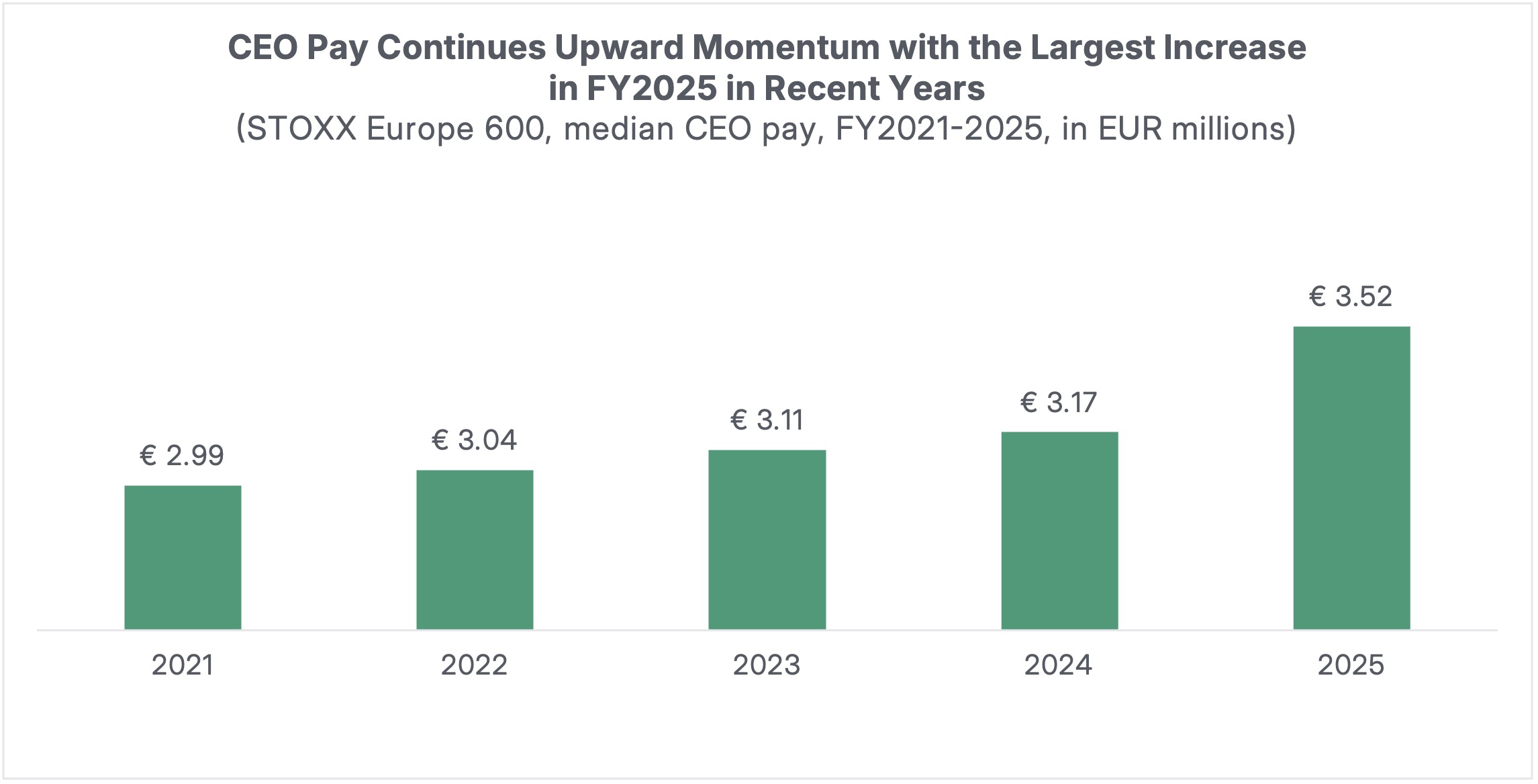
CEO pay across the STOXX Europe 600 rose from €2.99 million in FY2021 to €3.52 million in FY2025, with the largest annual increase recorded in 2025. At the same time, shareholder support for remuneration proposals remained consistently strong across Europe.
As the 2026 proxy season in Europe moves past its peak, pay for CEOs across the STOXX Europe 600 shows a consistent upward momentum. The median CEO pay increased from €2.99 million in fiscal 2021 to €3.52 million in fiscal 2025, an 18% increase. The STOXX 600 serves as a broad European benchmark, and its trajectory highlights how overall CEO pay across the largest issuers in the region is increasing gradually but steadily over the years. However, the rate of increase has accelerated, recording the largest single-year increase of 11.2% so far in FY2025, likely reflecting shifting competitive landscape for executive talents as well as strong market performance in Europe.
Pan-European Overview: Pay Trends Mixed but Compensation Rising Across the Region
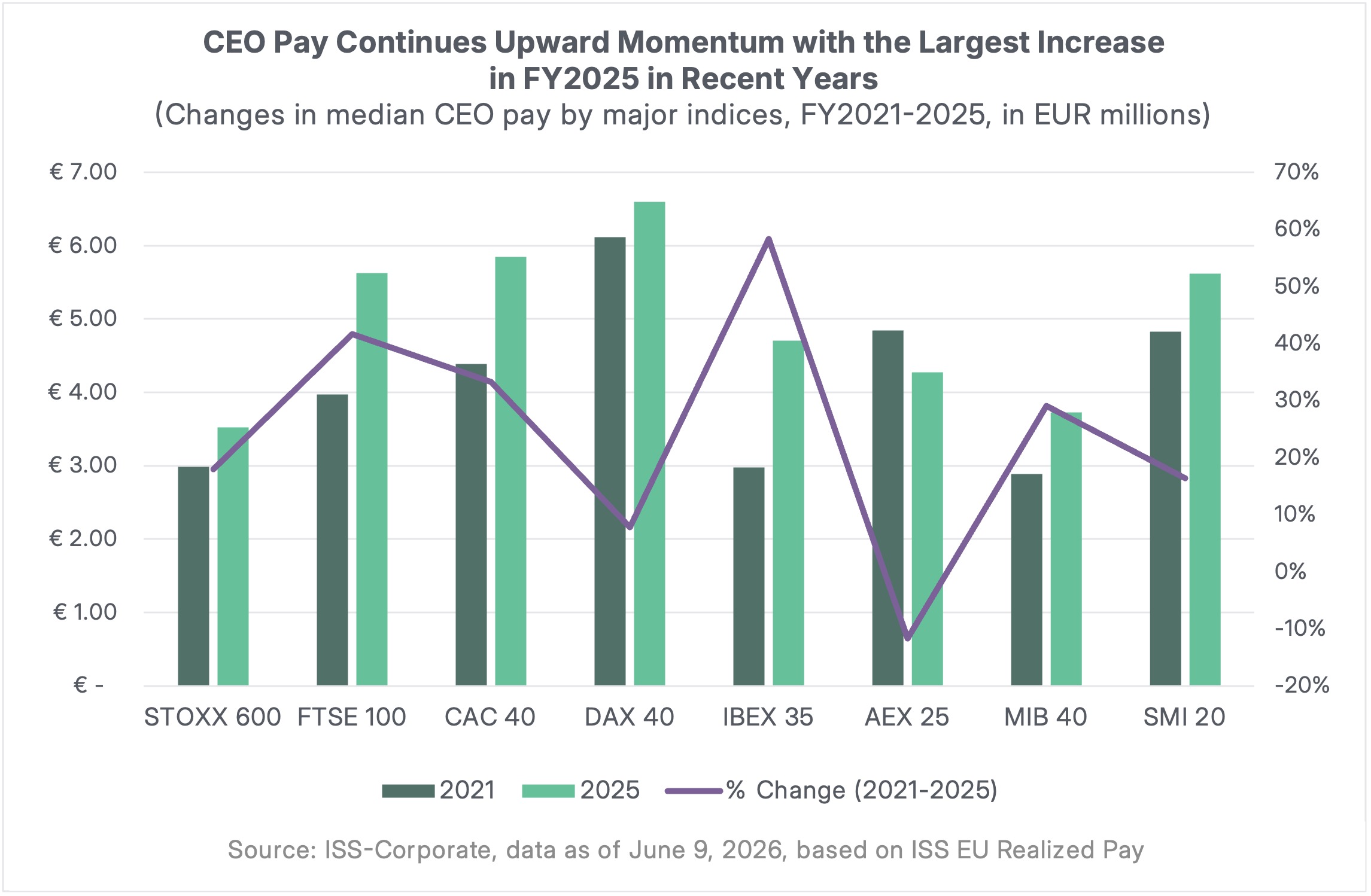
Across Europe, CEO pay trends present a mixed but broadly upward picture, with most major indices showing increases over the 2021–2025 period, albeit at different speeds and with varying levels of volatility. While some markets experienced periods of decline or stabilisation, the overall direction points to rising compensation across the region.
Germany’s DAX 40 has emerged as the highest-paying market in FY2025, overtaking Switzerland’s SMI 20, which had previously led but shows signs of moderation in recent years. This shift highlights a gradual rebalancing at the top end of the European pay landscape, alongside continued catch-up in several other markets.
Benchmark your executive pay programs against peers and investor expectations with ISS-Corporate »
United Kingdom: FTSE 100 CEO Pay Continues Its Upward Climb
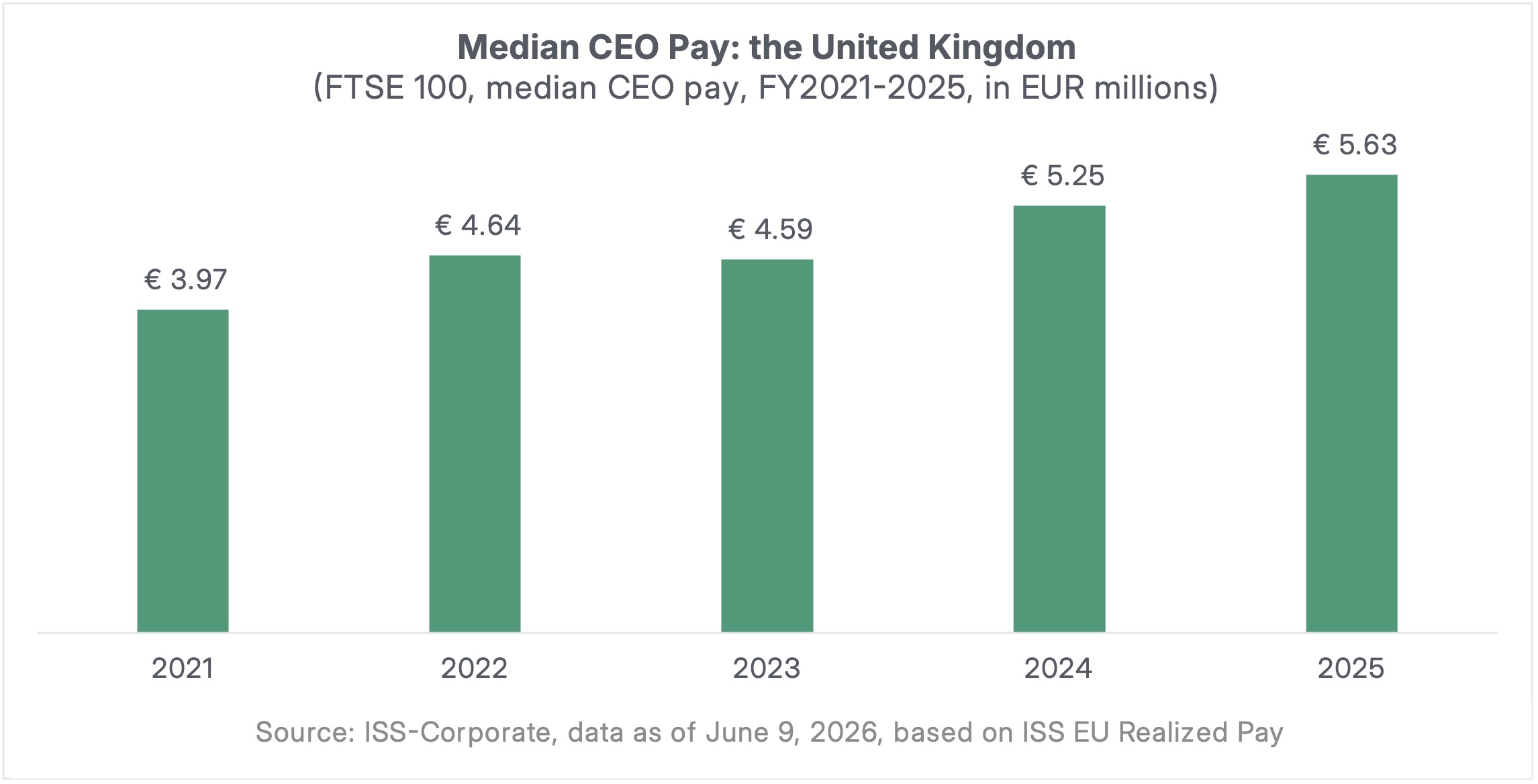
Within the FTSE 100, CEO pay has sustained its upward trajectory over the 2021–2025 period, with the median realized pay increasing from €3.97 million to €5.63 million, representing a cumulative increase of 42%. This growth has been particularly pronounced between 2022 and 2024, where double digit year-on-year increases highlight a period of accelerated compensation expansion.
This pattern also reflects a broader shift in the U.K.’s executive compensation landscape, driven by an intensifying focus on global competitiveness. U.K. boards have increasingly moved to narrow the gap with U.S. CEO pay levels, supported in part by a gradual softening of the regulatory and governance environment, most notably through greater flexibility in long-term incentive plans and variable pay structures.
Germany: DAX 40 Maintains Europe’s Highest CEO Compensation Levels
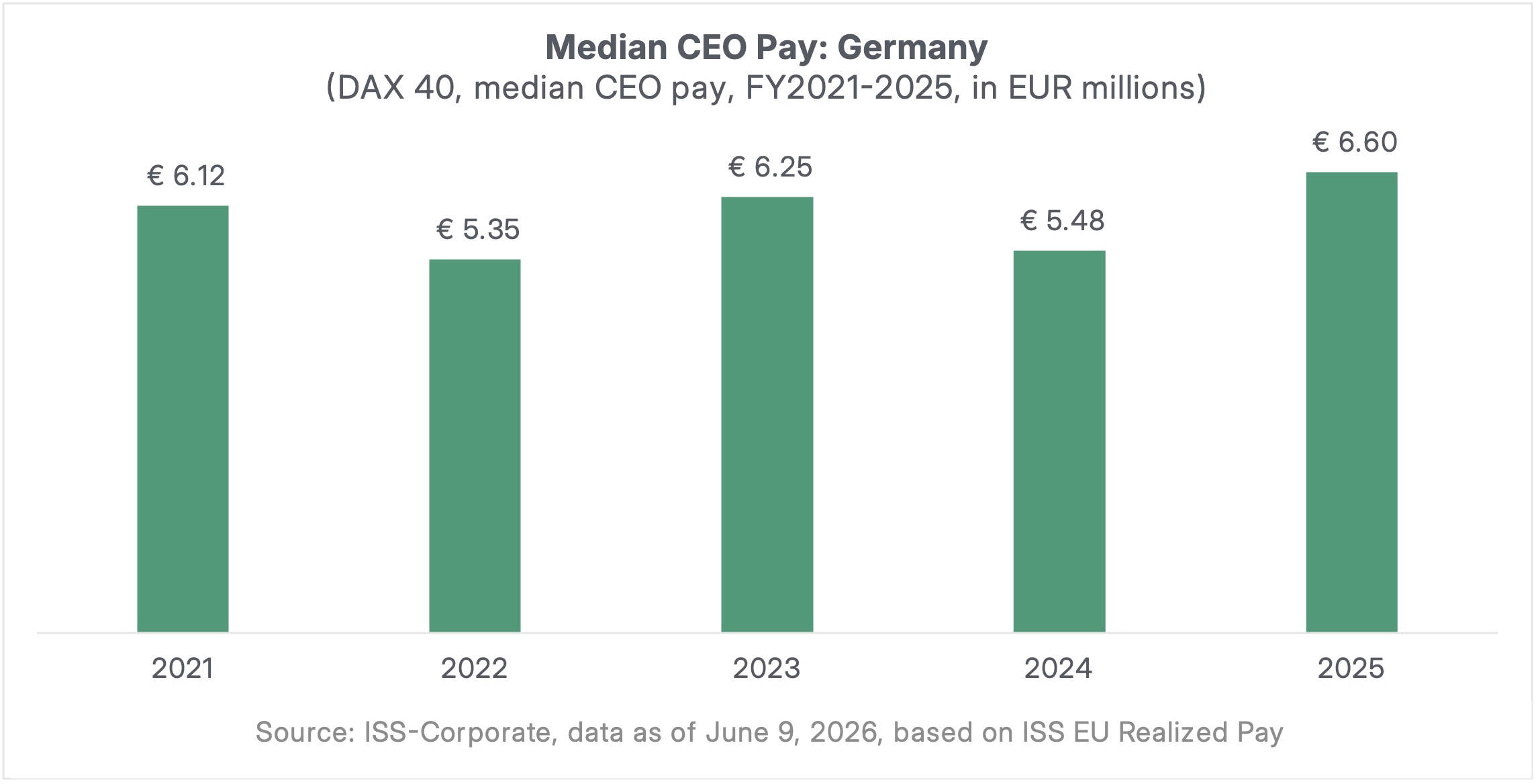
Germany continues to be a leader in CEO realized pay among major European markets, with median compensation exceeding million, the highest among major European markets YTD. There is a clear divergence in realized CEO pay between STOXX 600 companies and their DAX 40 counterparts—while the STOXX 600 shows a moderate and steadily rising median pay, German CEO pay fluctuated over the past five years but maintained high compensation levels relative to STOXX 600. However, the gap in pay has narrowed against several European markets.
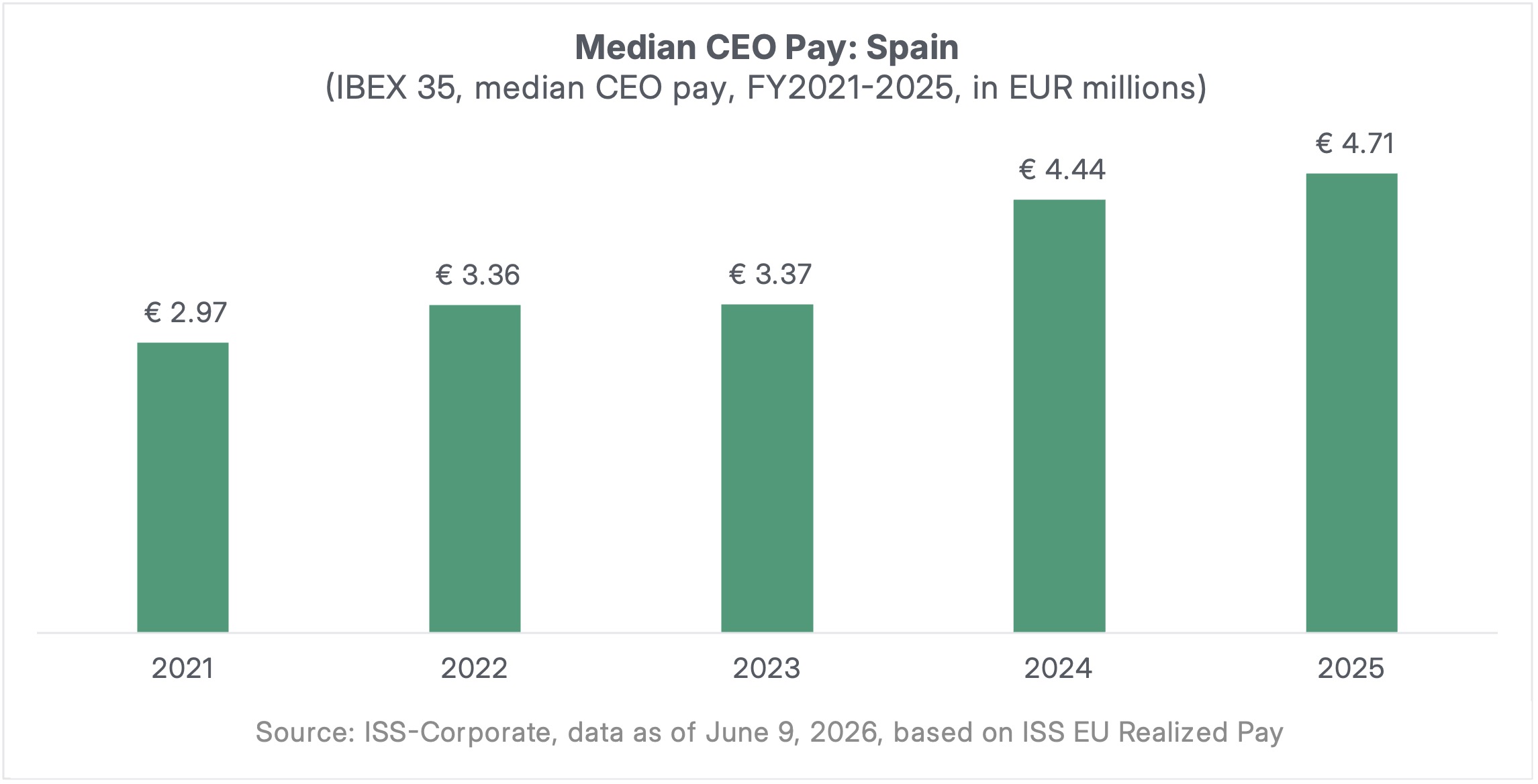
Spain: IBEX 35 Records Europe’s Fastest CEO Pay Growth
Spain experienced the largest increase in realized CEO pay among the European markets, with median pay increasing by 58% over the 2021-2025 period. The pay hike was particularly pronounced in 2024, when the median pay increased by more than €1 million, a 31.9% increased, marking a clear inflection point in compensation levels. The CEO pay has maintained the upward trajectory so far for fiscal 2025. These developments reflect changes in remuneration practices among IBEX 35 companies to more closely align with the broader European pay standards.
France: CAC 40 Pay Levels Moderate After Multi-Year Growth
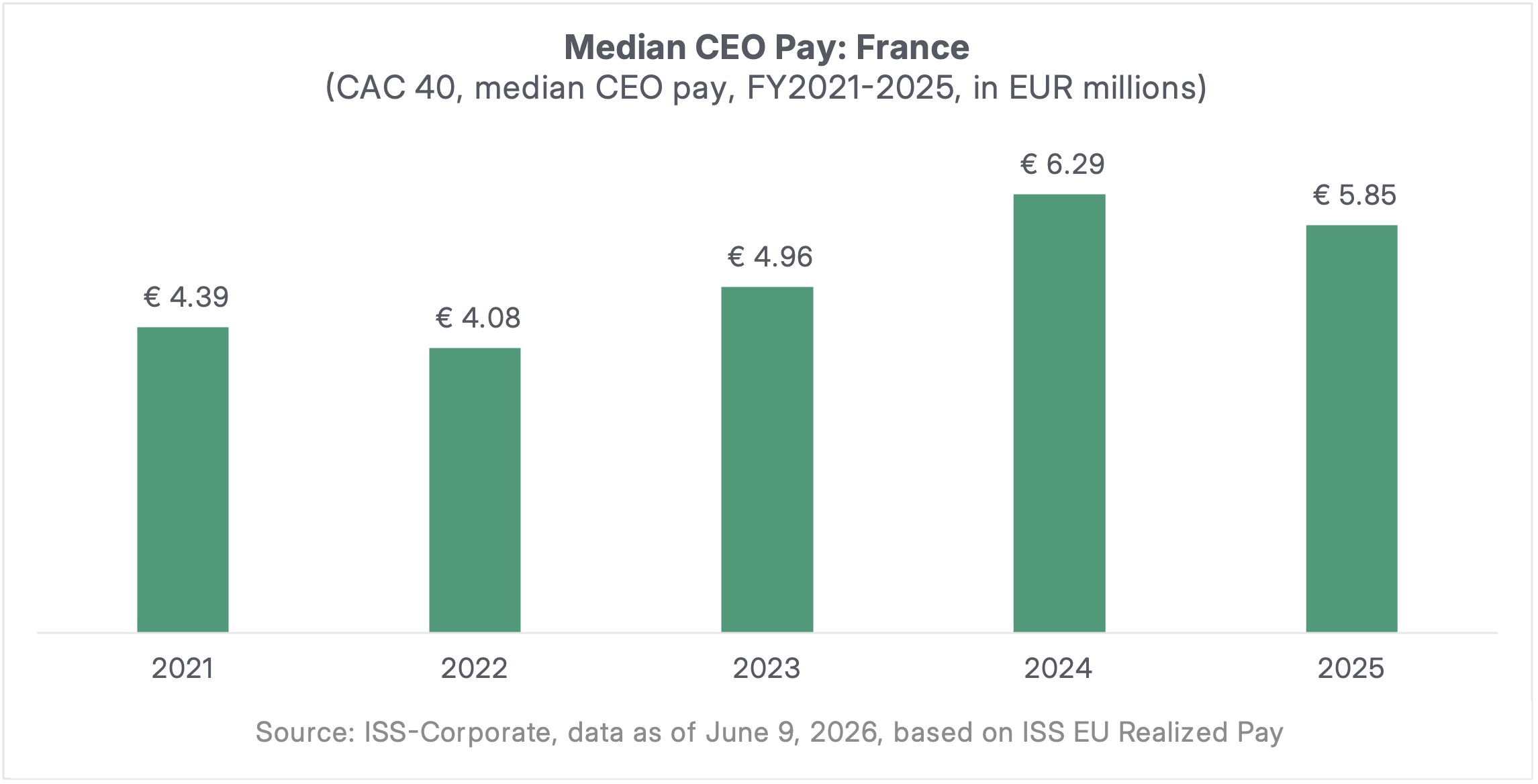
Between 2021 and 2024, the CEO pay among French companies saw a robust increase, with median realized pay increasing by roughly €2 million to approximately €6.29 million—equating to growth of about 26.7%. This firmly positions France among Europe’s leading markets in terms of CEO pay, narrowing the gap with historically higher-paying indices such as the DAX 40 and Switzerland’s SMI 20.
The CAC40, having delivered a strong upward run over several years and reaching a high point in 2024 at approximately €6.3 million, moderates in 2025 to around €5.8–6.0 million. This easing appears to reflect a recalibration after elevated payout levels in earlier years, likely influenced by softer long-term incentive vesting, more demanding performance hurdles, or wider market dynamics such as share price movements affecting realised remuneration.
Switzerland: SMI 20 Compensation Falls as Incentive Payouts Weaken
CEOs of Switzerland’s SMI 20 have consistently ranked among the highest paid in Europe, placing the Swiss market among the upper tier in Europe in terms of CEO pay. However, CEO realized pay in Switzerland declined sharply in 2025 largely as variable compensation weakened, with both bonus payments and long-term incentive vesting coming in lower as performance outcomes moderated.
At the same time, broader market conditions, including tariff-related uncertainty and a stronger Swiss franc, put pressure on company margins and share prices, reducing the value of equity-based awards that make up the majority of realised pay.
Benchmark your executive pay programs against peers and investor expectations with ISS-Corporate »
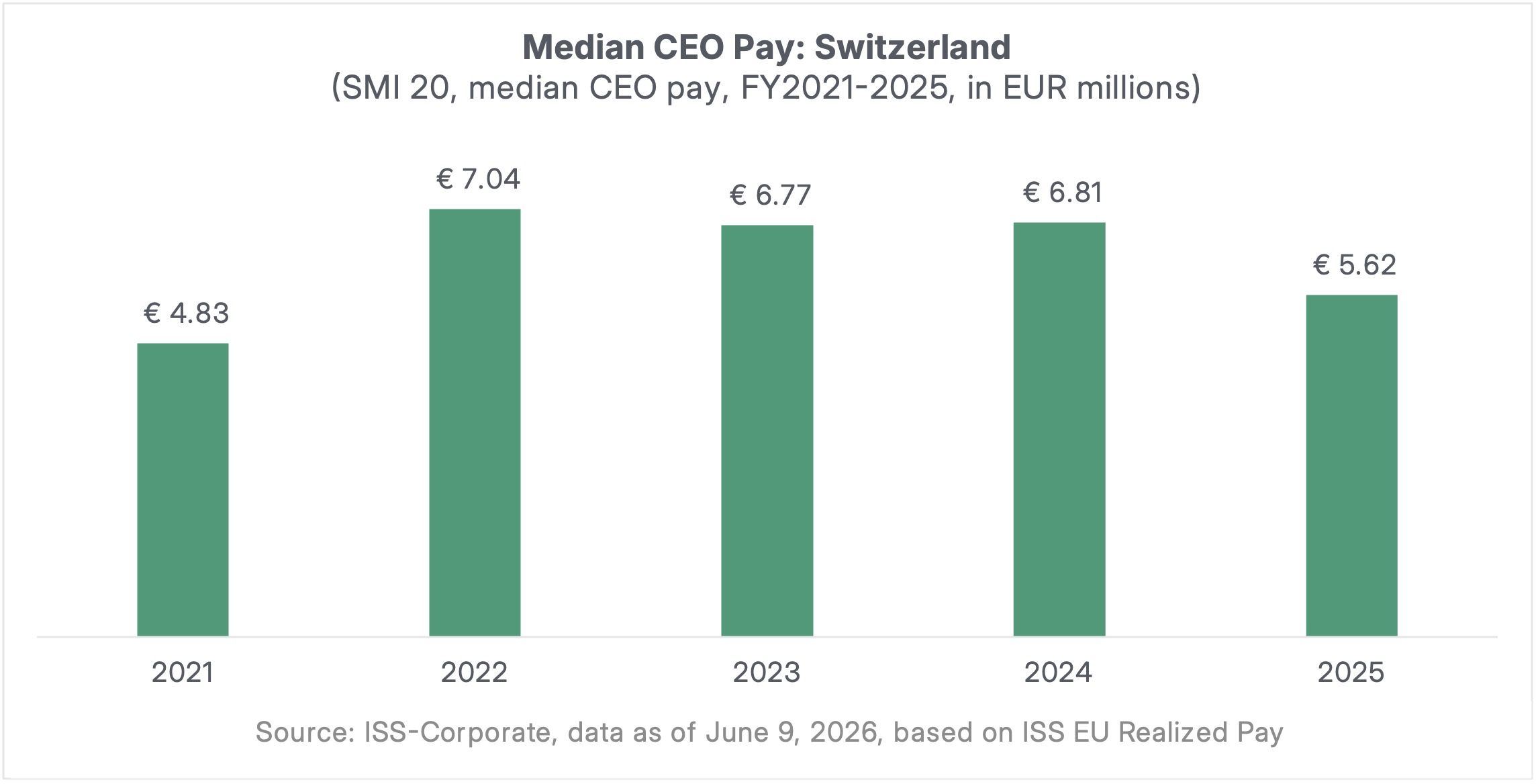
Together, these factors led to a more subdued pay environment, with lower incentive payouts driving the overall decline in CEO realised compensation. This resulted in pay levels converging with France, U.K., and Germany.
Italy: MIB 40 Reflects a More Conservative Pay Environment
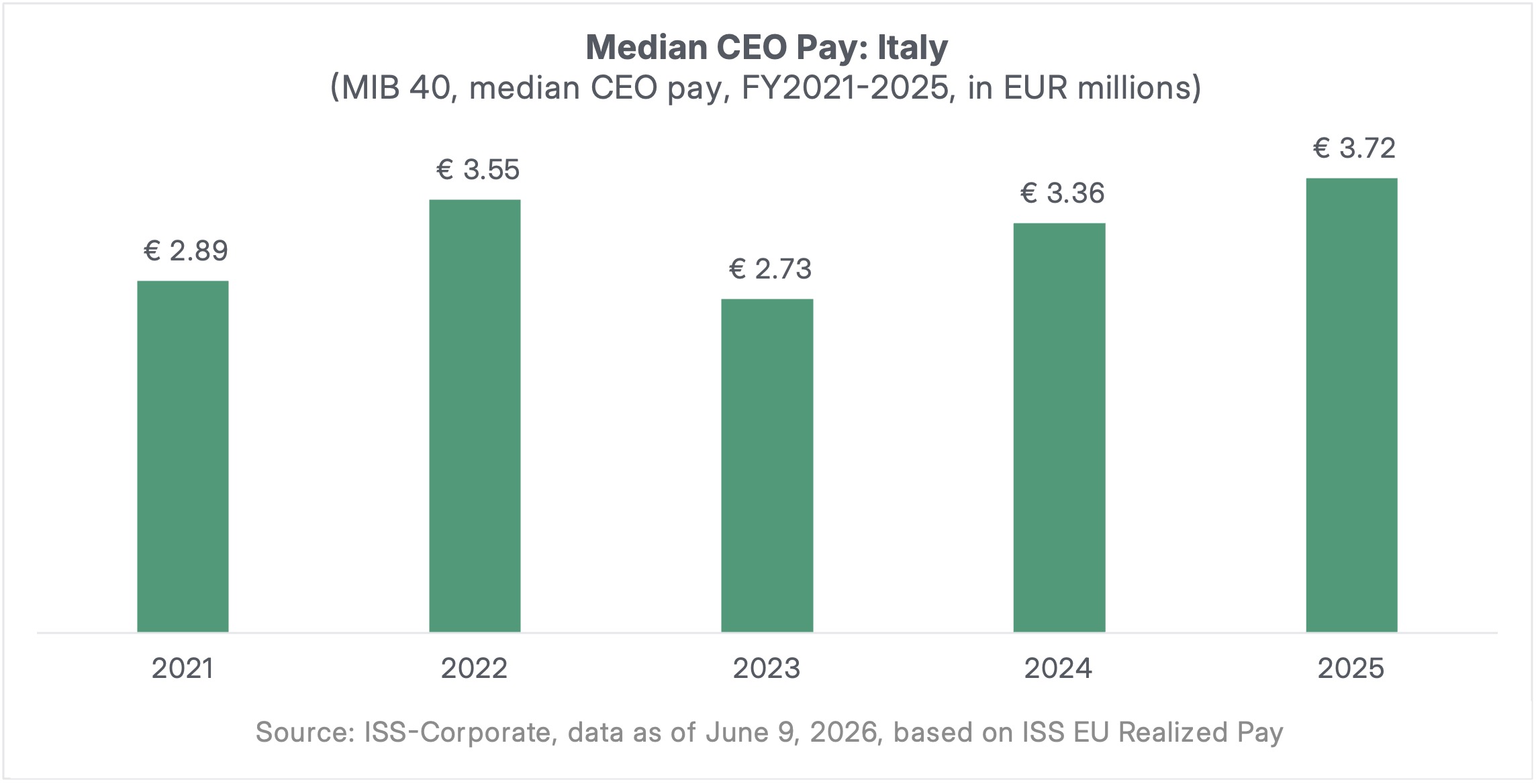
Italy’s MIB 40 continues to reflect a stable yet structurally lower compensation environment within the European landscape. Although median CEO pay has increased by approximately 29% over the period, the growth remains moderate and measured. This trend is largely driven by the underlying design of Italian remuneration frameworks, which tend to favour more conservative pay structures and place less emphasis on equity-based incentives.
Netherlands: AEX 25 Shows Slow Recovery in CEO Compensation
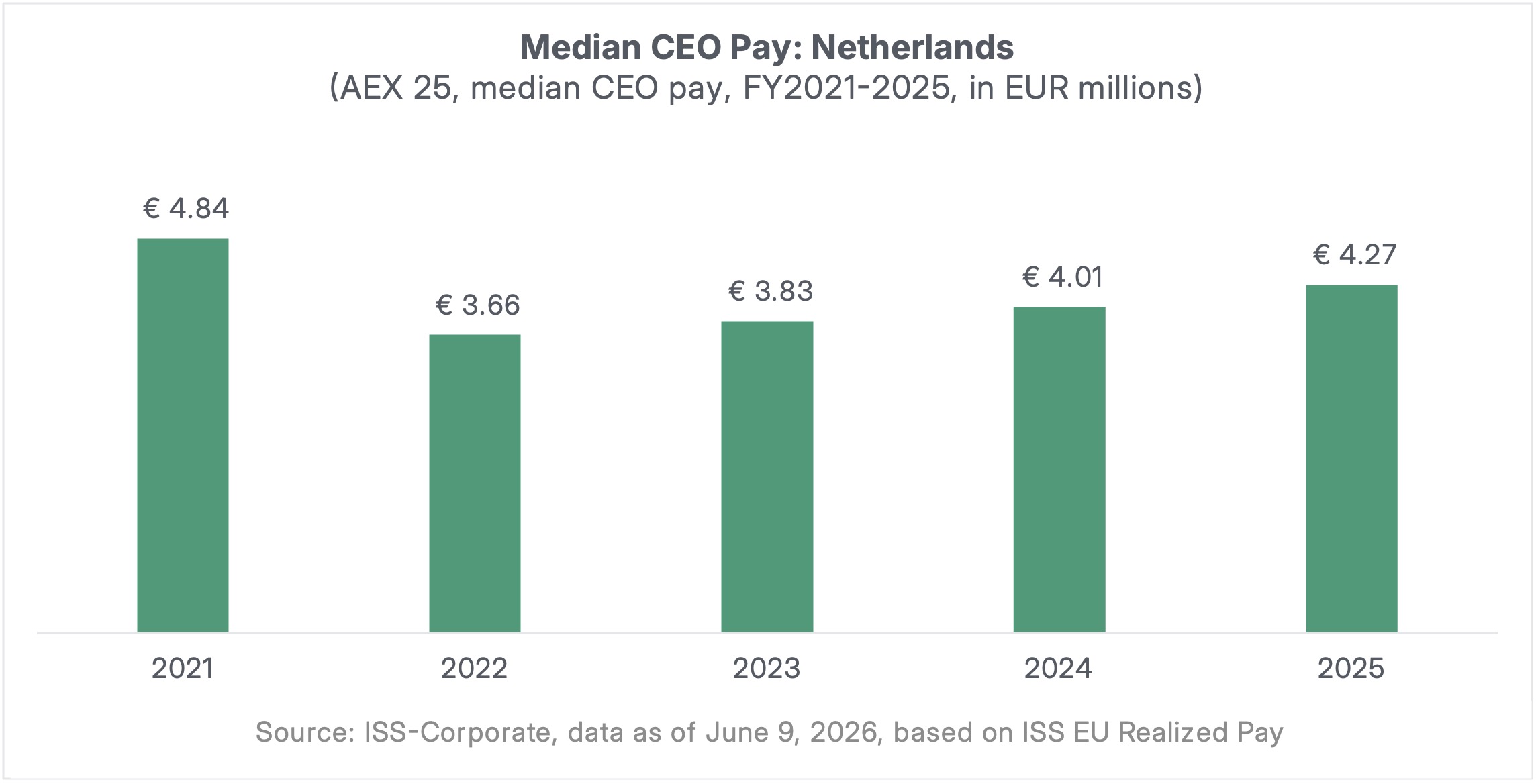
Median CEO pay at AEX 25 exhibits a distinct pattern of early decline followed by gradual recovery, positioning it as one of the more muted and less dynamic compensation markets among major European indices. Median realized pay dropped sharply from €4.6 million in 2021 to around €3.5 million in 2022, the most pronounced single-year decline across the major European indices. From that point onward, CEO pay among AEX 25 companies recovered slowly and steadily, reaching roughly €4.3 million in 2025, but notably failing to return to its 2021 level. This trend points to a reset in realized pay levels, likely driven by lower incentive payouts or a return to more typical levels following a particularly strong year in 2021, with recovery progressing gradually rather than through rapid growth.
Shareholder Support for Executive Pay Remains Strong in 2026 (June 2026)
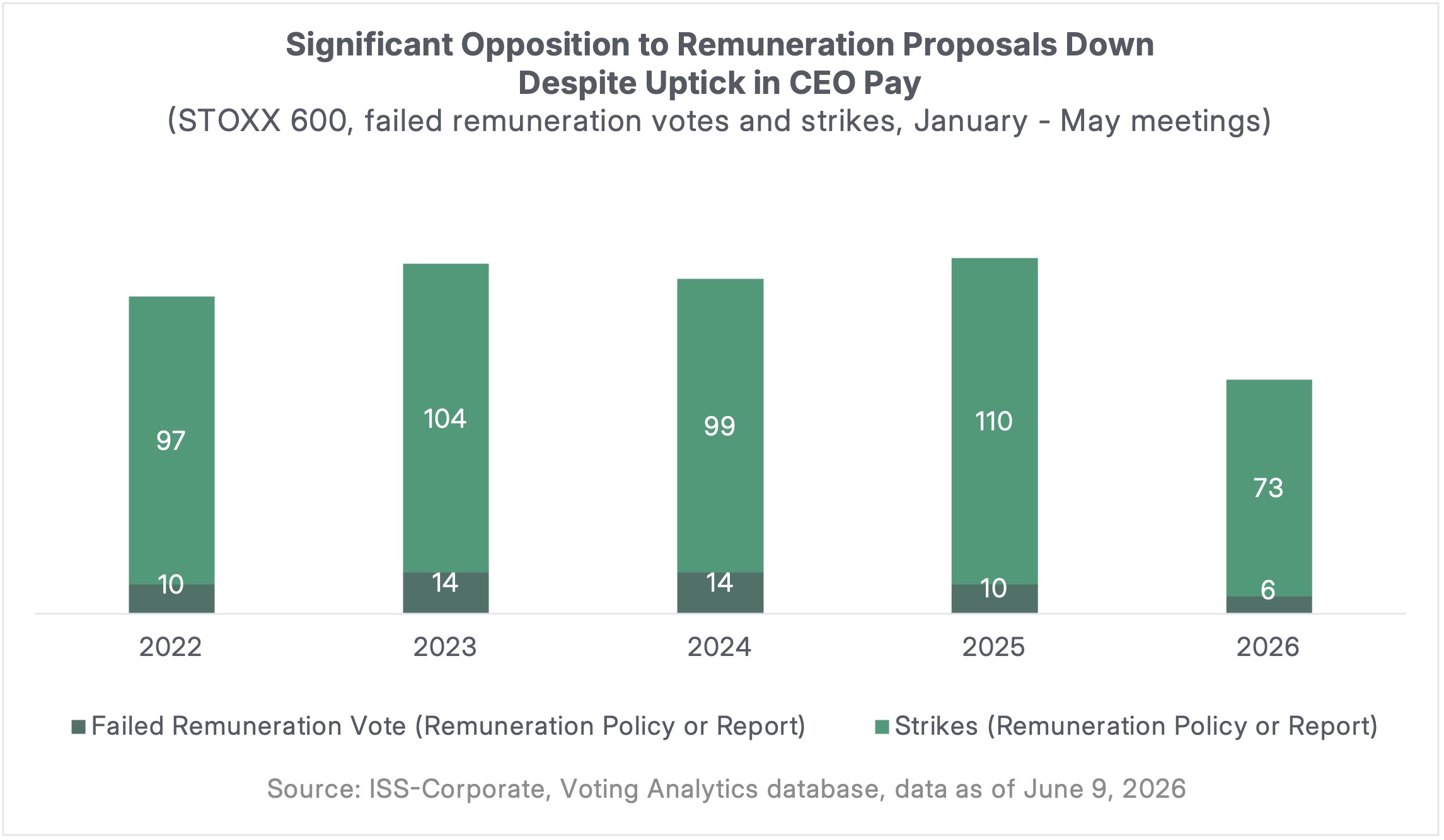
Median shareholder support for remuneration related proposals across the STOXX Europe 600 remains high and stable at around 95%, confirming continued broad investor backing of remuneration reports and pay frameworks. However, opposition is becoming more targeted rather than widespread, with “strikes” (votes below 80%) emerging as the key signal of investor concern rather than outright failures. Following a peak in scrutiny in 2025, 2026 so far shows a clear normalization, with failed proposals declining to six (from ten) and strikes falling to 73 (from 110). While outright remuneration failures remain rare in Europe, they are symbolically powerful, and often they are driven by perceived misalignment between pay outcomes and performance, deficient remuneration frameworks, or lack of disclosure.
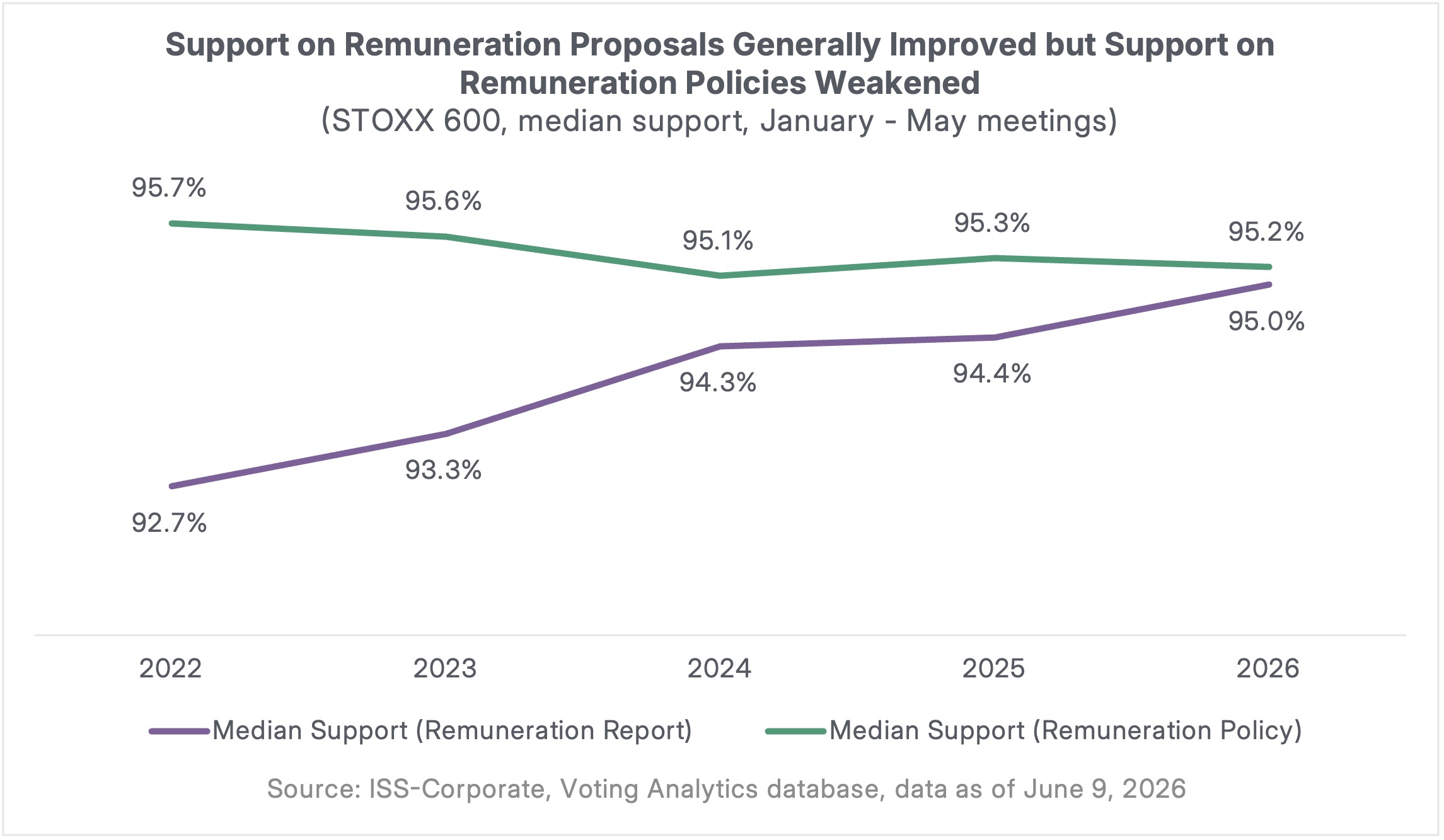
Remuneration policy votes continue to attract greater scrutiny than remuneration reports, particularly in markets such as Germany and, in select cases, the United Kingdom. This reflects the forward-looking nature of policy approvals, which define the structure, quantum and flexibility of executive pay over multiple years. As a result, investors are increasingly focusing on the design of remuneration frameworks—scrutinising incentive calibration, discretion, and pay opportunity—rather than solely assessing realised outcomes.
To date, the European proxy season underscores a market in transition, marked by both convergence and recalibration. CEO pay is continuing to rise across most major indices, supported by competitive pressures, evolving incentive structures, and stronger market performance, while longstanding differences between markets are gradually narrowing. At the same time, shareholder support remains firm, with consistently high approval levels reinforcing confidence in remuneration frameworks, even as more targeted dissent signals a growing emphasis on pay-for-performance alignment and transparency. Overall, these trends reflect a more mature European compensation landscape and one in which boards are increasingly challenged to balance global competitiveness with discipline, ensuring pay outcomes are both credible and closely aligned with long-term shareholder value.
ISS-Corporate’s Approach to Proxy Season Insight
ISS-Corporate analyzes early proxy disclosures to identify trends in governance, executive compensation, and board pay practices. As companies navigate proxy season and evolving regulatory requirements, issuers gain valuable insight into shifting investor expectations. ISS-Corporate’s Compensation & Governance Advisory team supports issuers by interpreting these trends, assessing remuneration frameworks against peer and investor benchmarks, and proactively addressing key governance considerations.
Benchmark your executive pay programs against peers and investor expectations with ISS-Corporate »