
EMEA Proxy Season 2026: Board Diversity Trends in STOXX Europe 600

Board gender diversity across the STOXX Europe 600 has approached regulatory thresholds, with broad gains across industries, while changes in executive leadership representation remain more limited.
Board gender diversity nears EU regulatory targets
As the 2026 proxy season enters its peak in Europe, this first iteration of the Proxy Season Pulse series for the European market examines trends in board gender diversity across the STOXX Europe 600 Index over the 2022–2026 period. Diversity has become a key focus area for regulators and investors across Europe in recent years, and this has been further reinforced by the EU Gender Balance on Corporate Boards Directive which sets a target for large European-listed companies[1] of at least 40 percent representation of the underrepresented sex among non-executive directors, and 33 percent among all directors. Member States were required to transpose the Directive into national law by 28 December 2024, with companies expected to meet the targets by 30 June 2026.
STOXX Europe 600 diversity trends (2022–2026)
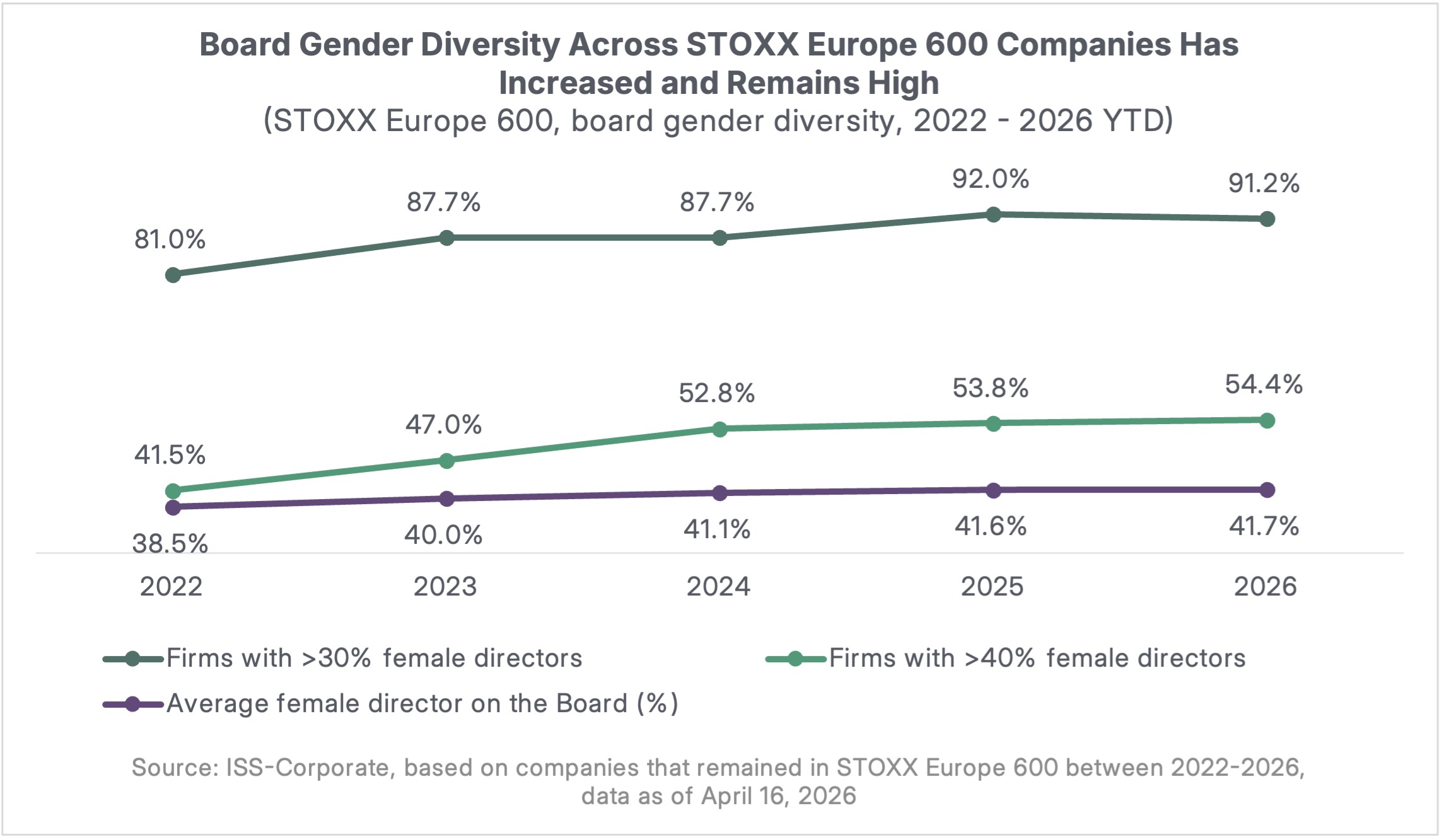
Against this background, board-level female representation has increased significantly since 2022, with almost all STOXX Europe 600 companies reaching at least 30 percent female representation, and approximately half surpassing the 40 percent threshold. As a result, the 2026 AGM season is likely to see high levels of compliance among the large European-listed companies with applicable regulatory gender diversity requirements (and correspondingly, fewer votes cast against directors for insufficient gender representation).
Industry-level convergence toward 40% representation
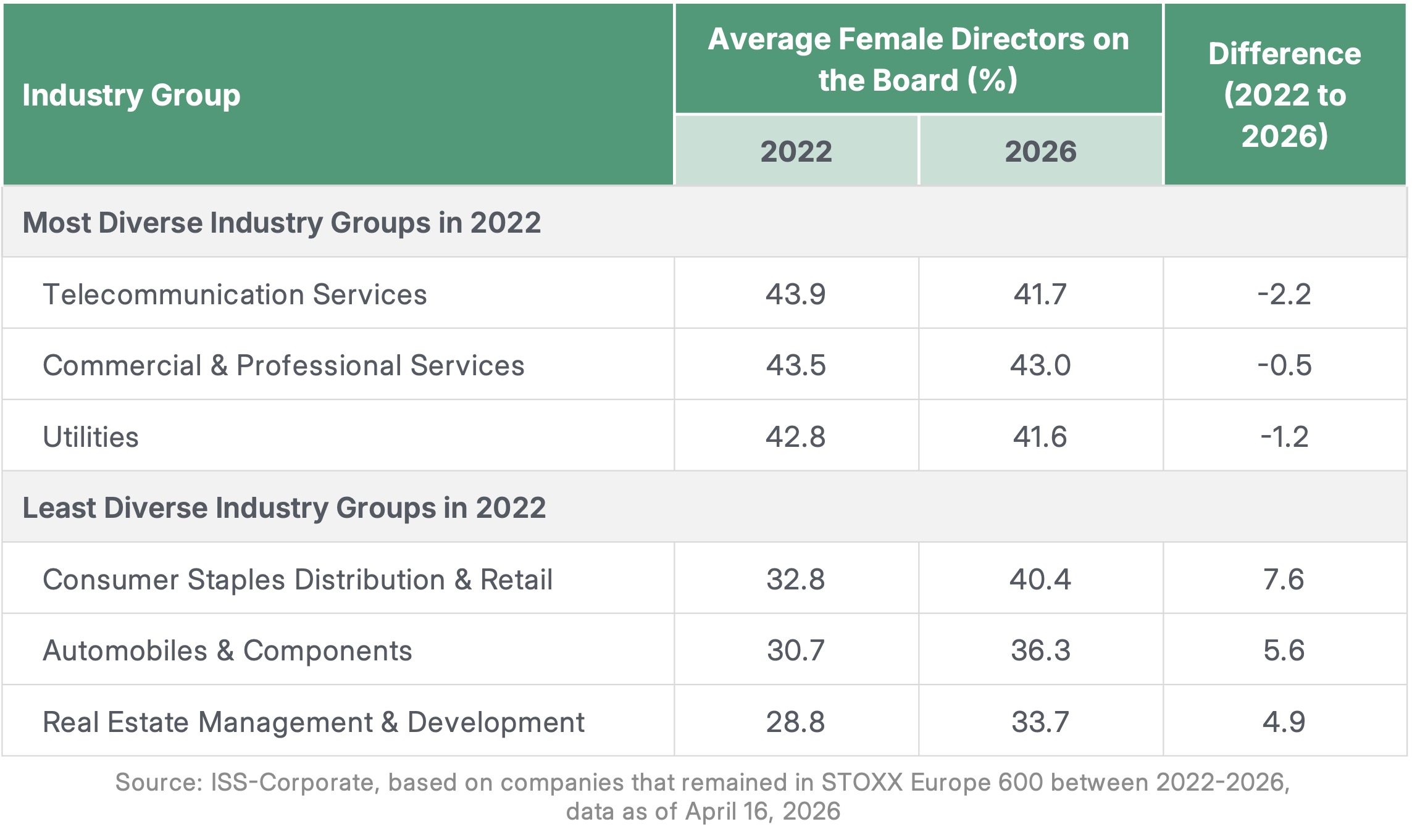
Most industry groups saw an increase in board gender diversity, with 17 out of 21 industry groups[2] posting higher percentages of female directors in 2026 than in 2022. Amid increased regulatory and investor pressure to achieve at least 33 percent or higher board gender diversity, industries with lower female representation in 2022 generally experienced larger increases. This trend was most pronounced in the Consumer Staples Distribution & Retail industry group, which recorded a 7.6 percentage points increase to 40.4 percent female directors in 2026, followed by the Media & Entertainment industry group with an increase of 6.1 percentage points from 2022 to 2026.
Assess how your board aligns with evolving governance expectations »
In contrast, the top three industry groups with the highest percentages of female directors in 2022 all show a decrease in board gender diversity in 2026. This brings to the forefront a key forward‑looking question for the coming years: will gender diversity continue to increase or will it plateau once mandated targets have been met?
Gender diversity in leadership roles remains limited
Table 2: Board Diversity Levels Converge Towards 40%
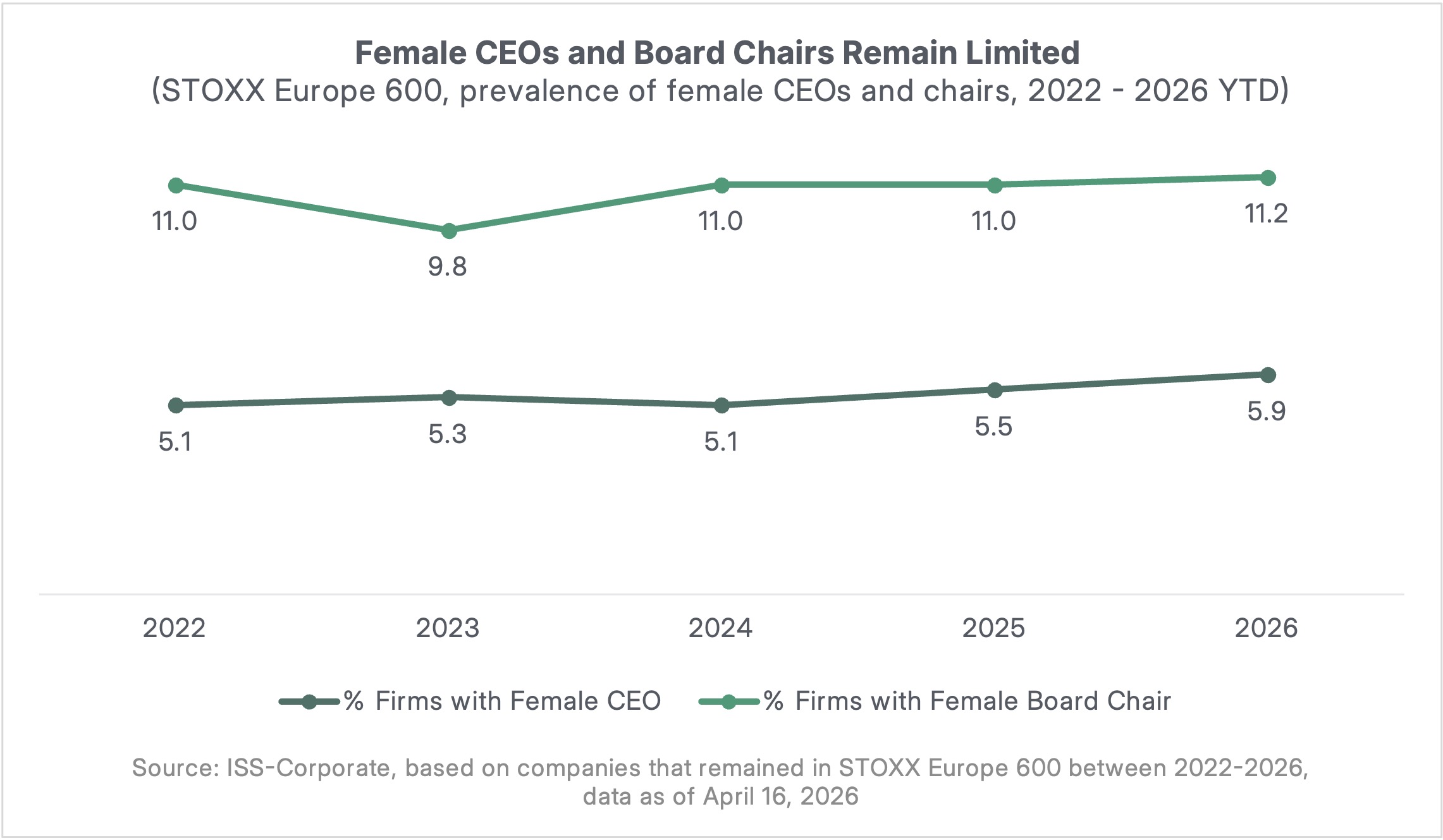
Although the average share of female directors rose steadily from around 38.5 percent in 2022 to 41.7 percent in 2026, the share of firms led by either a female board chair or a female CEO remained almost unchanged during the same period. While it is more common to see a female board chair among STOXX Europe 600 companies than a female CEO, the prevalence of female chairs is significantly lower than the overall share of board positions held by women—11% compared to more than 40 percent—largely unchanged from the 2022 level. Female CEOs did not see material change either, up slightly to 5.9 percent from 5.1 percent in 2022, despite some jurisdictions such as the U.K.[3] recommending more women in board leadership roles.
Women’s influence strongest in committee leadership
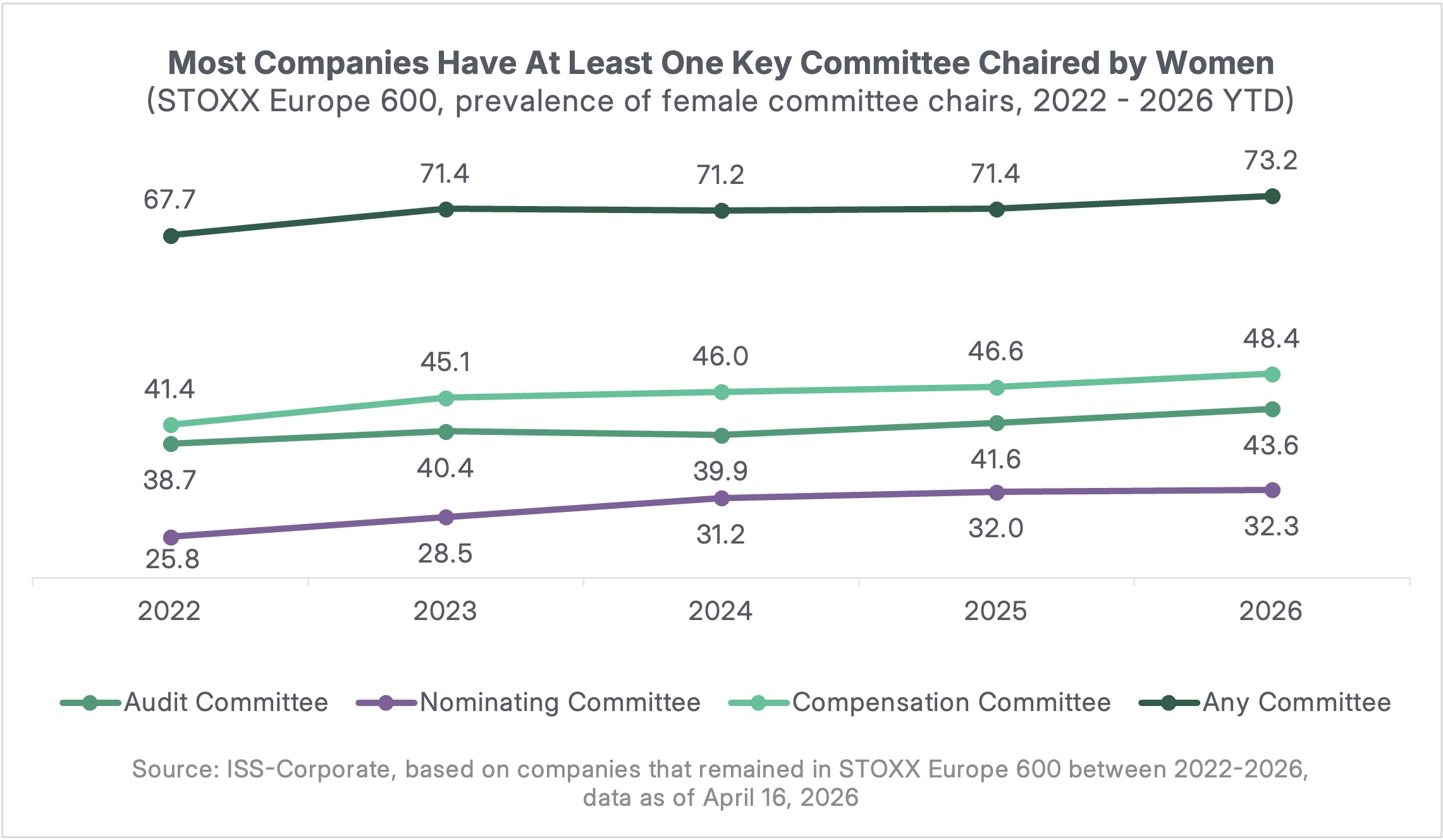
Female directors however continue to be strongly represented in committee chair roles, with 73.2 percent of STOXX Europe 600 companies having at least one female key committee chair. Notably, among key board committees, females are more likely to chair the compensation committee.
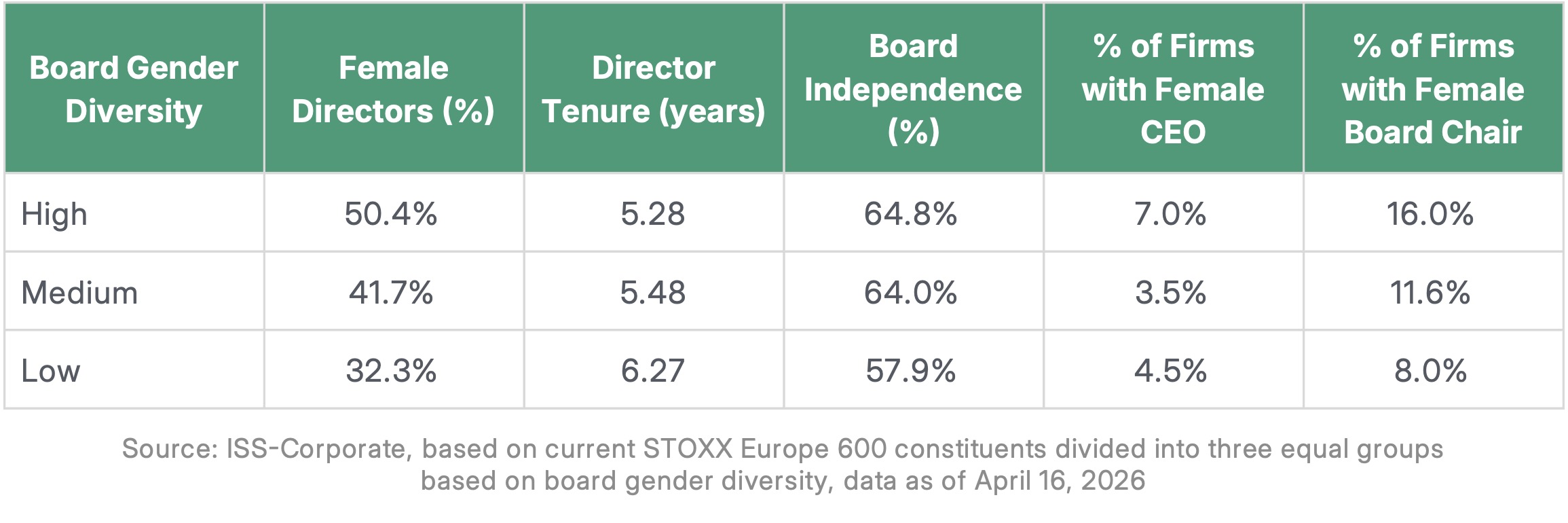
Female directors on average also tend to be younger, with shorter tenure, and firms with higher board gender diversity are often associated with stronger governance standards. Dividing STOXX Europe 600 companies into three equal groups from most diverse to least diverse, female directors represent one-half of board members on average among the most gender diverse cohort, compared with less than one-third among the least diverse group. Higher diversity is associated with shorter director tenures and greater board independence, indicating more active board refreshment process and stronger governance. These firms are also more likely to place women in senior leadership roles: 7.0 percent have a female chief executive and 16.0 percent have a female board chair, nearly double the level in the least diverse group.
As the proxy season progresses and European firms face the compliance deadline for board gender diversity, firms that lag behind their peers may face increased investor scrutiny this year.
Key takeaways from EMEA 2026 board diversity data
Board gender diversity across the STOXX Europe 600 has increased steadily from 2022 to 2026, with nearly all companies reaching at least 30 percent female representation and about half surpassing 40 percent. Gains are visible across industries, with historically lower-representation sectors narrowing the gap, while early leaders show more moderate increases over time.
Progress at the board level contrasts with more limited changes in leadership roles, where female representation among CEOs and board chairs remains comparatively low. Data also shows variation across governance structures, including committee roles and broader board characteristics such as independence, tenure, and refreshment.
ISS-Corporate’s Approach to Proxy Season Insight
ISS-Corporate analyzes early proxy disclosures and board gender diversity to identify governance trends and shifts in board composition. As companies navigate the proxy season and compliance with regulatory requirements, issuers can gain insights into how boards and investor expectations are evolving. ISS-Corporate’s Compensation & Governance Advisory team supports issuers by contextualizing these trends, evaluate composition against peer and investor expectations, and proactively address governance considerations.
Assess how your board aligns with evolving governance expectations »
Citations
[1] Companies with more than 250 employees, an annual turnover of over EUR 50 million, or a balance sheet total above EUR 43 million
[2] REITs and industry groups with a limited number of firms are excluded
[3] FCA Listing Rules require listed companies to report against specific diversity targets on a comply or explain basis. The targets include having at least 40 percent of women on the board, at least one senior board position (Chair, CEO, Senior Independent Director or CFO) held by a woman, and at least one board member from an ethnic minority background excluding white ethnic groups