
GHG Reduction Targets: Adoption Trends and Market Differences

GHG reduction targets remain firmly embedded in corporate planning across major markets, even as approaches evolve and attention shifts from target adoption to target effectiveness.
Are Companies Still Setting GHG Reduction Targets?
In recent years, quantitative greenhouse gas (GHG) emissions reduction targets have become a common feature of corporate sustainability strategies. These targets help organizations translate broad climate ambitions into measurable objectives, establish accountability, and create a framework for tracking progress over time. While climate considerations remain an important driver, the rationale for setting emissions reduction targets often extends beyond environmental commitments alone.
For many companies, emissions reduction targets support operational efficiency initiatives, energy management programs, long-term resilience planning, and preparedness for evolving reporting and regulatory expectations. They can also help organizations respond to requests from customers, business partners, lenders, and investors seeking greater visibility into climate-related risks and opportunities across the value chain. In certain markets, national policy initiatives and disclosure requirements have further encouraged companies to formalize their climate objectives and establish clearer pathways for reducing emissions.
At the same time, the broader sustainability landscape has become more complex. Regulatory timelines have shifted in some jurisdictions, economic and geopolitical priorities have evolved, and questions have emerged about whether companies are maintaining, revising, or moving away from previously announced climate commitments.
Key Findings
-
- Adoption remains high across major global markets
- Asia continues to experience significant growth
- Attention is shifting from target adoption to target effectiveness
How Common Are GHG Reduction Targets Across Global Markets?
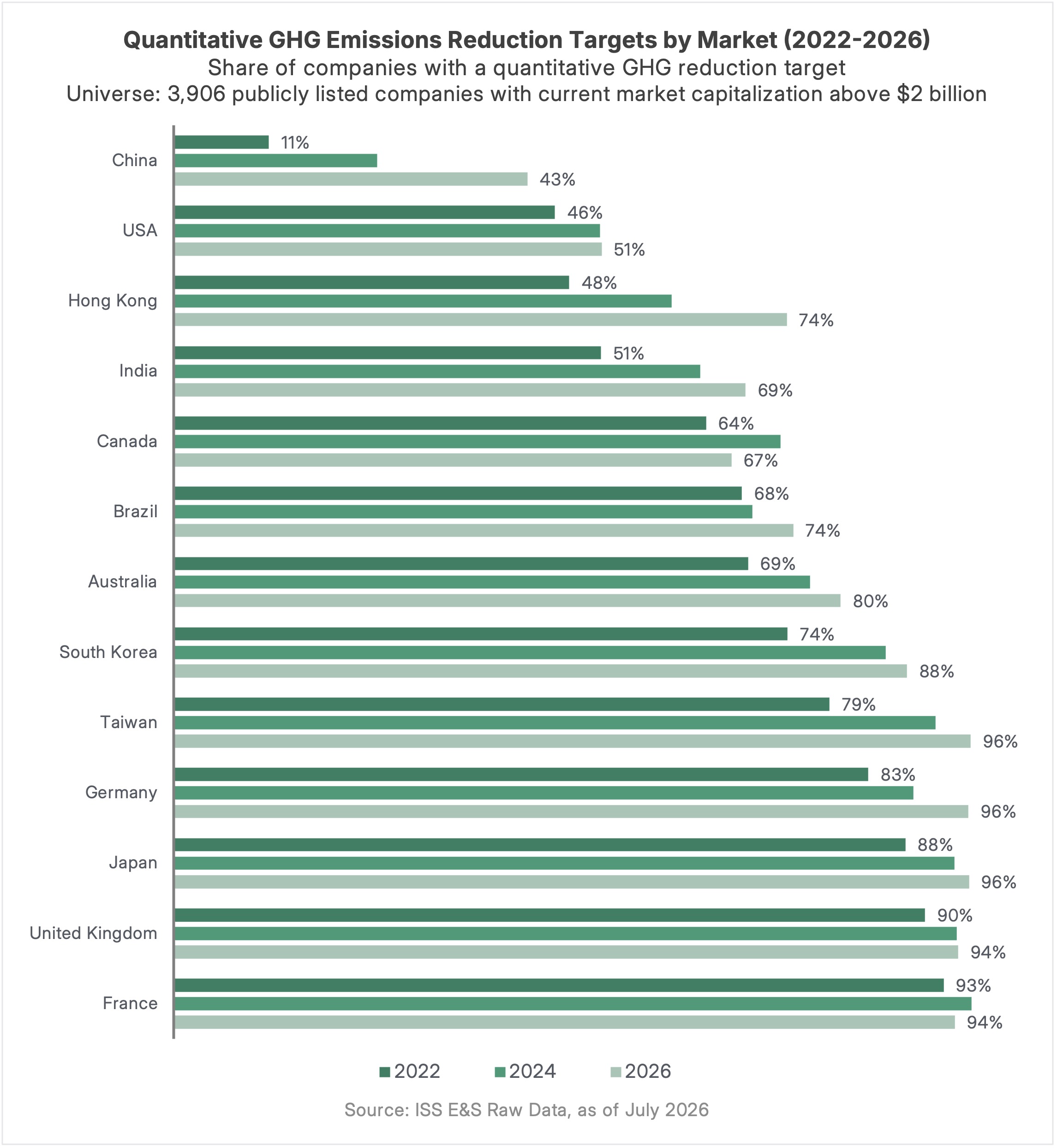
ISS-Corporate reviewed data on the adoption of quantitative GHG emissions reduction targets among publicly traded companies with a current market capitalization above $2 billion across select global markets between 2022 and 2026. Quantitative targets remain a common feature of corporate sustainability strategies in many major markets, with adoption rates generally increasing over the period under review. The data suggest that target-setting has become an established practice among larger companies in several European and Asia-Pacific markets, where adoption rates now approach or exceed 90% of companies under coverage. At the same time, adoption trends vary significantly across countries, highlighting differences in regulatory developments, national climate initiatives, market expectations, and the pace at which companies formalize long-term emissions reduction strategies.
Adoption Rates Are Highest in Several European and Asia-Pacific Markets
While several European markets appear to be approaching a mature stage of adoption, some of the strongest growth during the past five years has taken place in Asia. China, for example, increased from 11% of companies with quantitative GHG reduction targets in 2022 to 43% in 2026, while Hong Kong advanced from 48% to 74% and India from 51% to 69% over the same period. Taiwan and South Korea also recorded notable gains, reaching 96% and 88%, respectively, by 2026.
In contrast, adoption rates in several mature markets remained at consistently elevated levels throughout the period under review. France, Germany, Japan, and the United Kingdom all reported adoption rates approaching or exceeding 90% by 2026, suggesting that quantitative GHG reduction targets have become a well-established component of corporate sustainability strategies among larger publicly traded companies. In these markets, year-over-year changes were generally modest, reflecting a landscape where target-setting has become commonplace rather than an emerging practice. As a result, the conversation is increasingly shifting from whether companies have established emissions reduction targets to the scope, ambition, implementation, and progress associated with those commitments.
Target Adoption Has Stabilized in the United States
The United States exhibited a more moderate trajectory, with adoption increasing from 46% of companies in 2022 to 51% in 2026. While this represents an overall increase during the period under review, progress appears to have slowed in recent years, with adoption rates largely stabilizing after 2024.
At the same time, it is important to recognize that the U.S. market encompasses companies across a broad range of industries and sizes. Among larger companies, quantitative GHG reduction targets remain considerably more common. For example, 71% of U.S. companies with a market capitalization above $10 billion reported a quantitative target in 2026, while adoption among S&P 500 constituents stood at 86%. These figures suggest that while target adoption has become more firmly established among large-cap U.S. companies, growth among smaller companies has been more limited, contributing to a flatter overall trend in the broader market.
Are Companies Moving Away from GHG Reduction Targets?
The findings suggest that quantitative GHG reduction targets remain firmly embedded in corporate planning across many major markets, even as approaches to target-setting continue to evolve. Adoption rates remain high in markets with established sustainability practices and continue to increase in several regions where sustainability efforts are accelerating.
Importantly, the discussion should not be reduced to whether companies have a target. In some cases, organizations may be reassessing existing commitments, refining assumptions, adjusting timelines, or recalibrating targets to better reflect operational realities and evolving business conditions. Such developments may alter the nature of individual commitments, but the data reviewed here do not indicate a broad move away from quantitative GHG reduction targets among larger public companies.
Companies Are Refining Targets Rather Than Abandoning Them
As sustainability programs continue to mature, attention is increasingly shifting from target adoption to target effectiveness. For companies, establishing objectives that are both ambitious and achievable remains critical, particularly as emissions reduction efforts become more closely linked to operational performance, energy management, capital allocation, and long-term business strategy. Benchmarking against peers and industry leaders can provide valuable context, helping organizations assess prevailing practices, identify opportunities for improvement, and understand how targets are evolving across their sector. Increasingly, the question is not simply whether a company has a target, but whether that target is positioned to support long-term business objectives and deliver meaningful results.