
Environmental Supply Chain Management: Trends and Best Practices

Managing environmental impacts increasingly requires supplier engagement, as upstream risks and Scope 3 emissions affect resilience, reputation, and performance outcomes.
Environmental management increasingly extends well beyond a company’s own operations. For many organizations, the most significant environmental impacts and exposures sit upstream in the supply chain, where resource use, emissions, waste, water stress, and biodiversity impacts are concentrated across multiple tiers of suppliers. These impacts can translate into tangible business risks, including reputational damage, operational disruptions, regulatory scrutiny, cost volatility, and challenges to business continuity. Supply chain incidents linked to environmental issues can also affect access to customer relationships, reinforcing the financial relevance of effective environmental oversight.
At the same time, more companies are setting environmental objectives and greenhouse gas emissions targets that cannot be achieved through direct operations alone. Scope 3 emissions, which often represent the majority of a company’s footprint, require engagement with suppliers on emissions measurement, reduction pathways, and data quality. As a result, environmental supply chain management is becoming more structured and multifaceted. Common elements include supplier mapping and risk screening, environmental policies and codes of conduct, defined expectations embedded in contracts, ongoing risk assessments and audits, and mitigation or corrective action plans.
Explore how ISS‑Corporate supports companies in strengthening environmental supply chain oversight »
Many programs also incorporate supplier training, performance metrics, grievance or escalation mechanisms, and transparent monitoring processes. Together, these tools help companies better understand, manage, and influence environmental performance across their value chain.
Signals from Environmental Supply Chain Corporate Disclosures
ISS-Corporate reviewed environmental supply chain disclosures among 6,074 publicly traded companies with a market capitalization above USD 1 billion, assessing the extent to which companies describe environmental expectations and oversight mechanisms for their suppliers. The review focused on four elements commonly associated with environmental supply chain management: the existence of a supplier environmental policy, the use of supplier environmental risk assessments, the application of supplier environmental audits, and the articulation of expectations for suppliers to reduce greenhouse gas emissions.
Regional Trends in Supply Chain Environmental Disclosures and Practices
At a regional level, the data highlights notable differences in both the maturity and depth of disclosure. Companies in EMEA demonstrate the highest overall levels of disclosure across all four elements, with 77% referencing a supplier environmental policy and nearly half disclosing the use of audits. Asia Pacific companies show comparatively stronger disclosure on supplier risk assessments and audits than peers in the Americas, while expectations around supplier-facing GHG emissions reductions remain less common across all regions. In the Americas, disclosure tends to drop off more sharply once moving beyond high-level policies, particularly for audits and emissions reduction expectations.
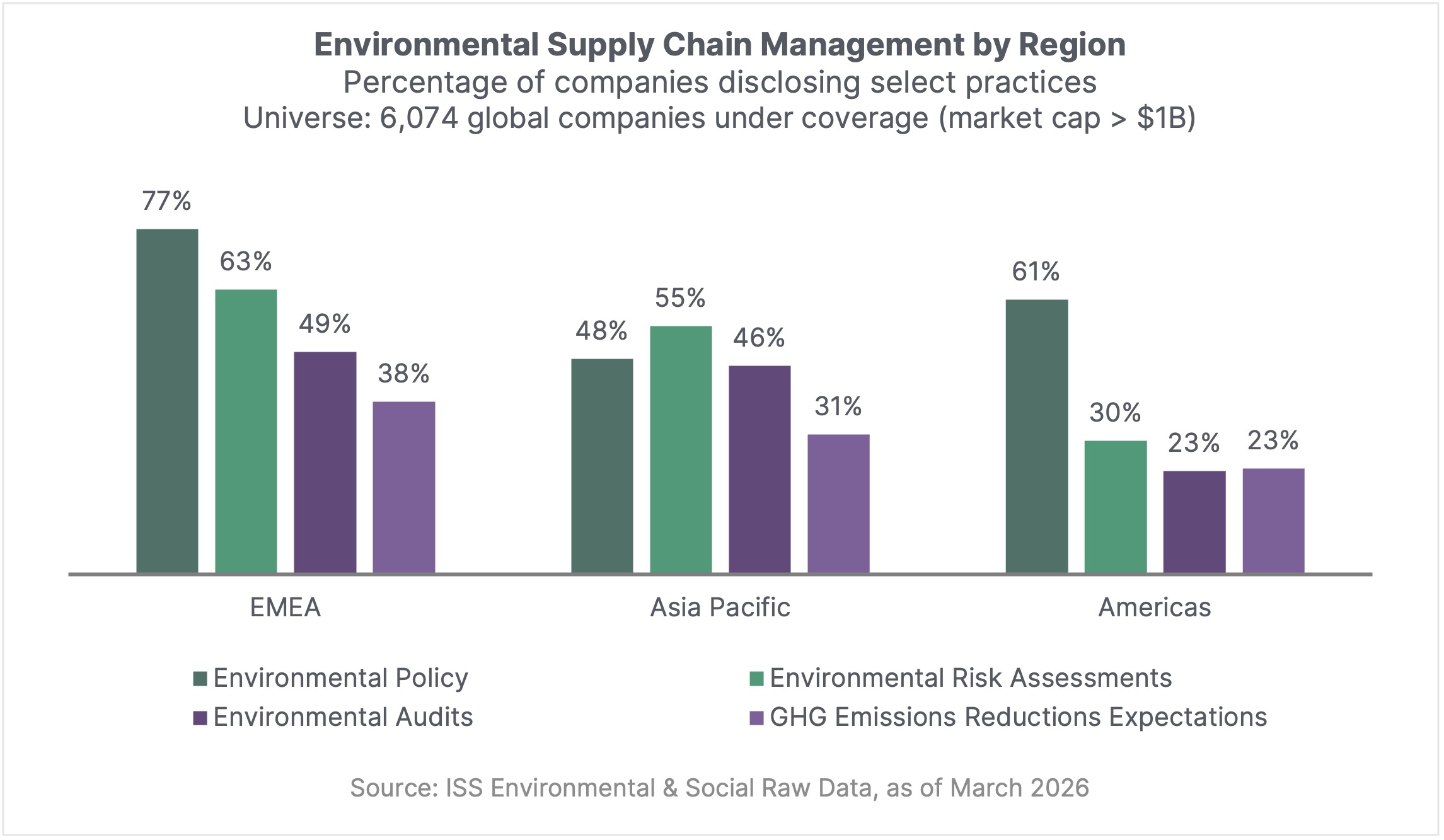
Country-level patterns further underscore these regional dynamics. Several European and Asia Pacific markets – such as France, Germany, the Netherlands, Taiwan, Thailand, and South Korea – exhibit comparatively strong uptake of supplier risk assessments and audits. In contrast, disclosure among companies headquartered in the United States, Canada, Japan, and Australia is more uneven, particularly with respect to audits and supplier GHG emissions expectations. Across nearly all countries reviewed, expectations for suppliers to reduce emissions lag other forms of environmental supply chain oversight, suggesting that climate-related engagement remains an emerging, rather than a well-established, practice.
Environmental Supply Chain Disclosure Practices by Sector
Sectoral analysis reveals that disclosure levels are often highest in industries with complex, global, and environmentally intensive supply chains. Utilities, consumer-facing sectors, industrials, materials, and information technology companies are more likely to describe formal supplier policies and monitoring mechanisms. Information technology stands out for having the highest disclosure of supplier GHG emissions reduction expectations at the sector level, reflecting growing attention to Scope 3 emissions in electronics, and hardware supply chains. By contrast, financials and real estate display lower levels of disclosure across most categories, consistent with shorter or less resource-intensive supply chains and a greater reliance on indirect exposure.
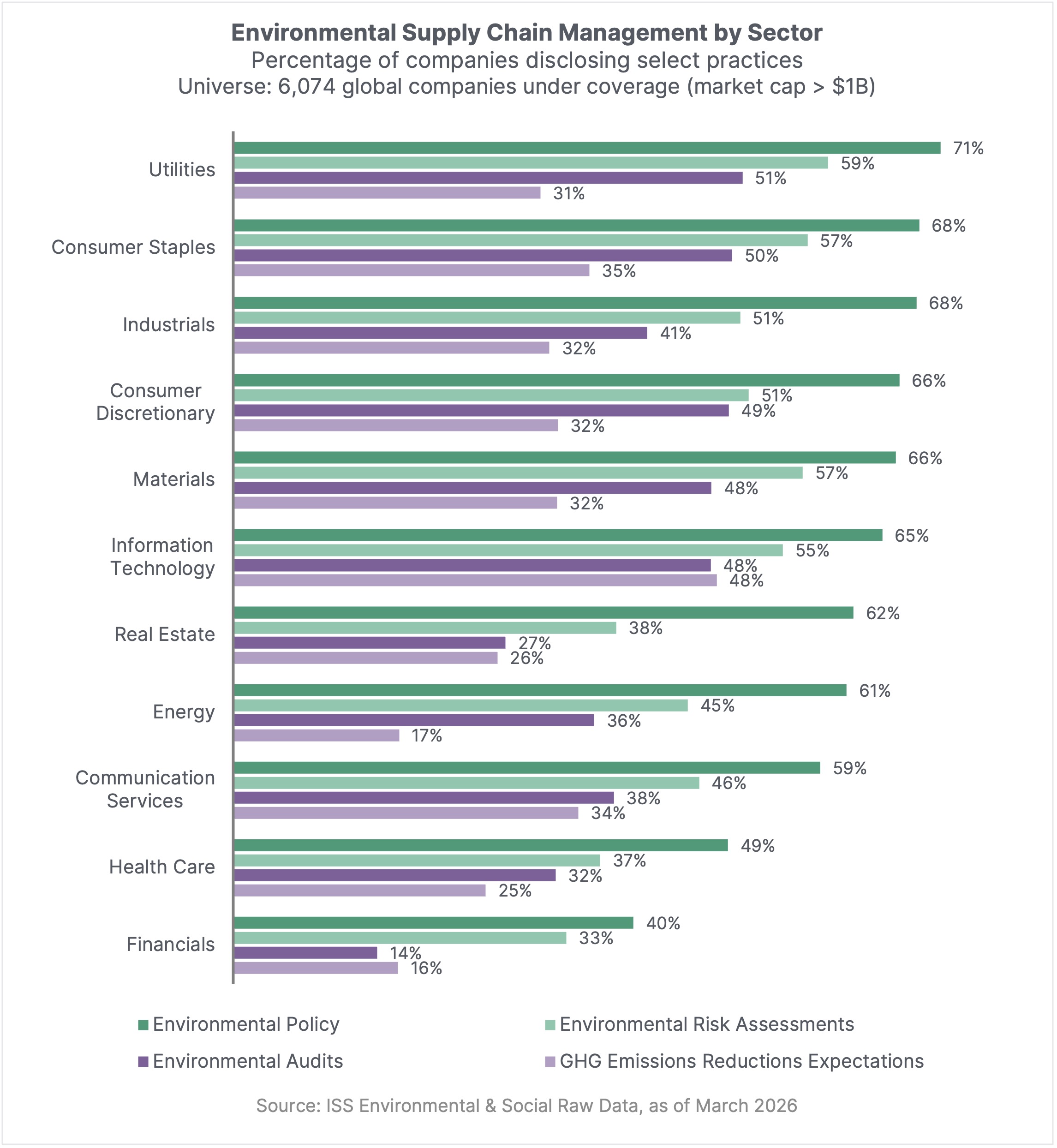
A more granular industry lens shows especially high levels of supplier engagement in sectors such as automobiles, semiconductors, technology hardware, personal care products, textiles, and communications equipment. These industries are typically characterized by complex, multi-tier supply chains, significant upstream environmental footprints, and a high degree of operational reliance on supplier performance, which coincides with more detailed disclosure of supplier oversight mechanisms.
Building Effective Environmental Supply Chain Governance
As companies seek to strengthen environmental management across their value chains, emerging disclosure and governance practices point to several common features of more mature approaches. While implementation will vary by sector and supplier profile, the following practices are increasingly referenced in leading environmental supply chain programs:
Enhanced supply chain visibility
Leading companies go beyond first tier supplier identification, using mapping exercises to understand upstream supply chain structures and environmental risk exposure across multiple tiers.
Clear supplier expectations and monitoring
Environmental policies, codes of conduct, and defined expectations – often reinforced through contractual terms – are complemented by supplier risk assessments and, where relevant, environmental audits.
Use of metrics and follow up mechanisms
More mature programs track audit outcomes, noncompliance rates, and corrective actions, helping translate oversight activities into measurable insights and remediation processes.
Accessible reporting and grievance channels
Companies increasingly reference mechanisms that allow suppliers and supply chain workers to report environmental concerns confidentially or anonymously, including the use of third-party platforms and local language access where appropriate.
Capacity building within and beyond the organization
Training for suppliers and procurement teams on environmental expectations and risk management supports consistent implementation and helps embed supply chain considerations into day-to-day decision making.
How ISS‑Corporate Supports Environmental Supply Chain Oversight
As environmental risks and emissions pressures increasingly concentrate in the supply chain, companies are being challenged to move beyond high‑level policies toward more consistent, data‑driven oversight. ISS‑Corporate supports organizations in assessing supplier exposure, strengthening governance frameworks, and aligning environmental supply chain practices with evolving regulatory, investor, and stakeholder expectations. Through independent analysis and tailored advisory support, companies can better understand where gaps exist and how to prioritize practical, scalable improvements across their value chains.
Learn more about ISS‑Corporate’s sustainability advisory services »