
Anti-Corruption Programs: A Key Safeguard for Business Continuity

The Importance of Anti-Corruption and Anti-Bribery Programs
Issuers have been implementing anti-bribery and anti-corruption policies for many years. Corruption can distort markets and expose companies to significant risks, making robust policies and practices essential for an organization’s license to operate.
Companies with robust policies and implementation practices protect themselves against legal and regulatory risks, including severe penalties for violations, such as criminal chargers, hefty fines, and restrictions on business operations. Anti-corruption and anti-bribery programs also help companies boost investor confidence and build a strong reputation among customers and employees. A commitment to integrity can differentiate a company from competitors, especially where ethical concerns may be a priority for key stakeholders, while also improving corporate culture and employee morale. Furthermore, these programs protect against potential operational risks, such as inflated costs, unreliable supply chains, and inefficient resource allocation.
Corporate Disclosures on Anti-Corruption and Anti-Bribery Policies and Practices
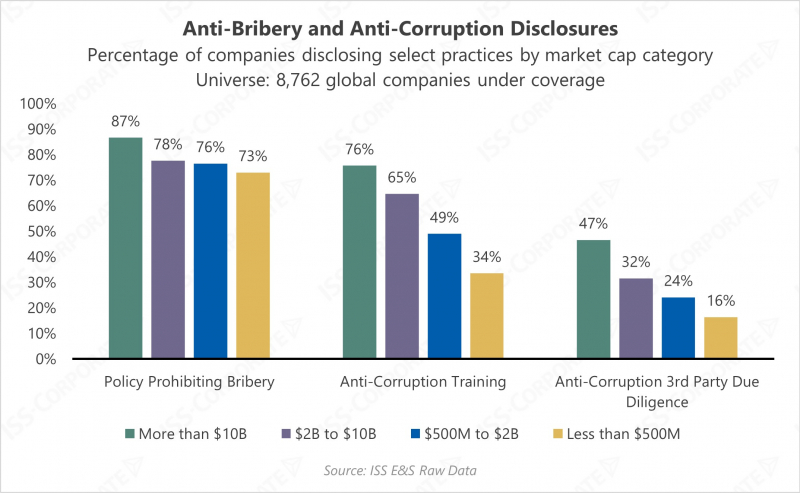
ISS-Corporate analyzed corporate disclosures on anti-corruption and anti-bribery programs to identify key trends in company practices. Anti-bribery policies and commitments are widely adopted across companies of all sizes, including smaller firms, with approximately 78% of all companies publicly disclosing such policies.
However, disclosures become more variable when detailing specific program elements. For instance, the availability of mandatory anti-corruption training for employees ranges from approximately 34% among micro-cap companies (market capitalization under $500 million) to 76% among large-cap companies (market capitalization over $10 billion).
Transparency declines further regarding anti-corruption due diligence for third parties and risk assessments. Fewer than 50% of large-cap companies disclose such practices, with disclosure rates dropping even further among smaller organizations.
As corruption risks intensify amid geopolitical volatility, companies must continually strengthen their anti-corruption practices to safeguard their reputation and maintain business resilience.