
5 Leadership Lessons from Hong Kong and New York Climate Events

The question is increasingly shifting from ‘What is your climate strategy?’ to ‘Show us how you will deliver it.’ Stakeholders are looking beyond commitments and disclosures to governance, investment decisions, accountability, resilience and measurable progress.
Recent discussions at ReThink Hong Kong event and ISS-Corporate’s Climate Week NYC roundtable revealed a shared challenge facing organizations across markets: moving from climate commitments and disclosure towards implementation and better business decisions.
Climate-related reporting frameworks, including the ISSB’s IFRS S2 and the EU CSRD’s ESRS E1, are encouraging companies to explain not only their climate ambitions, but also how those ambitions are governed, financed and implemented. The discussions in New York and Hong Kong reinforced that climate is increasingly becoming a business issue, closely linked to priorities that boards and executives already consider, including operational resilience, supply-chain exposure, energy availability and cost, capital allocation, financing, and long-term growth.
Over the past five years, disclosure of climate risk integration, strategic and financial impacts, and scenario analysis has increased steadily, reaching 58%, 82%, and 42% of covered companies globally, respectively.
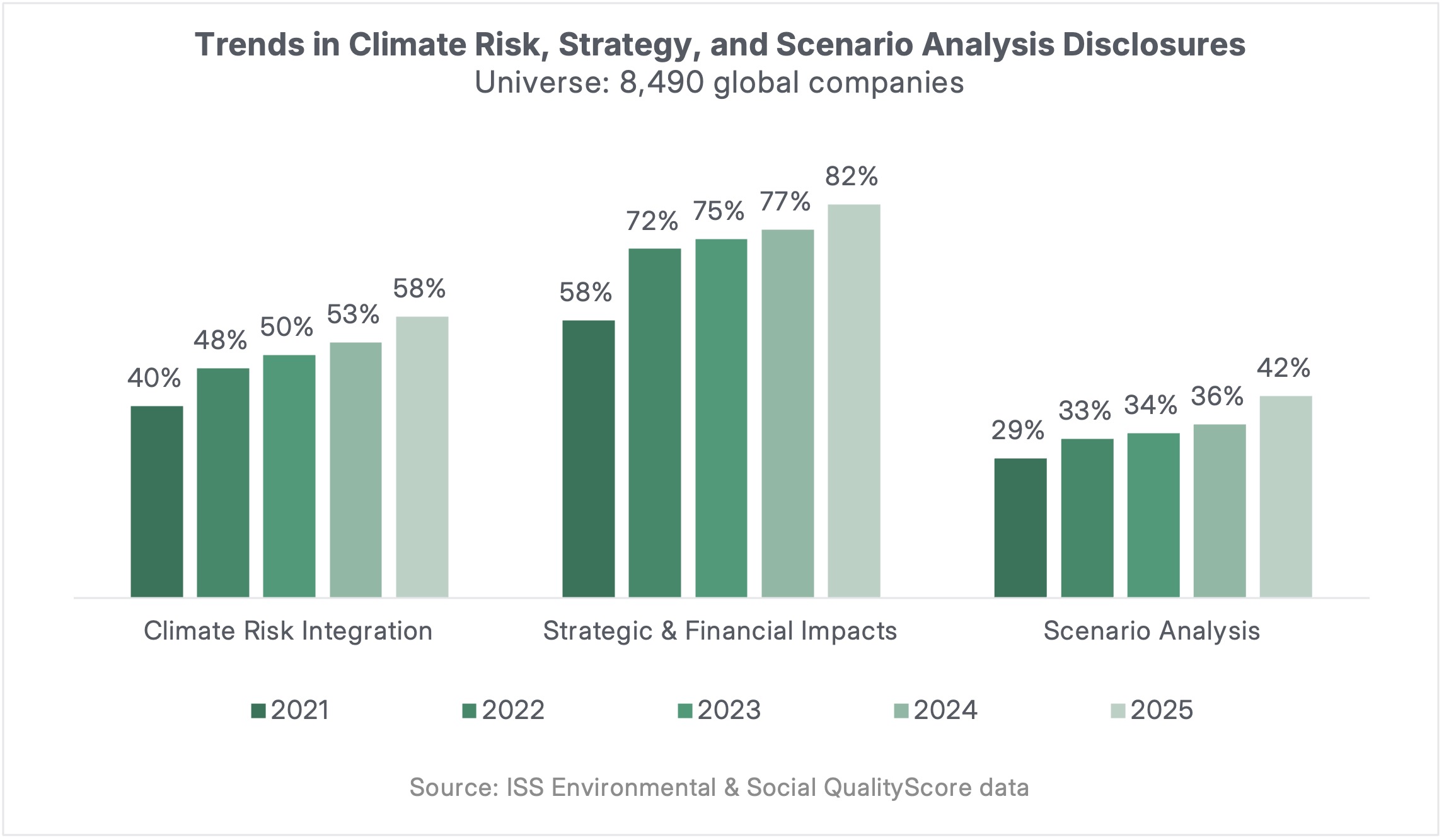
At the same time, increasing scrutiny of sustainability-related claims through developments such as the EU’s Empowering Consumers for the Green Transition (EmpCo) Directive, coupled with continued investor engagement on financially material climate issues, are reinforcing the need for credible implementation.
The result is a broader shift in stakeholder expectations. The question is increasingly moving from “What is your climate strategy?” to “How will you deliver it?”
Five Climate Leadership Themes Emerging Across Global Markets
Five themes stood out.
1. Climate is becoming a business resilience issue
Participants in both markets noted that climate-related risks are becoming increasingly visible across operations and value chains. Topics such as extreme weather events, heat stress and supply-chain disruption continue to rank highly in materiality assessments and risk discussions.
As a result, climate is increasingly being viewed not only as a reporting or compliance topic, but as a business resilience issue with implications for operational continuity, costs, workforce productivity, competitiveness and long-term value creation.
2. The conversation is moving beyond disclosure
Most organizations are now familiar with emissions reporting, targets and governance disclosures. What stakeholders increasingly want to understand is how climate influences business decisions.
Climate-related reporting frameworks, including the IFRS S2 and the ESRS E1, are ultimately not just about disclosure. They seek to provide insight into how organizations govern climate-related risks and opportunities, manage trade-offs, and translate climate ambitions into strategy and action.
The discussion is increasingly shifting from “What do you disclose?” to “How does climate influence strategy, decision-making and business planning?”
3. Governance structures must create ownership and accountability
A recurring theme was that governance remains one of the biggest barriers to implementation. Many organizations have climate commitments and transition plans, but translating these ambitions into decisions often requires stronger management engagement, clearer accountability and greater board involvement. Participants discussed the importance of moving beyond oversight alone and ensuring climate considerations are embedded within governance structures, decision-making processes and strategic planning.
Climate leadership requires boards and executives to understand how climate-related risks and opportunities affect strategy, capital allocation, and long-term value. It also requires clarity on who is accountable when targets or implementation milestones are missed.
Investor engagement continues to reinforce this focus. Discussions highlighted that investors remain actively engaged in financially material climate issues, particularly where they perceive gaps in governance, disclosure, strategy, or execution.
Climate governance is therefore becoming less about reporting to the board and more about ensuring climate considerations influence the decisions that shape business outcomes.
4. Transition plans must connect to capital allocation
One of the strongest themes across both events was the connection between transition plans and investment decisions.
Many organizations have established climate ambitions and long-term targets. The challenge is ensuring these ambitions are reflected in budgets, investments and resource allocation decisions. Participants noted that transition plans become far more credible when organizations can demonstrate how capital is being deployed to support stated objectives.
The New York discussion highlighted practical examples of this connection, including the use of internal carbon pricing in investment reviews and investments in solar, storage, microgrids, charging infrastructure and energy resilience. These examples illustrate how climate information can become part of conventional financial and operational decision-making.
A transition plan is ultimately a business plan. Its credibility increasingly depends on whether financial resources, investment decisions and implementation pathways align with the ambition being communicated externally.
5. Time horizons remain difficult to navigate
A recurring discussion point during the Hong Kong discussions was the tension between short-term business priorities and longer-term transition objectives. Climate-related risks and opportunities often emerge over decades, while corporate planning, budgeting and performance cycles typically operate over much shorter time horizons. This can make it challenging to prioritise investments whose benefits may only become visible over the longer term.
Participants in New York discussed how tools such as scenario analysis can help bridge this gap by testing whether strategies and response plans remain resilient under multiple plausible futures. Decision-useful metrics, interim milestones, and quantified decarbonization levers can also help companies translate long-term ambitions into near-term actions, ownership, and investment requirements.
Several participants in Hong Kong suggested that organizations making the greatest progress are increasingly treating climate as a strategic investment-horizon issue rather than solely a sustainability issue.
Climate Leadership Is Increasingly Measured by Implementation
The discussions in Hong Kong and New York reinforced that the challenge is no longer simply understanding climate risks, setting climate targets or preparing disclosures. Most large organizations have already taken those steps.
The next challenge is implementation: ensuring climate considerations are embedded within governance structures, capital allocation decisions and strategic planning processes. Increasingly, stakeholders want evidence that commitments are supported by investment, accountability and measurable action.
Climate leadership will look different across sectors, markets, and organizations. There is no single model. However, as climate expectations continue to evolve, credibility may depend less on the ambition of a target and more on an organization’s ability to demonstrate a realistic pathway for delivery.
See how ISS-Corporate helps embed climate considerations into governance and decision-making »