
Canadian Sustainability Disclosure Trends: Steady Foundations, Evolving Priorities

Canadian sustainability reporting is evolving selectively, with established practices holding broadly steady as progress concentrates in policies, due diligence and assurance.
Canadian sustainability disclosure appears to be entering a phase of selective maturity. Rather than expanding uniformly, established practices remain broadly stable, while the most notable improvements are concentrated in policy- and due diligence-related disclosures.
This trend is evident across the five areas reviewed. Core climate and human capital reporting remain relatively well established, although some workforce and forward-looking disclosures have softened. Human rights and supply-chain disclosures have expanded more notably, while environmental policies have advanced faster than operational metrics. Reporting practices show a similar divergence, with external assurance increasing even as references to several established frameworks have declined.
These trends are unfolding alongside an evolving Canadian policy landscape, including the introduction of the voluntary Canadian Sustainability Disclosure Standards, CSDS 1 and CSDS 2; reporting requirements under the Fighting Against Forced Labour and Child Labour in Supply Chains Act; Canada’s legislated net-zero emissions objective under the Canadian Net-Zero Emissions Accountability Act; amendments to the Competition Act affecting certain environmental claims; and Office of the Superintendent of Financial Institutions (OSFI)’s climate-risk expectations for federally regulated financial institutions under Guideline B-15. Against this backdrop, the strongest progress has been concentrated in policy- and due-diligence-related disclosures and external assurance.
Canadian Sustainability Disclosure Trends: Key Findings
ISS-Corporate reviewed corporate climate disclosures across Canadian large-cap companies with market capitalizations above $10 billion and mid- and small-cap companies below $10 billion from 2024 to 2026.
Climate: Core Reporting Remains Stable as Some Forward-Looking Practices Soften
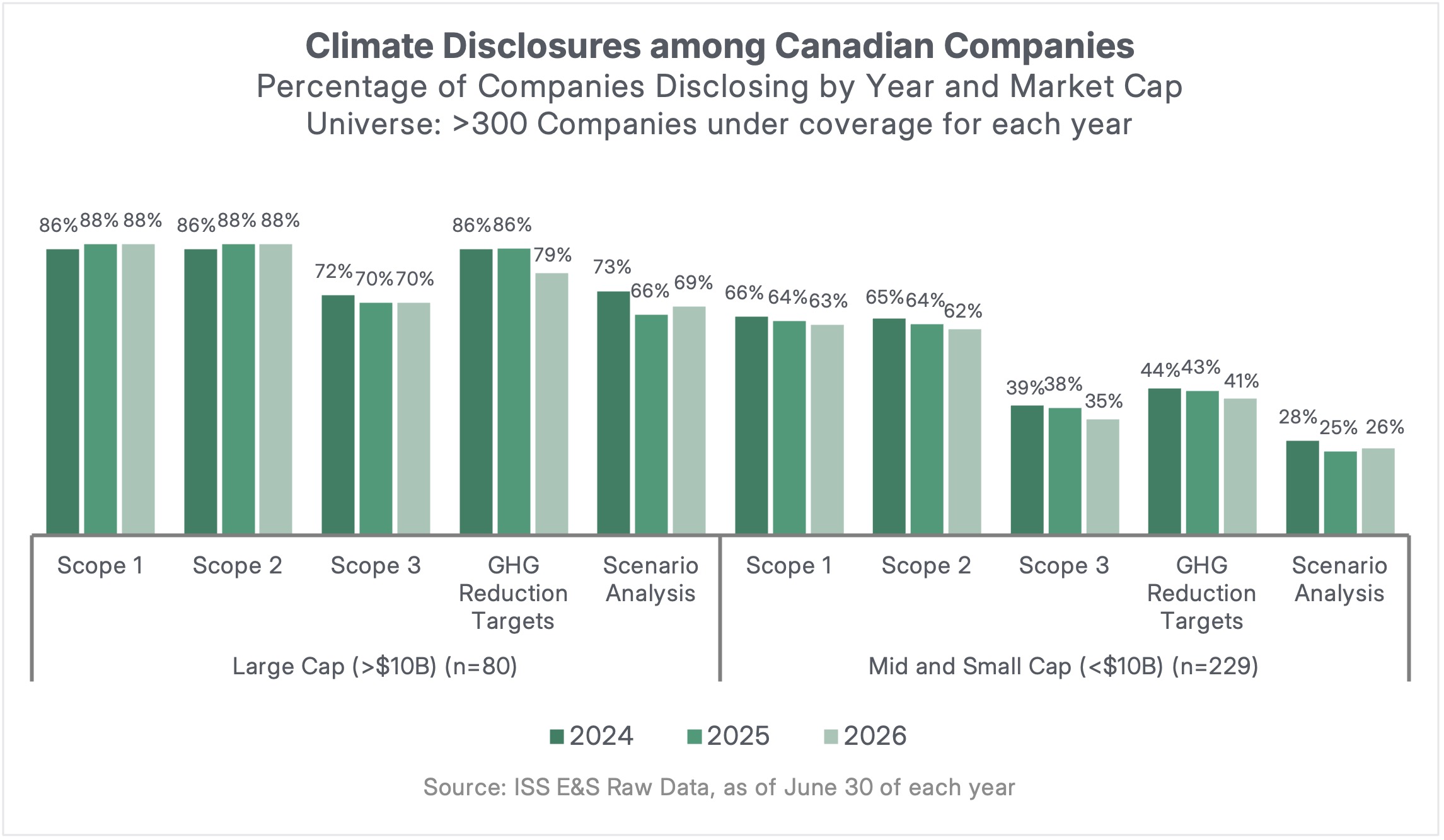
Core climate disclosures remained relatively steady, while some forward-looking practices, including target setting and scenario analysis, softened over the period.
Among large-cap companies, Scope 1 and Scope 2 disclosures increased slightly from 86% in 2024 to 88% in 2026, while Scope 3 declined from 72% to 70%. GHG reduction targets declined from 86% to 79%, while scenario analysis fell from 73% to 69% over the same period.
The relative stability of emissions reporting suggests that these disclosures have become an established part of reporting practice for many larger Canadian issuers. By comparison, target setting and scenario analysis can involve greater reliance on forward-looking assumptions, methodologies, and supporting analysis. This divergence is occurring against an evolving Canadian disclosure landscape and increased scrutiny of environmental claims.
Among mid- and small-cap companies, disclosure softened across Scope 1, Scope 2, Scope 3, and GHG reduction targets between 2024 and 2026, while scenario analysis remained mostly stable and considerably less prevalent than among large-cap companies. The pattern is consistent with the greater data, methodological, and analytical demands associated with more developed climate reporting, particularly for companies with fewer reporting resources.
Taken together, the data indicates that emissions reporting remains comparatively well established, particularly among larger issuers, even as some forward-looking climate disclosures have become less prevalent. The distinction is notable as Canada’s climate-disclosure landscape continues to evolve.
Environmental Management: Policies Expand Faster Than Operational Metrics
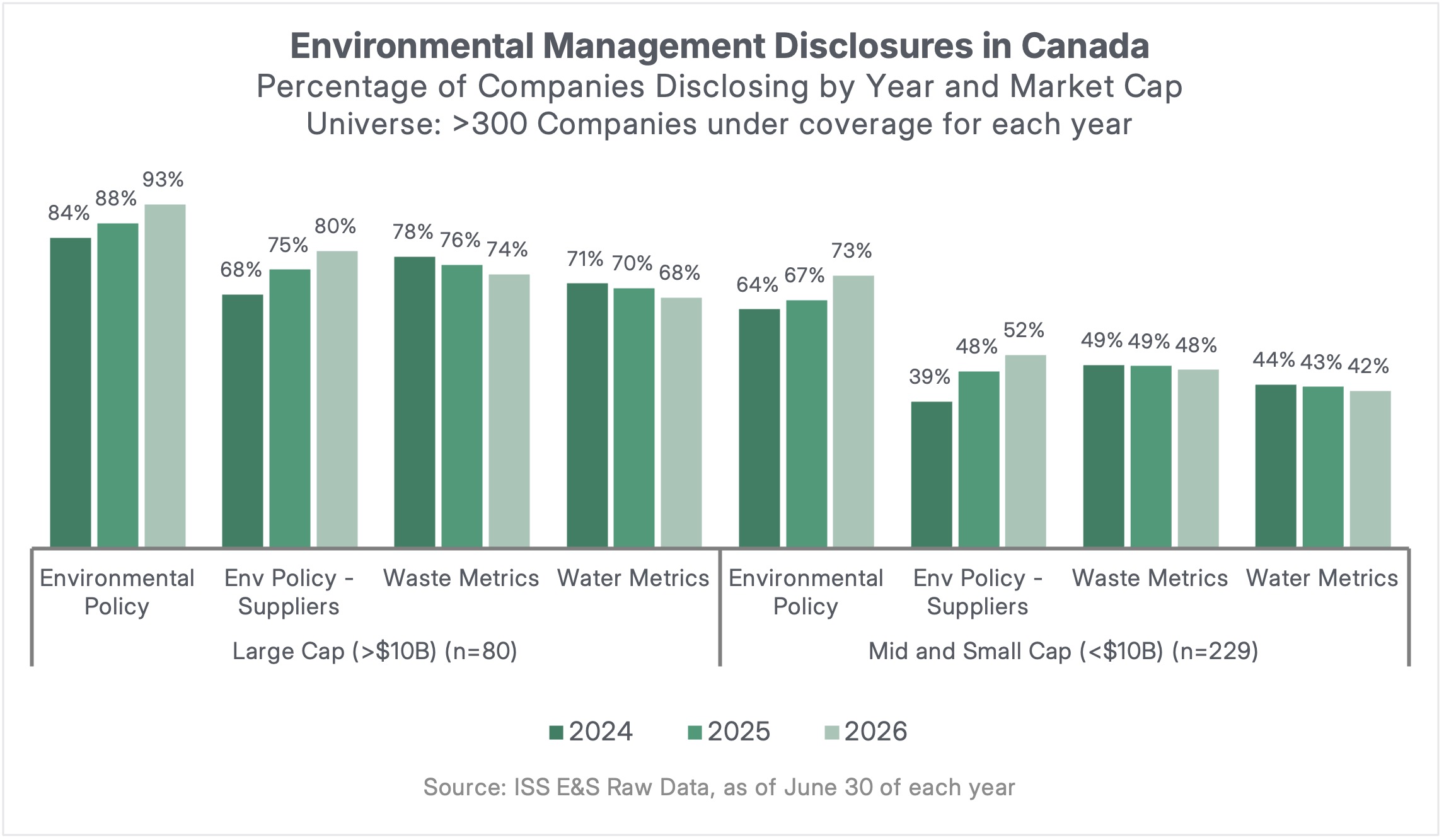
Environmental management shows a clear divergence between policy-related and operational disclosures. Across both company groups, environmental policy and supplier-focused environmental policy disclosure increased between 2024 and 2026, while waste and water metrics remained steady or declined.
Among large-cap companies, environmental policy disclosure rose from 84% to 93%, while supplier-focused environmental policy disclosure increased from 68% to 80%. Among mid- and small-cap companies, the same indicators increased from 64% to 73% and from 39% to 52%, respectively.
Waste and water disclosures moved in the opposite direction among large-cap companies and remained comparatively stable among mid- and small-cap companies.
The divergence may partly reflect the different demands associated with policy and operational disclosure. Companies can establish policies and extend expectations to suppliers at an organizational level, while consistent waste and water reporting can depend on more granular operational data, measurement and audit processes.
This pattern is also emerging against a Canadian policy backdrop that includes increased scrutiny of environmental claims and continued attention to environmental management issues.
Human Rights and Supply Chain: The Clearest Area of Expansion
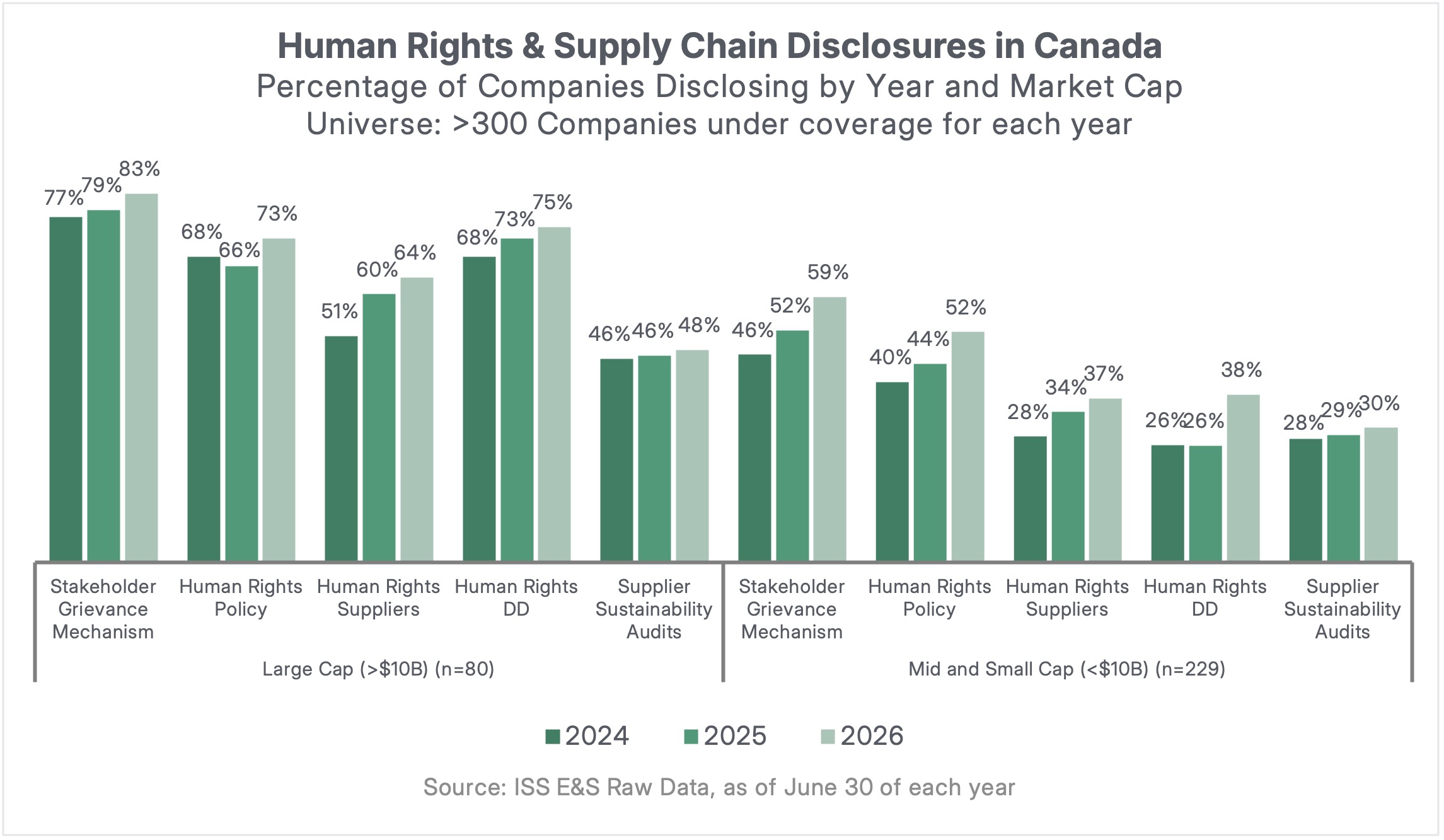
Human rights and supply chain disclosure data show the clearest area of expansion among Canadian issuers. Between 2024 and 2026, disclosure increased across all five indicators for both company groups, although individual indicators moved at different rates. The topics reviewed included grievance mechanisms, human rights policies and supplier expectations, due diligence processes, and supplier sustainability audits.
Among large-cap companies, all five indicators were higher in 2026 than in 2024, though they did not necessarily increase every year. The largest gains were in supplier-focused human rights disclosure, which rose from 51% in 2024 to 64% in 2026, and human rights due diligence, which increased from 68% to 75%.
Among mid- and small-cap companies, the largest gains were in stakeholder grievance mechanisms, which increased from 46% to 59%; human rights policies, which rose from 40% to 52%; and human rights due diligence, which increased from 26% to 38%.
Taken together, the pattern is broadly consistent with increased attention to supply-chain transparency and due diligence under Canada’s modern-slavery reporting regime. The legislation requires covered entities to report on their policies and due diligence processes, forced- and child-labour risks and risk management steps, remediation measures, employee training, and how they assess effectiveness.
Human Capital: Broad Stability, with Some Workforce Indicators Softening
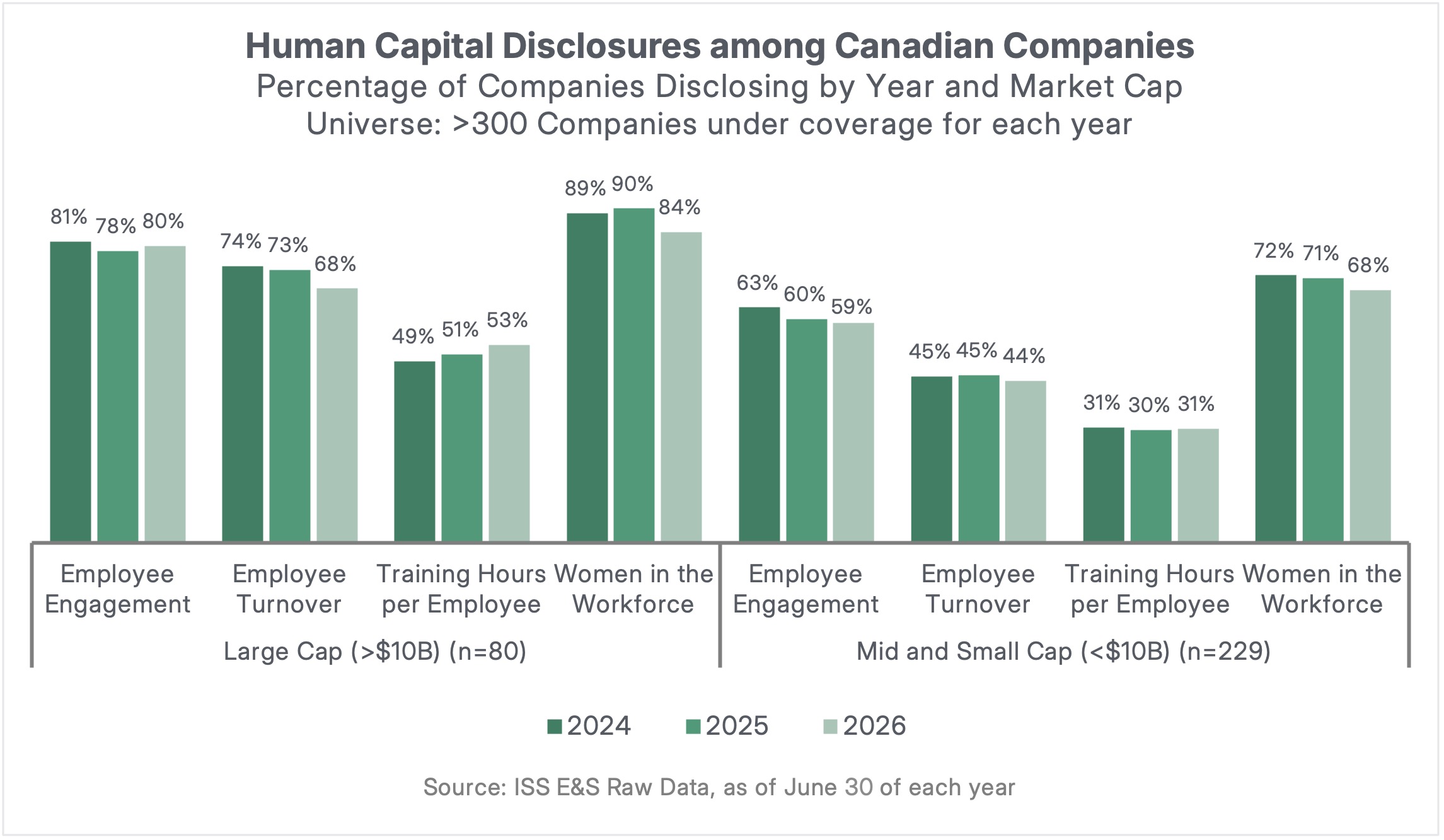
Human capital disclosure remained broadly stable between 2024 and 2026, particularly among larger companies, although several workforce indicators softened.
Among large-cap companies, employee engagement disclosure remained relatively stable, while training hours per employee increased from 49% to 53%. Disclosure of women in the workforce declined from 89% to 84%, while employee turnover disclosure fell from 74% to 68%.
Among mid- and small-cap companies, employee engagement disclosure and disclosure of women in the workforce each declined by approximately four percentage points, while turnover and training hours disclosure changed comparatively little.
Unlike the clearer directional movements in human rights and environmental policies, the human capital indicators do not show a uniform trajectory. The uneven movement may partly reflect differences in the maturity, consistency, and complexity of underlying workforce data and reporting processes. Rather than pointing to a broad retreat from human capital reporting, the data show a mixed trajectory across individual workforce indicators.
Reporting Practices: Framework References and Data Credibility
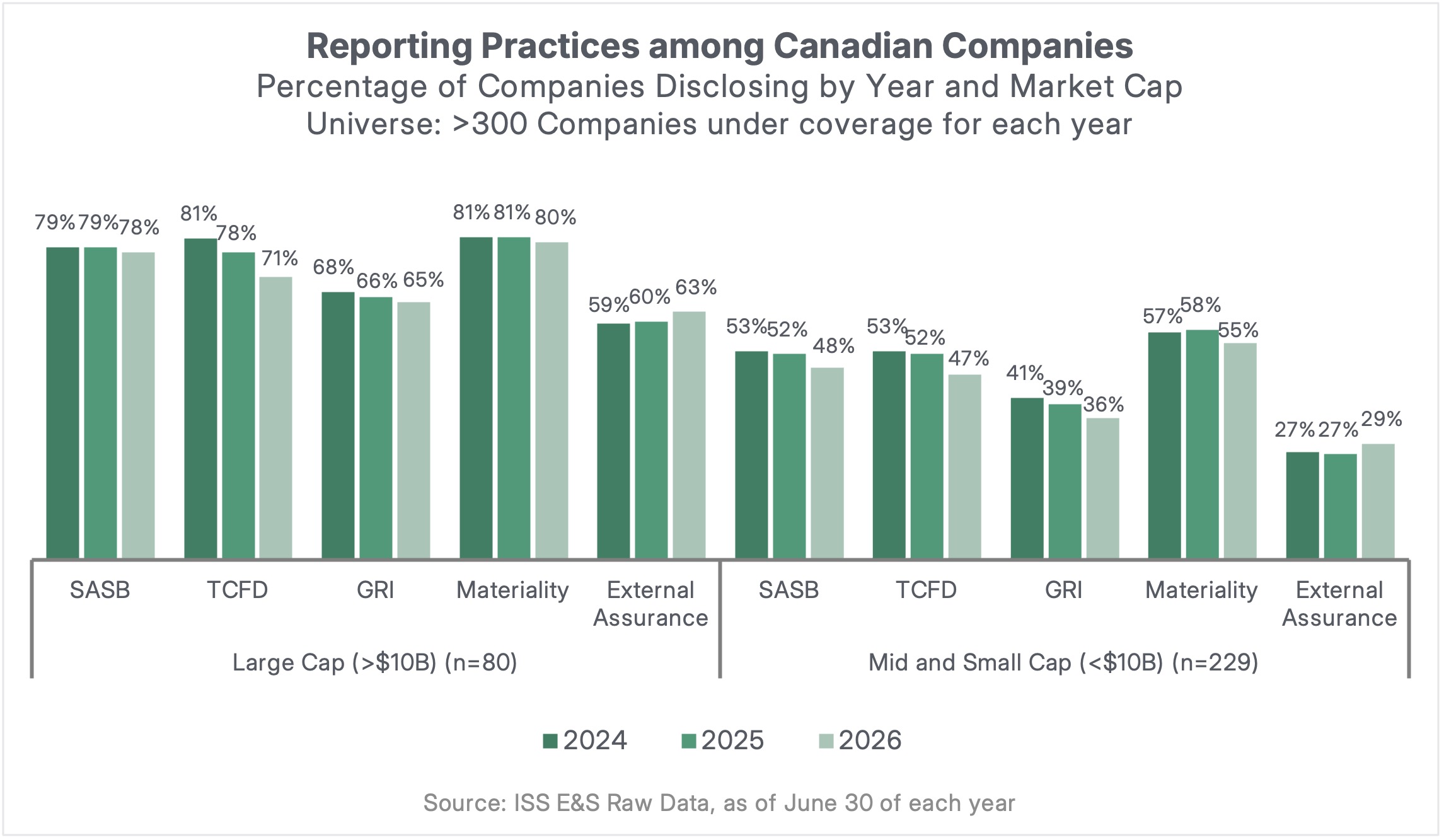
Reporting practices show another divergence. References to several established reporting frameworks declined between 2024 and 2026, while external assurance increased modestly.
The most pronounced decline was in TCFD references. Among large-cap companies, TCFD disclosure declined from 81% in 2024 to 71% in 2026. Among mid- and small-cap companies, references to TCFD, GRI, and SASB also declined over the same period.
The decline is occurring as the sustainability reporting landscape itself evolves, including the introduction of voluntary CSDS 1 and CSDS 2.
External assurance, by contrast, increased modestly among both company groups. The increase is consistent with continued attention to the credibility and supportability of reported information.
The two trends should not necessarily be interpreted as directly related. Together, however, they point to a reporting environment in which both the structure and validation of sustainability information are continuing to evolve.
What Canadian Sustainability Disclosure Trends Reveal About a Maturing Reporting Landscape
The five areas reviewed point to a phase of selective maturity in Canadian sustainability disclosure. Rather than broad expansion or retrenchment, the data show that disclosure is developing differently by topic and by the type of information reported.
Core climate disclosure remains relatively stable, particularly among large-cap issuers, while some forward-looking practices have softened. Human capital disclosure similarly shows broad stability alongside declines in selected workforce indicators.
Environmental policies and supplier expectations have expanded even as waste and water metrics have remained steady or declined. Human rights and supply chain disclosure stands out as the strongest area of growth, particularly across policies, grievance mechanisms, supplier expectations, and due diligence.
Reporting practices add another dimension to this picture. References to several established frameworks have declined, while external assurance has increased modestly among both company groups.
Taken together, the findings suggest that many established disclosure practices are being maintained, particularly among larger issuers, while the most notable expansion is concentrated in policies, supplier expectations, grievance mechanisms, and due diligence processes.
Disclosures oriented towards operational and implementation measures show a less consistent trajectory, potentially reflecting their reliance on more granular data, established audits, and processes that extend beyond policy development into operational execution.
The result is not more sustainability disclosure across the board, but a more selective evolution in what companies disclose and how that information is supported. As Canadian reporting continues to develop, progress may be reflected less in the addition of new topics than in the consistency, credibility, and supportability of the information companies provide.