
EU Deforestation Regulation July 2026 Update: Near-Term Priorities for Issuers

EU Commission July update shifts issuer focus to supply-chain evidence, role mapping and operating readiness.
For corporate issuers monitoring the EU Deforestation Regulation (EUDR), recent European Commission implementation measures updating product scope and filing requirements make preparation more operational. The focus is shifting from interpretation to evidence of product scope, supply-chain origin, transaction roles and filing readiness.
The legal test remains unchanged: relevant commodities and listed derived products may only enter, circulate in or leave the EU market if they are deforestation-free, legally produced, and covered by the required due diligence statement or simplified declaration. What has changed is the implementation detail: revised product scope, clarified exclusions and exemptions, and Information System filing rules.
Navigate evolving sustainability requirements with ISS-Corporate »
For companies exposed to covered commodities or derived products, EUDR readiness now links market access, procurement controls, traceability, trade compliance, nature-related risk and investor confidence. The practical task is to turn the July changes into evidence, governance and workflow priorities.
- Operational deadline: 30 December 2026 for large and medium-sized operators and relevant traders.
- Near-term priority: refreshing product scoping against the updated Annex I at product-code level.
What Changed in the July 2026 EUDR Update?
On 13 July 2026, the European Commission published two implementation measures for the EUDR. The Delegated Act updates Annex I, which lists the products covered by the Regulation. The Implementing Act sets technical rules for the EUDR Information System, where due diligence statements and simplified declarations will be submitted. Together, the measures do not change the seven covered commodity categories, but they clarify product scope, exclusions, filing processes, and differentiated timing for certain micro and small operators.
- Removed from Annex I: cattle hides, skins and leather; re-treaded tyres; soybeans for sowing; articles of vulcanised rubber; conveyor and transmission belts; and aircraft and motor vehicle seats.
- Added to Annex I: soluble coffee, certain palm oil-derived oleochemicals and frozen cattle tongues.
- Timing clarification: certain micro and small operators benefit from a deferred EUDR application date of 30 June 2027, while newly added products are expected to fall under the Regulation from 30 December 2027.
Why the EUDR Update Matters for Issuers
The impact for issuers is mixed. The July 2026 Delegated Act removes some product categories from Annex I while adding soluble coffee and certain palm oil-derived oleochemicals, changing exposure for affected businesses and supply chains. Commodity-level assumptions may be insufficient: EUDR applicability ultimately depends on the specific product classification codes listed in Annex I, making product mapping and supporting supply-chain documentation important for compliance and customer or stakeholder due diligence requests.
EUDR Due Diligence Requirements in Practice
EUDR due diligence is evidence-led, not mainly a narrative disclosure exercise. Companies may be expected to provide evidence for product origin, data reliability, legality, deforestation-free status, and how any non-negligible risk has been addressed. Risk is highest where supply chains are multi-tiered, mixed-origin, or lack plot-level visibility. The EUDR places primary responsibility on the first placer of a relevant product on the EU market. Downstream operators and traders may still face customer, data-retention and substantiated-concern expectations, including requests for reliable EUDR data before the relevant legal application date.
Key Evidence Requirements and Implementation Risks
| Where exposure may arise |
What companies need to evidence |
Where implementation risk concentrates |
|---|---|---|
|
|
|
EUDR is a product-market rule, but its consequences can flow into capital-market conversations. As ISS STOXX’s Natural Capital Research Institute has highlighted, deforestation is central to biodiversity loss, climate change and related physical, transition and systemic risks. For issuers with material exposure, weak traceability may raise investor and lender questions on supply-chain resilience, customer contracts, covenant headroom, refinancing and cost of capital.
Where exposure is material, companies may be expected to explain their product and geographic exposure, supplier evidence, gap management and governance. Broad claims such as “deforestation-free supply chain” carry risk unless supported by robust, auditable evidence.
Market Preparedness Remains Uneven
While EUDR readiness ultimately depends on company-specific product exposure and supply-chain characteristics, ISS STOXX Corporate Rating data suggests that many issuers in industries commonly associated with deforestation risk may still face implementation challenges. Across a sample of 353 publicly traded companies in relevant industries, average scores were generally low on indicators assessing the certification of commodities as deforestation- or conversion-free and measures designed to prevent deforestation.
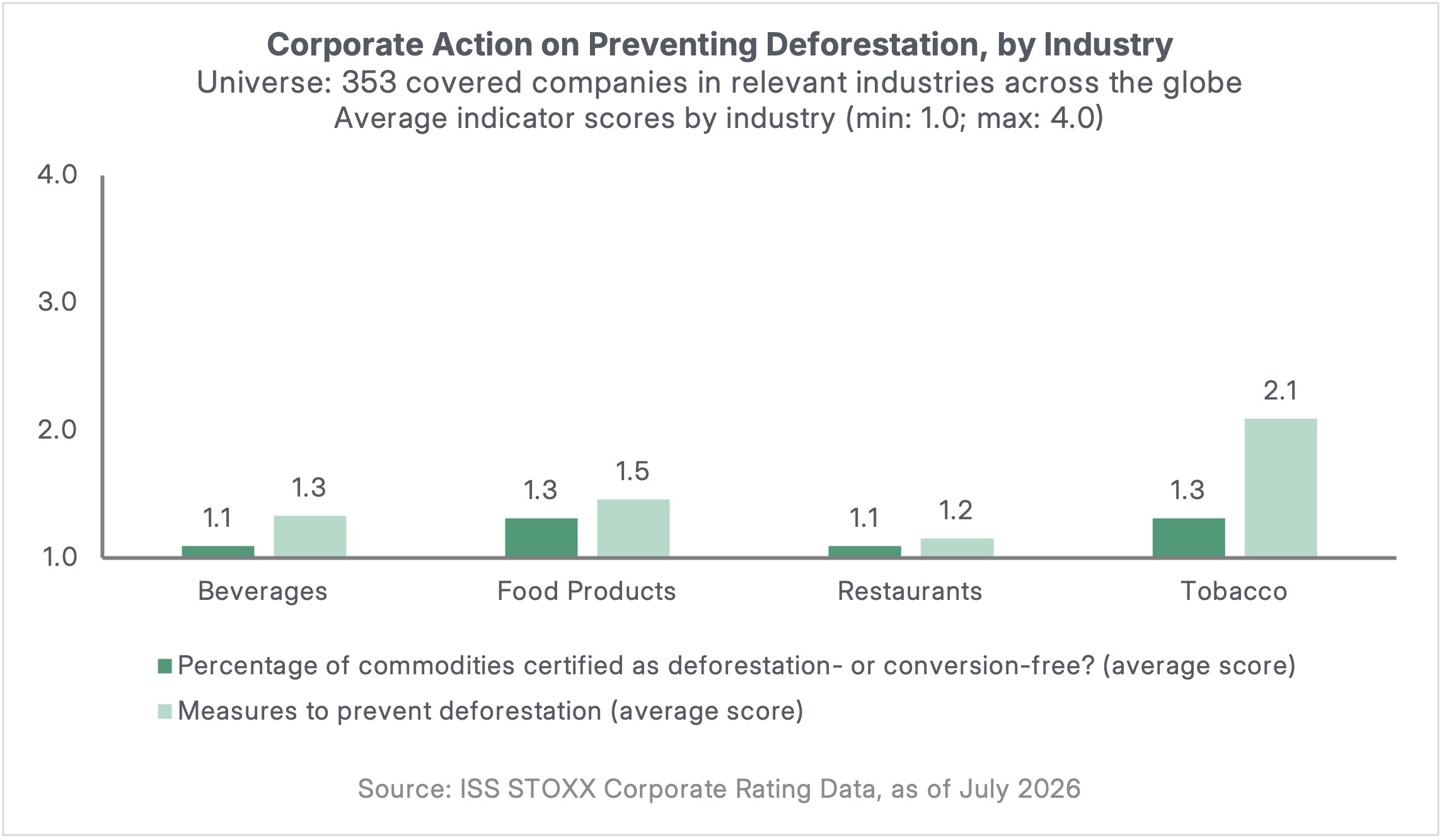
The “measures to prevent deforestation” indicator evaluates practices such as supply-chain risk assessments and audits, supplier training, forestation programmes, quantitative forestation targets, and the use of independent third-party certification and traceability systems. Average scores generally clustered between 1 and 2 on a four-point scale, where 1 indicates no credit and 4 indicates full credit, suggesting that many companies may not yet have the governance, monitoring or traceability practices that could support EUDR compliance expectations.
Five priorities before application
The July 2026 updates provide greater clarity on product scope and filing requirements, but they also reinforce the need for companies to translate regulatory obligations into operational processes. For issuers with material exposure, the following actions can help strengthen readiness ahead of the first compliance wave.
- Refresh product scoping: Map products, components, ingredients and packaging against the updated Annex I at product-code level and by legal entity. Identify removed, newly added and still in-scope products.
- Assign transaction roles: Determine where each entity acts as operator, downstream operator, trader or exporter, and test this against actual transaction flows, customs arrangements and contracts.
- Build an evidence model: Define the data needed to support deforestation-free status, legality and filings, including geolocation, country of production, supplier identifiers, traceability links, legality documentation and retention rules.
- Prioritise high-risk supply chains: Focus first on high-volume, high-margin, strategic or higher-risk sourcing routes, especially mixed-origin supply chains, indirect suppliers and categories where substitution or segregation would be difficult.
- Test operating readiness. Pilot supplier requests, data validation, escalation, Information System workflows, reference-number retention and customs handoffs, with clear ownership across key functions.
The companies best placed for the first compliance wave will be those that treat EUDR readiness as an evidence and operating-readiness exercise, not only a regulatory interpretation task. Clear product scoping, traceable sourcing data, defined responsibilities and tested filing workflows can help protect EU market access while strengthening investor and lender confidence in how companies manage nature-related supply-chain risk and substantiate sustainability-related claims.
Navigate evolving sustainability requirements with ISS-Corporate »