
California SB 54: EPR Packaging Rules & Deadlines
California’s SB 54 introduces a comprehensive EPR framework requiring producers to redesign packaging and meet recyclability, recycling, and reduction targets by 2032.
California has taken a significant step in reshaping packaging requirements. As of May 1, 2026, the Plastic Pollution Prevention and Packaging Producer Responsibility Act (SB 54) is now in effect, introducing a comprehensive extended producer responsibility framework that requires companies to rethink how packaging is designed, used, and managed.
The law establishes a statewide extended producer responsibility (EPR) system covering packaging and single-use plastic food service ware and is expected to apply to more than 5,700 producers. Its core objectives include reducing plastic pollution, increasing recycling rates, and advancing a more circular approach to packaging in California.
SB 54 Targets and Timeline
By 2032, producers must collectively ensure that:
- 100% of single-use packaging and single-use plastic food service ware sold in California is recyclable or compostable;
- 65% of single-use plastic packaging and single-use food service ware is recycled; and
- a 25% reduction, compared to 2023, in the sale or distribution of single-use plastic packaging and single-use food service ware.
To ensure steady progress toward these outcomes, interim recycling and source‑reduction targets apply ahead of 2032.
Governance and Program Structure
CalRecycle serves as the lead regulator, overseeing rulemaking, compliance, and enforcement. Circular Action Alliance (CAA) has been approved as California’s Producer Responsibility Organization (PRO) and is tasked with developing and executing the statewide EPR program on behalf of participating producers.
Producers registration requirements (by June 1, 2026)
All producers subject to SB 54 must register by June 1, 2026, through one of the following ways:
- Participate in CAA
Register with the Circular Action Alliance (CAA) and submit the required supply and packaging data - Operate as an Independent Producer
Registering directly with CalRecycle and obtain approval for an independent compliance plan, demonstrating the ability to meet recycling and source-reduction requirements - Qualify for Small Producer Exemption
Register with CalRecycle and apply for exemption if qualifying under the statutory small-producer thresholds (under $1 million in California sales)
The Global Expansion of EPR Regulations
California’s SB 54 is part of a broader global shift: across Europe, Canada, Asia‑Pacific, and beyond, governments are making producers financially and operationally responsible for their products across their lifecycle, including waste generated through packaging. An OECD analysis shows that EPR schemes have expanded significantly since 2020, with more than 600 systems in place across over 80 countries by 2025 – making EPR, particularly for packaging, one of the largest producer‑funded environmental policy mechanisms globally.
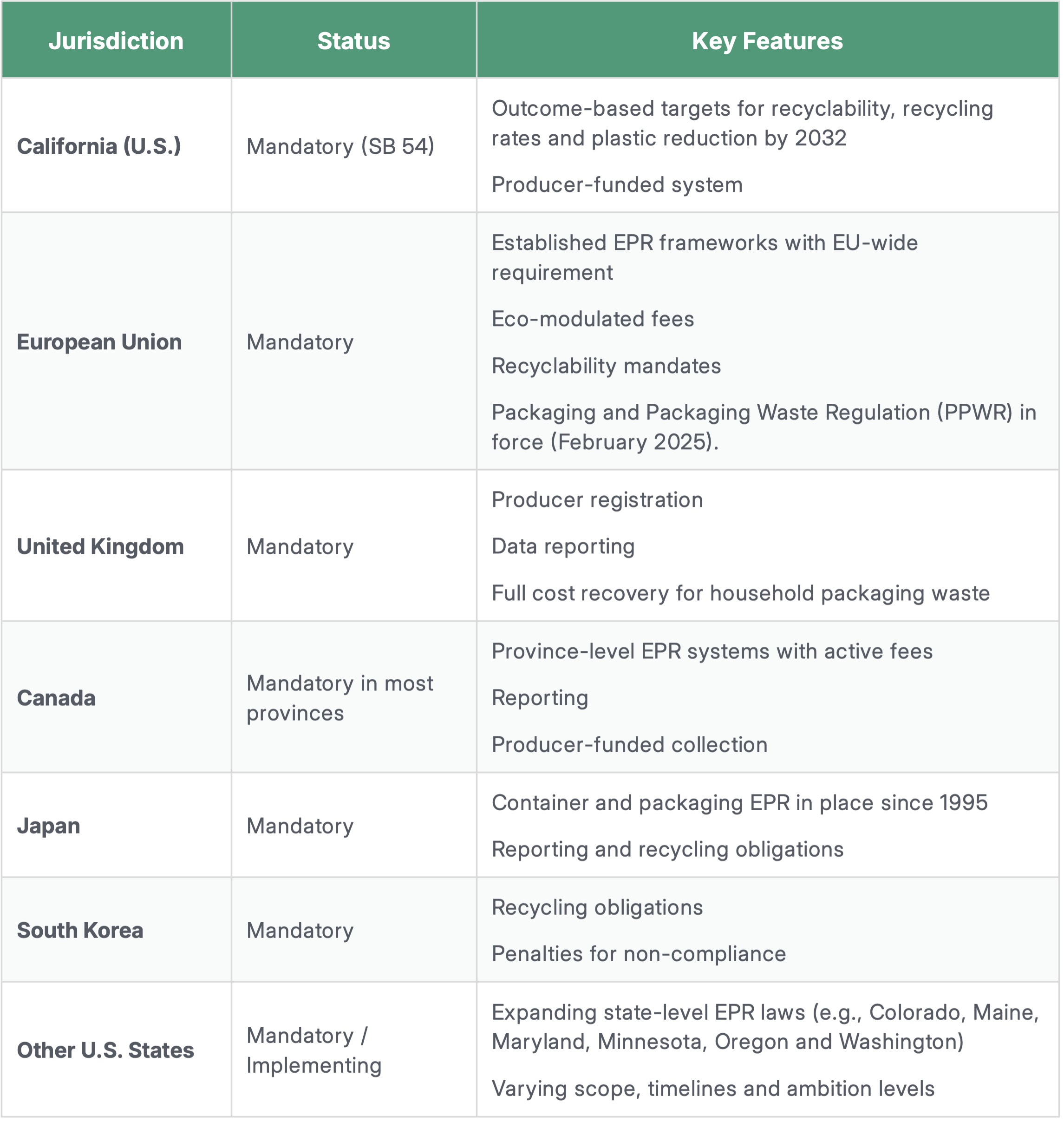
Common requirements across EPR frameworks include:
- Producer registration
- Material-level reporting
- Eco-modulated fees
- Design for recyclability
- Recycled content requirements
- Consumer guidance
These requirements also form the basis for how investors and customers may assess companies’ targets, progress, and governance mechanisms related to packaging and waste.
Packaging Disclosure Gaps and Data Challenges
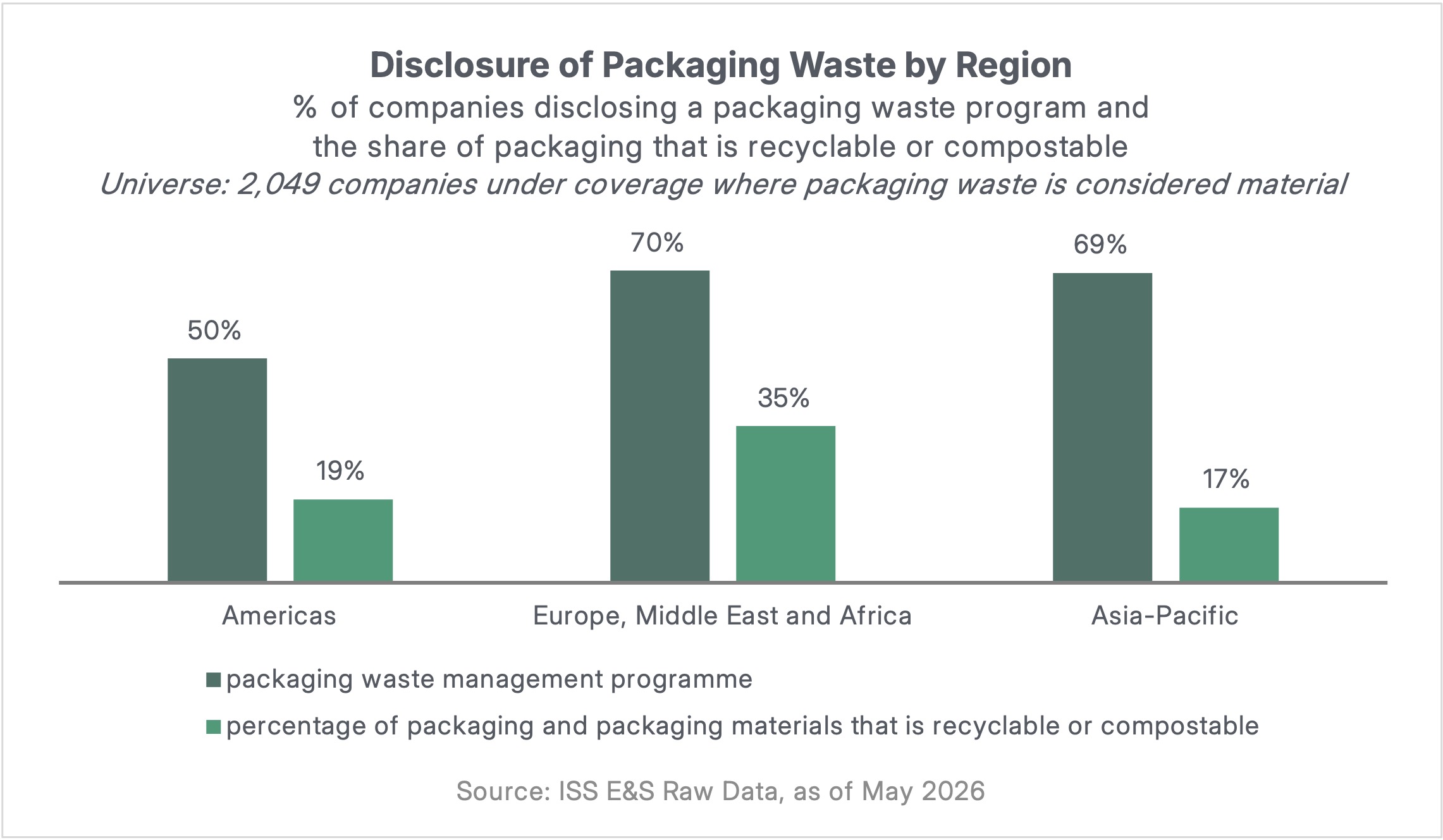
Disclosure patterns vary across regions, particularly between policy-level commitments and measurable outcomes. While 70% of companies in the EMEA region and 69% in Asia-Pacific report having a packaging waste program, only 35% and 17%, respectively, disclose the share of packaging that is recyclable or compostable. In the Americas, 50% of companies disclose a program, with 19% reporting this metric.
This gap reflects the additional complexity associated with measuring and reporting packaging composition and recyclability. Quantifying these metrics typically requires detailed material-level data, established methodologies, and supporting systems, which are still evolving across many organizations.
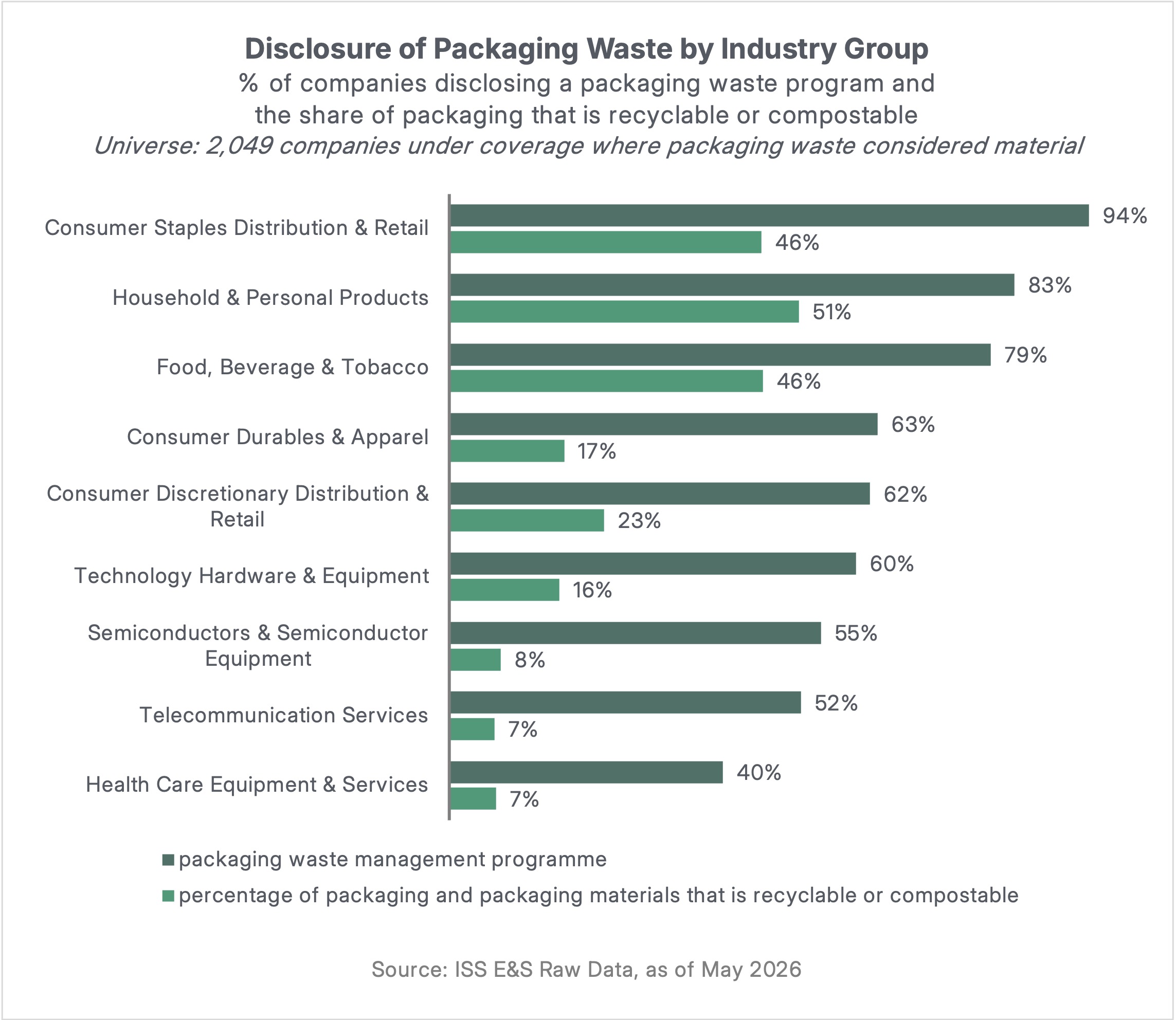
A similar pattern is observed across industry groups. Consumer-facing sectors – such as Consumer Staples Distribution & Retail, Household & Personal Products, and Food, Beverage & Tobacco – report the highest levels of both program disclosure (79% – 94%) and recyclability metrics (46% – 51%).
In contrast, sectors such as Health Care Equipment & Services, Semiconductors, and Telecommunication Services disclose significantly lower levels of quantified packaging data (7% – 8%), despite moderate levels of program adoption.
These differences reflect variation in operational control over packaging and the availability of underlying data. Companies with direct responsibility for product packaging and greater exposure to consumer scrutiny are generally better positioned to measure and report packaging composition, while others may face greater challenges in consolidating material-level data across complex value chains.
Preparing for SB 54 and Long-Term EPR Compliance
Beyond registration and fee payment, extended producer responsibility (EPR) regulations – including California’s SB 54 – introduce outcome‑based obligations that require producers to take greater accountability for packaging across its lifecycle.
As EPR frameworks continue to expand, companies that plan early can reduce regulatory risk and manage long‑term costs more effectively. Key considerations for EPR readiness include:
- Designing packaging using recyclable or compostable materials
- Providing clear consumer education and labeling to support proper sorting and recycling
- Ensuring that packaging materials are recycled or composted in practice, rather than being recyclable in theory only
Together, these steps support compliance across jurisdictions while advancing broader circular‑economy objectives.