
Nature Reporting Takes Shape: COP17, ISSB and TNFD

COP17 outcomes, the ISSB’s nature proposal, and TNFD’s LEAP v2.0 put implementation, disclosure, and assessment in focus.
Nature-Related Preparedness: Three Developments Companies Should Watch
Three developments are bringing nature-related implementation, disclosure and assessment into sharper focus for companies:
- At COP 17, governments agreed on a pathway to accelerate implementation of global biodiversity commitments;
- The ISSB proposed an investor-focused Practice Statement on nature disclosure;
- and the Taskforce on Nature-Related Financial Disclosures (TNFD) updated its LEAP approach for nature assessment.
Together, they sharpen the focus on how companies identify nature-related exposures and translate them into strategy, risk management, and reporting. These three developments address complementary aspects of corporate nature-related preparedness, as summarized below.
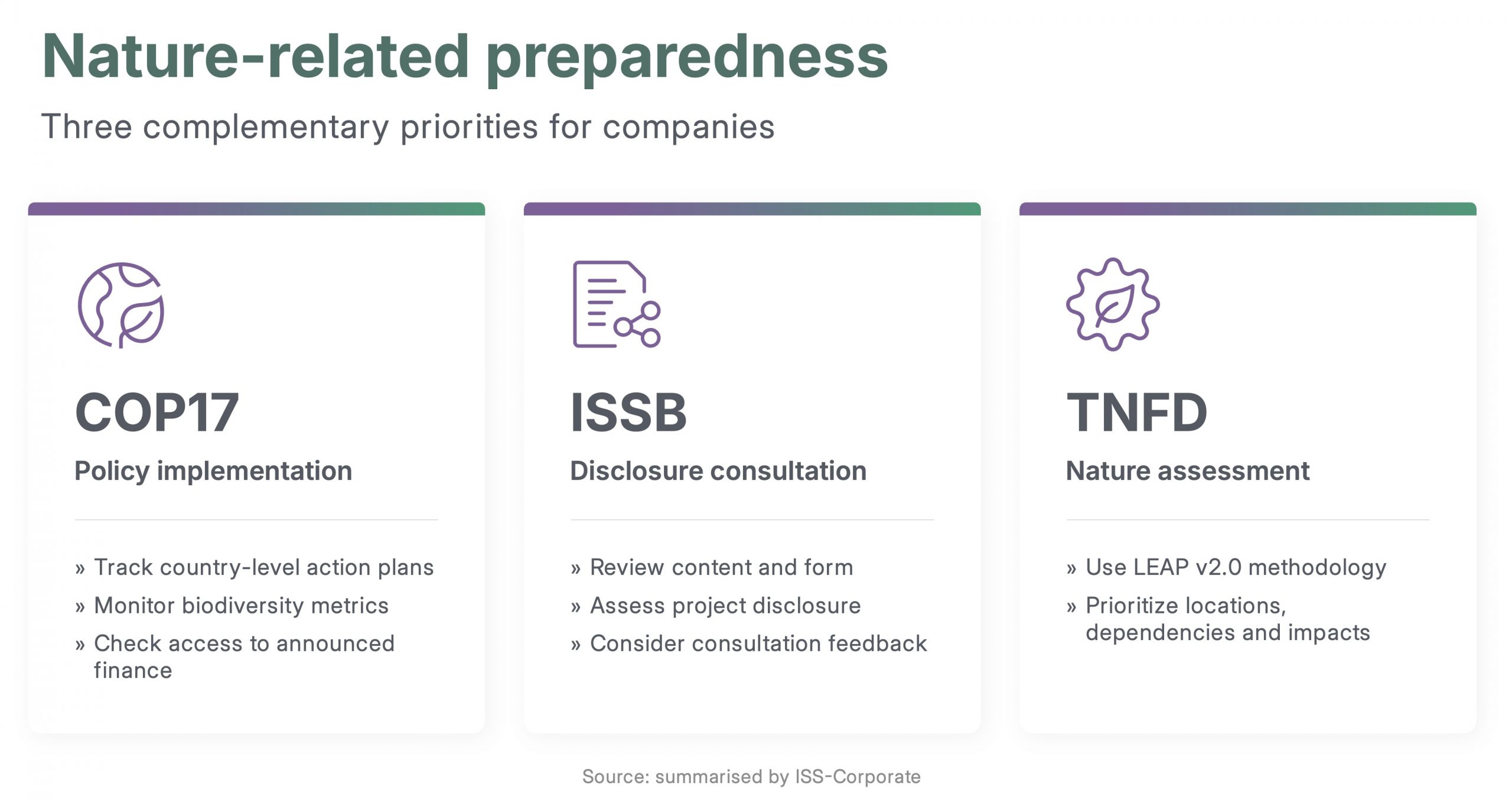
COP17: Biodiversity Commitments Move Into Implementation
The 17th meeting of the Conference of the Parties to the UN Convention on Biological Diversity (CBD COP17), held in October in Yerevan, Armenia, concluded with agreement on the Yerevan Pathway, a roadmap to accelerate delivery of the Kunming-Montreal Global Biodiversity Framework’s 23 targets by 2030, following a first global review that showed progress was insufficient to achieve them.
For companies, the key development is the shift from global commitments toward national implementation. Potential subsidy reforms and shifts in public spending could have implications for operating costs, supply chains, and market access, while biodiversity funding pledges – nearly $2 billion in total – announced in Yerevan provide further signal of growing investment attention to nature.
ISSB: Nature Disclosure Proposal Opens for Comment
On October 22, the ISSB published its proposed Practice Statement on nature-related disclosures, with comments due February 19, 2027. To avoid a separate, nature-specific reporting silo, the proposal builds on IFRS S1’s existing requirement to disclose material sustainability-related risks and opportunities.
The proposal draws extensively on TNFD’s work, particularly its attention to where a company operates and how it engages with Indigenous Peoples, local communities, and other affected stakeholders. The ISSB Practice Statement is also designed to work efficiently alongside GRI Standards and ESRS.
A key feature is that applying the Practice Statement would be optional for companies claiming compliance with ISSB Standards. However, a company choosing to apply it would need to meet all of its requirements. The ISSB is also asking for feedback on whether the content should ultimately stay a Practice Statement or become a Standard. This distinction is worth watching, as it could influence how nature-related disclosure expectations develop over time. Companies with exposure in nature-sensitive locations may therefore consider responding to the consultation before the February deadline. Background details can be found in the ISS-Corporate article ISSB’s Nature Disclosures: What Companies Should Do Now.
TNFD: LEAP v2.0 Strengthens Nature Assessment
TNFD published LEAP v2.0 in October, updating its assessment approach based on market feedback. The four phases remain:
- Locate the organization’s interface with nature;
- Evaluate dependencies and impacts;
- Assess risks and opportunities; and
- Prepare to respond and report. LEAP can support TNFD-aligned disclosures but can also be used independently of formal reporting requirements.
Compared with the original 2023 approach, v2.0 adds depth on how to measure the state of nature across land, freshwater and ocean ecosystems, as well as non-native invasive species. It also expands guidance on assessing risks and opportunities, environmental crime, and nature in transition planning. Additional guidance covers collaborative landscape and seascape approaches, portfolio assessments for financial institutions, and alignment with target-setting guidance from the Science-Based Targets Network (SBTN). The SBTN alignment and state-of-nature measures may be the most practical additions, allowing companies to use same location-based evidence across assessment, target-setting, and reporting.
For companies, LEAP offers an assessment process, not a new disclosure standard. A practical next step is to review existing assessments against the updated guidance, prioritizing relevant locations, dependencies, and impacts, before determining reporting needs.
What These Developments Signal for Nature-Related Risk Management
Together, these developments address different aspects of corporate nature-related preparedness, spanning implementation, disclosure and assessment. Companies can prepare by connecting location-specific evidence with governance, strategy, and disclosure.