
Unequal Voting Rights: The European Experience Revisited

Across Europe, loyalty shares are reshaping shareholder rights by strengthening long-term ownership without introducing separate share classes.
Across much of Europe, unequal voting rights remain a common governance mechanism, demonstrating a willingness among companies and policymakers to trade shareholder equality for long-term ownership and stable corporate control.
Unequal voting rights can benefit or disadvantage minority shareholders depending on whether the arrangement encourages long-term value creation or simply entrenches management and founder control. Loyalty shares have become Europe’s preferred approach, granting additional voting rights to long-term shareholders, typically after two years of continuous ownership, without introducing separate share classes.
This blog post surveying unequal voting rights in Europe follows an earlier analysis looking at similar arrangements in 2023.
Key Findings
- France remains Europe’s largest market for unequal voting rights, with nearly 70% of listed companies employing loyalty or enhanced voting structures.
- Italy has become one of Europe’s fastest-growing adopters of differentiated voting rights, with approximately 44% of listed companies utilizing enhanced voting mechanisms and one third employing loyalty shares.
- Unequal voting rights remain concentrated in Western European and Nordic markets, where family ownership, strategic shareholders and long-term capital structures remain common.
- Minority shareholders increasingly expect to see governance safeguards in place such as an independent board majority, the independent approval of related-party transactions, and the equal treatment for all shareholders.
- Germany, the United Kingdom, and several other Anglo-Germanic markets continue to exhibit limited adoption despite recent regulatory reforms to facilitate such structures.
Europe’s Unequal Voting Landscape: A Story of Regional Divergence
There is a pronounced regional divide in the adoption of unequal voting structures across Europe, suggesting that attitudes toward shareholder democracy and corporate control remain heavily influenced by local market traditions.
continues to exhibit the highest prevalence, with 47.5% of companies employing unequal voting rights, followed by the Nordic region at 34.8% and Southern Europe at 25.1%. While the Nordic Region has witnessed a slight increase since 2023, Southern Europe’s increase more than doubled loyalty shares have become more prevalent. By contrast, Anglo and Germanic markets remain clear outliers, with adoption rates declining from 4.1% and 4.5% in 2023 to 3.0% and 3.6%, respectively.
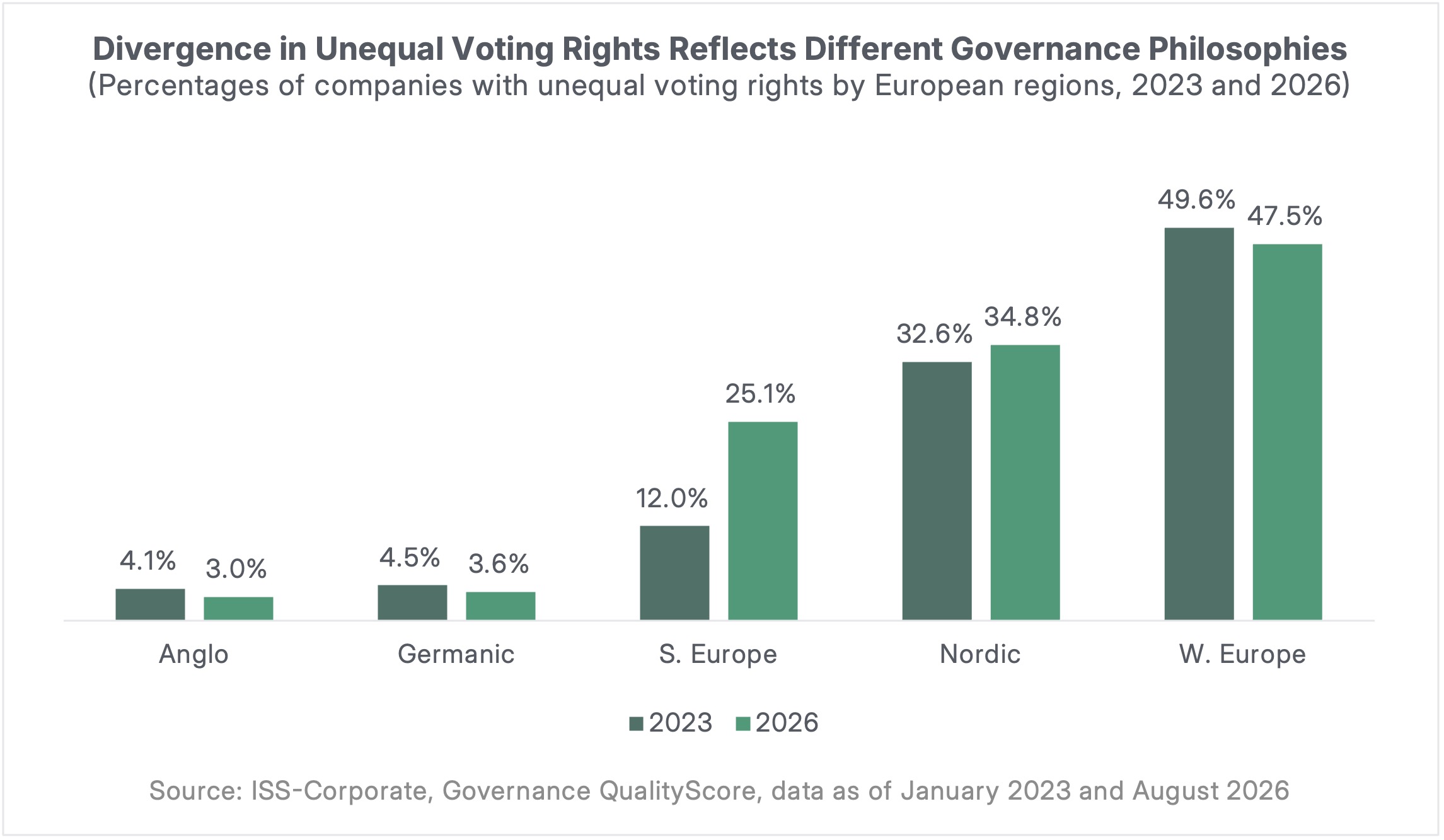
This disparity reflects fundamentally different governance philosophies. In many Western European, Nordic, and Southern European markets, policymakers and listed companies have become increasingly comfortable with mechanisms that strengthen long-term ownership and preserve strategic control, particularly for founding families, entrepreneurs, and anchor shareholders. The continued preference for equal voting rights in Anglo and Germanic markets reflects a longstanding commitment to the “one share, one vote” principle, whereby voting rights are generally aligned with economic ownership. by institutional investors, corporate governance codes, and stock exchange frameworks in jurisdictions such as the United Kingdom, Germany, and, until recently, several other Northern European markets, as a means of promoting equal shareholder treatment and limiting the concentration of control.
The New Geography of Unequal Voting Rights
A country-level review of European market practice reveals a highly fragmented landscape in the adoption of unequal voting rights. At one end of the spectrum, France (67.9%) and Sweden (53.6%) have firmly embedded enhanced voting mechanisms within their corporate governance frameworks, reflecting a longstanding acceptance of structures that reward enduring ownership and support stable control. At the same time, Italy has established itself as one of Europe’s fastest-evolving markets, with of listed companies now utilizing differentiated voting rights, driven primarily by the increasing adoption of loyalty share regimes.
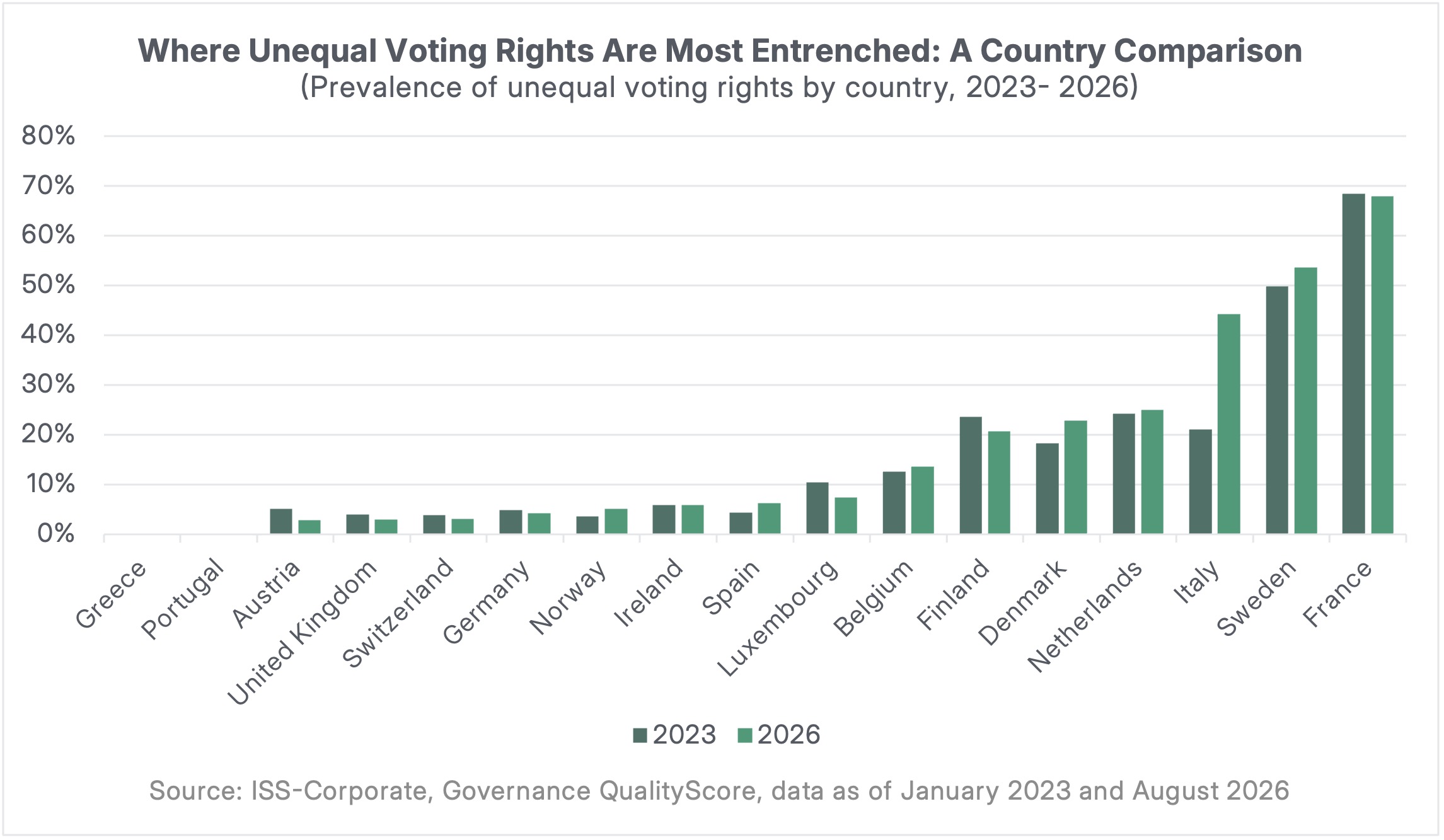
The widespread adoption of unequal voting rights in some European jurisdictions suggests that such structures no longer a niche governance feature but rather a mainstream structural tool in several major capital markets. Increasingly, market practice is being shaped by national ownership patterns, competitive listing considerations, and policymakers’ efforts to attract entrepreneurial and founder-led businesses.
The countries with the lowest adoption of unequal voting rights are concentrated in a group of European markets where the one-share-one-vote principle continues to dominate corporate governance practices. At the bottom of the ranking are Greece and Portugal, both of which show no meaningful adoption Although legal reforms in these countries have begun to create greater flexibility, enhanced voting structures have yet to gain traction among public companies.
Austria (2.8%), the United Kingdom (3%), and Switzerland (3.1%) also exhibit limited use of unequal voting rights, indicating a continued preference for proportional voting rights and strong investor protection norms. Germany (4.2%) remains a low-adoption market despite recent reforms introduced through the Future Financing Act, suggesting that companies have shown a limited willingness to embrace the new flexibility. Similarly, Norway (5.1%), Ireland (5.9%), and Spain (6.3%) report only modest levels of adoption, with fewer than one in 15 listed companies utilizing enhanced voting mechanisms. Luxembourg (7.4%) represents the upper end of the low-adoption group but still remains limited compared with markets such as France, Sweden, and Italy.
More broadly, the evidence highlights a clear relationship between ownership structure and the prevalence of unequal voting rights. These mechanisms are most common in markets characterized by concentrated shareholding, family-controlled enterprises and large strategic investors, where companies seek to balance access to public equity capital with the preservation of long-term strategic influence. By comparison, companies in jurisdictions with limited use of unequal voting rights rely on traditional governance models, often reflecting capital market cultures that place a greater emphasis on shareholder equality and proportional voting power. The result is an increasingly bifurcated European governance landscape in which some jurisdictions continue to prioritize one-share-one-vote principle, while others view voting-right flexibility as a legitimate tool for encouraging long-term ownership, supporting corporate resilience, and protecting entrepreneurial or family-led ownership through public market cycles.
At the same time, recent legislative developments in countries such as Germany, Portugal, and the United Kingdom indicate that competitive pressures among European capital markets may gradually encourage greater acceptance of unequal voting structures in the years ahead, particularly as policymakers seek to attract growth companies and founder-led businesses while balancing concerns around minority shareholder protections.
Future Outlook for Unequal Voting Rights in European Capital Markets
The European market is likely to witness continued expansion in the use of unequal voting rights. Recent reforms in Germany, the United Kingdom, Spain, and other countries reflect a growing desire to attract more companies as they balance long-term ownership with access to capital markets. At the same time, institutional investors are expected to remain focused on governance safeguards that protect minority shareholders from excessive concentration of power. The future debate is therefore unlikely to centre on whether unequal voting rights should exist, but on what governance frameworks should accompany them. As this balance continues to develop, unequal voting rights of the defining corporate governance themes of the European capital markets landscape.