
When a Crisis Exposes Hidden Boardroom Risks

A crisis has a way of revealing governance weaknesses that remain invisible during periods of success. Recent events at Nvidia brought attention to key governance risks regarding board leadership, board refreshment, and succession planning, particularly at founder-led companies built around a single highly influential leader.
Board Leadership and the Need for Independent Oversight
Founder-led companies can create extraordinary value, but they can also concentrate authority, influence, expertise and values as well as risks, and a lack of sufficient counterbalance within the board could deepen a crisis.
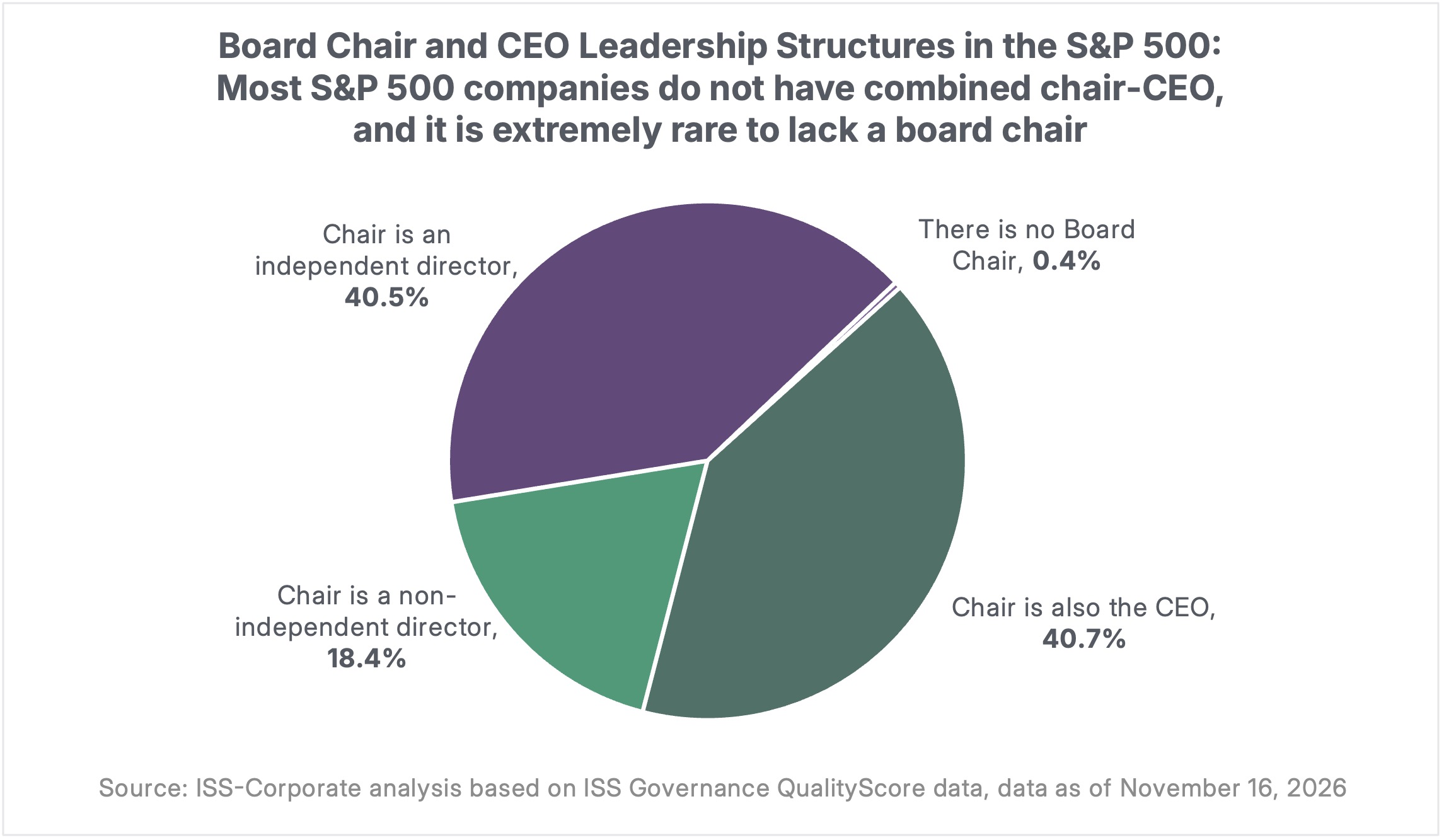
While most S&P 500 companies have the positions of the board chair and CEO separated, many founder-led companies combine the positions. Structures such as at Nvidia where there is only a lead independent director and no board chair named is extremely rare.
A lead independent director position may provide an important counterbalance to the CEO and this structure may function well through a period of rapid growth. However, without a strong independent board leadership in a position of authority that can credibly challenge management, the lead director may struggle to lead the board through a crisis, and the board may not notice a pitfall until it’s too late.
Director Tenure, Independence, and Board Refreshment
Warning signs of insufficient checks and balance may present themselves in other ways, such as the prevalence of directors with lengthy tenure or a board’s lack of refreshment. Tenure can bring valuable institutional knowledge and experience, but it can also raise questions about independence, objectivity, and oversight[i]. When several directors have been serving on the board for a long period of time together with the founder-CEO, investors often ask whether the long tenure reflects experience and expertise or entrenchment. The divide between investors and corporate respondents in the 2026 ISS STOXX Global Benchmark Policy Survey underscores this tension, with 64% of investor respondents answering that long tenure is a concern (with 22% saying “it depends”), whereas 74% of non-investor respondents stated that tenure should not play a role in determining director independence.[ii] Of those who answered affirmatively, a significant majority of both the investors and non-investors supported consideration of multiple factors, including tenure, board refreshment, and length of overlap with the CEO/Chair as part of the independence evaluation.
Refreshment Policies Are Now Widespread
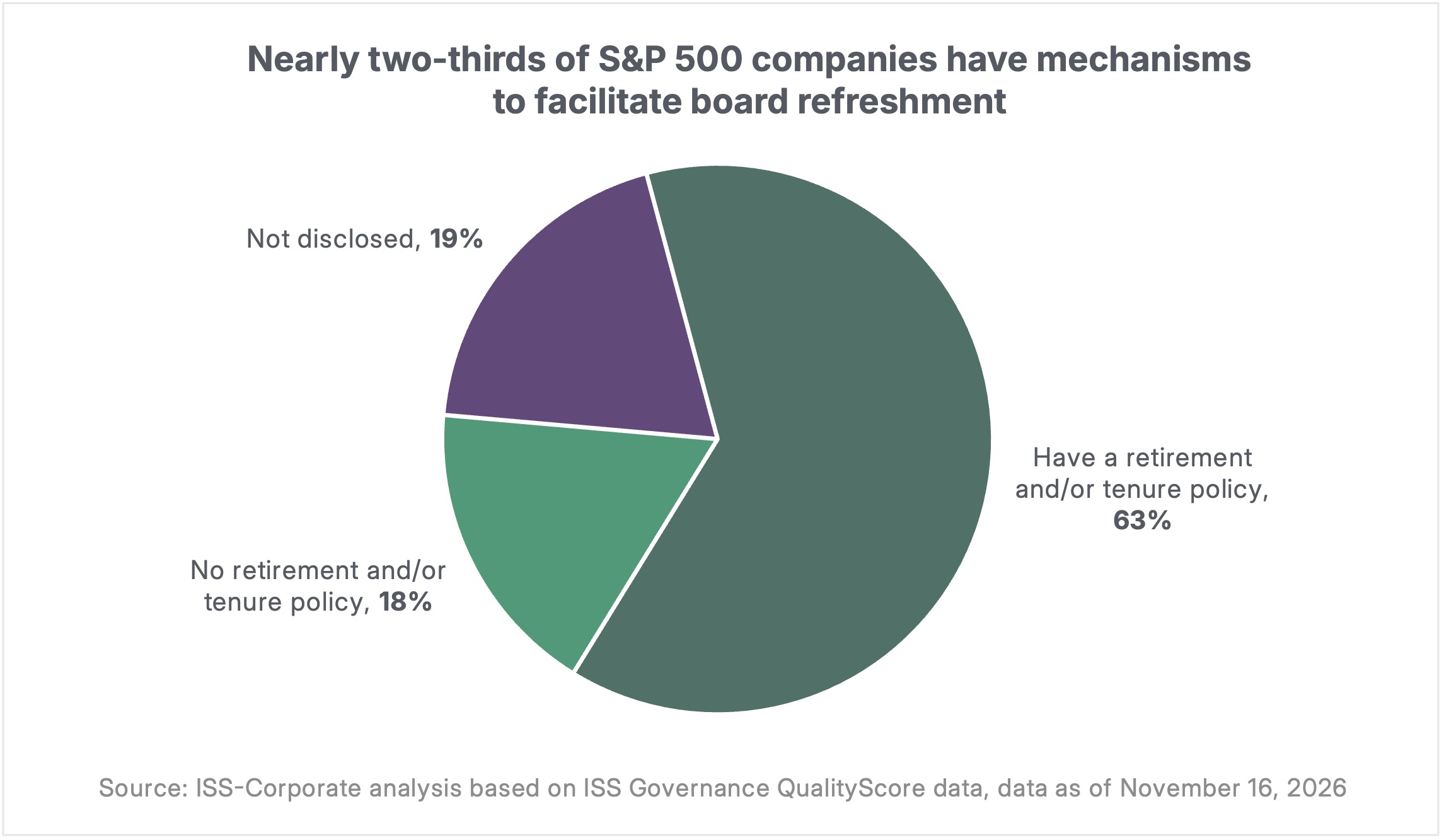
Against these backdrops, refreshment policies have become widespread among S&P 500 companies with 63% having either a retirement or tenure-based policy in place. The prevalence of refreshment policies at large companies suggests that most boards recognize the importance of balancing experience with fresh perspectives, to reduce the risk of complacency and entrenchment.
Succession Planning Becomes Critical During a Crisis
Finally, a crisis can greatly magnify the governance risks associated with poor succession planning. Fewer than 2% of companies in the S&P 500 do not disclose CEO and key executive succession plan, and 14% do not designate a committee with primary responsibility of oversight for succession.[iii] When succession planning is poorly disclosed or inadequately governed, uncertainty can quickly spread across investors, employees, customers, and business partners.
Evaluating Governance Resilience
Governance risks sometimes lay dormant for years before being laid bare. Then, in a single moment, they become impossible to ignore. Vulnerabilities related to board leadership, refreshment, and succession planning may be compounded at founder-led companies, and investors and boards alike should evaluate their governance resilience as much as growth potential.
Learn more about our Corporate Governance Solutions »
Footnotes:
[i] “Experience or Independence? Director Tenure and Potential Tradeoffs: A Global Comparison,” ISS-Corporate, March 13, 2025.
[ii] 2026 ISS Global Benchmark Policy Survey: Summary of Results. (Published: October 7, 2026). Retrieved from: https://www.iss-stoxx.com/file/policy/current/updates/policy-survey-summary-2026.pdf
[iii] ISS-Corporate analysis based on ISS Governance QualityScore data, data as of November 16, 2026